latest header logo

Let's Create Something Extraordinary Together

Your Trusted Partner in Digital Innovation

Reach out to explore tailored solutions designed to transform your business.

Transparent Project Insights

Understand your project’s scope clearly, with no unexpected surprises

Step Into the Future

Share your ideas, and we’ll connect with you within 16 hours (excluding holidays) to bring your vision to life.

Crafting Excellence for You

From mobile apps to web solutions and ERP systems, we’re here to build technology that works perfectly for you.

Quick and Reliable Response

Share your vision, and we’ll connect within 16 hours (excluding holidays).



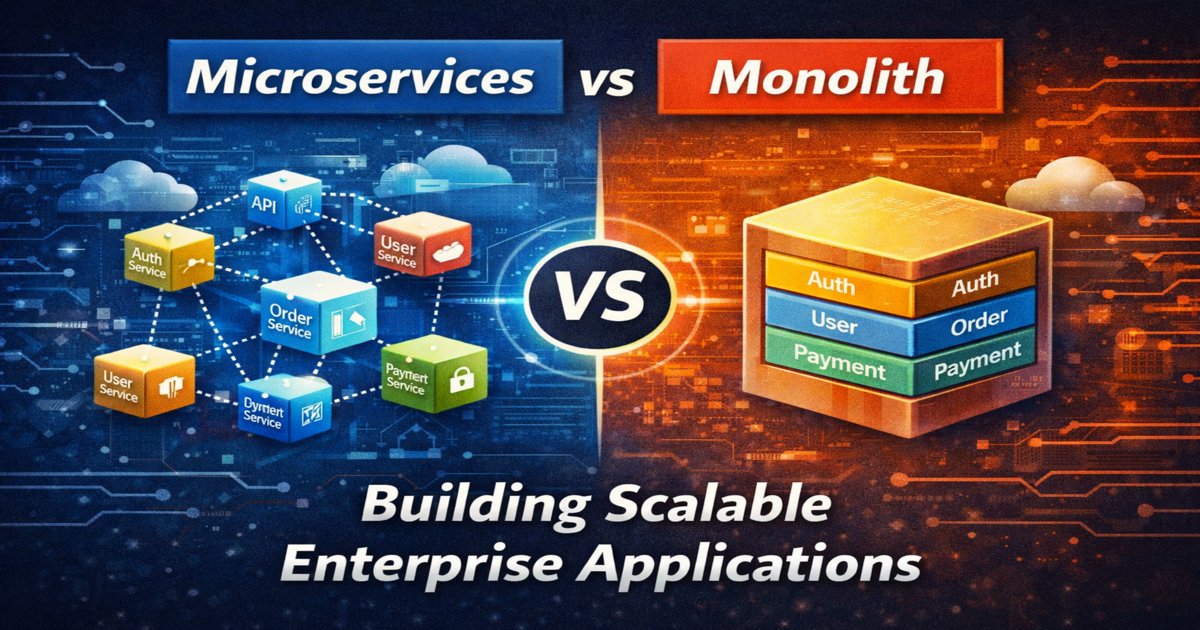
    Microservices vs Monolith: Building Scalable Enterprise Applications

    Microservices vs Monolith: Building Scalable Enterprise Applications

    Edit Template

    In 2026, building scalable and high-performing applications is a top priority for businesses. As applications grow in complexity, choosing the right architecture becomes critical for long-term success.

    Two of the most common approaches are monolithic architecture and microservices architecture. Each has its own advantages, challenges, and use cases depending on the size and needs of the business. While monoliths offer simplicity and faster initial development, microservices provide flexibility, scalability, and better fault isolation.

    Table of content
      Add a header to begin generating the table of contents

      1. Android Studio: Unveiling the Power of Android App Development

      1. Why Architecture Choice Matters

      The architecture you choose directly impacts performance, scalability, and development efficiency.

      1.1 Scalability Requirements

      As your application grows, it must handle increased traffic and data efficiently.

      1.2 Development Speed

      The right architecture can speed up development and deployment processes.

      1.3 Maintenance and Flexibility

      A good architecture makes it easier to update and maintain your application over time.

      2. What is Monolithic Architecture

      2.1 Definition

      A monolithic application is built as a single unified codebase where all components are tightly integrated.

      2.2 How It Works

      All functionalities such as UI, business logic, and database operations are part of one system and deployed together.

      2.3 Key Advantages

      Monoliths are easier to develop initially, simpler to deploy, and require less complex infrastructure.

      2.4 Limitations

      As the application grows, it becomes harder to scale, maintain, and update without affecting the entire system.

      3. What are Microservices

      3.1 Definition

      Microservices architecture breaks an application into smaller, independent services that communicate through APIs.

      3.2 How It Works

      Each service handles a specific function and can be developed, deployed, and scaled independently.

      3.3 Key Advantages

      Microservices offer better scalability, flexibility, fault isolation, and faster deployment cycles.

      3.4 Challenges

      They require more complex infrastructure, service management, and monitoring.

      4. Key Differences Between Microservices and Monolith

    • Scalability
    • Monolith scales as a whole system, while microservices allow individual components to scale independently.

    • Development Approach
    • Monolith uses a single codebase, whereas microservices use multiple smaller services.

    • Deployment
    • Monolith is deployed as one unit, while microservices can be deployed independently.

    • Maintenance
    • Monolith becomes harder to maintain as it grows, while microservices are easier to manage in smaller parts.

    • Technology Flexibility
    • Microservices allow different technologies for different services, while monolith typically uses a single stack.

      When to Choose Monolithic Architecture

    • Small to Medium Applications
    • Ideal for startups or small projects with limited complexity.

    • Faster Initial Development
    • Helps launch products quickly with minimal infrastructure.

    • Limited Team Size
    • Works well when you have a small development team.

      When to Choose Microservices

    • Large-Scale Applications
    • Best for enterprise systems with complex requirements.

    • High Scalability Needs
    • Allows scaling specific components without affecting the entire system.

    • Continuous Deployment
    • Supports faster updates and independent releases.

    • Large Development Teams
    • Enables multiple teams to work on different services simultaneously.

      Conclusion

      In 2026, there is no one-size-fits-all solution when choosing between microservices and monolith architecture. Monolith is ideal for simplicity and faster development, while microservices provide scalability, flexibility, and long-term growth advantages. The right choice depends on your business requirements, team capabilities, and future plans. Understanding both approaches helps you build a scalable, efficient, and future-ready enterprise application.

      Frequently Asked Questions

      What is the main difference between microservices and monolith?

      Monolith is a single unified application, while microservices consist of multiple independent services.

      Which architecture is better for startups?

      Monolith is usually better for startups due to simplicity and faster development.


      Are microservices more scalable?

      Yes. Microservices allow individual components to scale independently.

      Is microservices architecture expensive?

      It can be more expensive due to infrastructure and management complexity.

      Can I switch from monolith to microservices later?

      Yes. Many businesses start with monolith and migrate to microservices as they grow.

      Get Free consultation and let us know about your custom web and Mobile App project idea
      grocy blog sidebar

      Over 14+ years of work experience, we have built 210+ web and mobile apps

      We can help you with
      Edit Template
      Edit Template
      Scroll to Top