
In 2026, building scalable and high-performing applications is a top priority for businesses. As applications grow in complexity, choosing the right architecture becomes critical for long-term success.
Two of the most common approaches are monolithic architecture and microservices architecture. Each has its own advantages, challenges, and use cases depending on the size and needs of the business. While monoliths offer simplicity and faster initial development, microservices provide flexibility, scalability, and better fault isolation.
Why Architecture Choice Matters
The architecture you choose directly impacts performance, scalability, and development efficiency.
As your application grows, it must handle increased traffic and data efficiently.
The right architecture can speed up development and deployment processes.
A good architecture makes it easier to update and maintain your application over time.
What is Monolithic Architecture
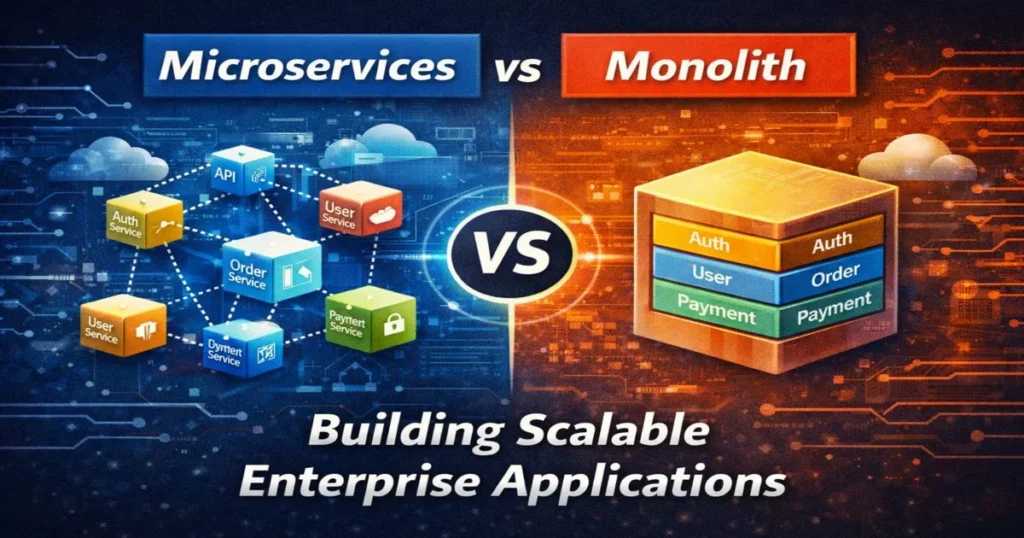
A monolithic application is built as a single unified codebase where all components are tightly integrated.
All functionalities such as UI, business logic, and database operations are part of one system and deployed together.
Monoliths are easier to develop initially, simpler to deploy, and require less complex infrastructure.
As the application grows, it becomes harder to scale, maintain, and update without affecting the entire system.
What are Microservices
Microservices architecture breaks an application into smaller, independent services that communicate through APIs.
Each service handles a specific function and can be developed, deployed, and scaled independently.
Microservices offer better scalability, flexibility, fault isolation, and faster deployment cycles.
They require more complex infrastructure, service management, and monitoring.
Key Differences Between Microservices and Monolith
Monolith scales as a whole system, while microservices allow individual components to scale independently.
Monolith uses a single codebase, whereas microservices use multiple smaller services.
Monolith is deployed as one unit, while microservices can be deployed independently.
Monolith becomes harder to maintain as it grows, while microservices are easier to manage in smaller parts.
Microservices allow different technologies for different services, while monolith typically uses a single stack.
When to Choose Monolithic Architecture
Ideal for startups or small projects with limited complexity.
Helps launch products quickly with minimal infrastructure.
Works well when you have a small development team.
When to Choose Microservices
Best for enterprise systems with complex requirements.
Loved What You Just Read?
Let's Build Something Just as Great — For Your Business.
From web & mobile apps to UI/UX, AI solutions, and digital marketing — NGD Technolab turns ideas into scalable, real-world products. 14+ years, 550+ projects, one team you can rely on.
Allows scaling specific components without affecting the entire system.
Supports faster updates and independent releases.
Enables multiple teams to work on different services simultaneously.
Conclusion
In 2026, there is no one-size-fits-all solution when choosing between microservices and monolith architecture. Monolith is ideal for simplicity and faster development, while microservices provide scalability, flexibility, and long-term growth advantages. The right choice depends on your business requirements, team capabilities, and future plans. Understanding both approaches helps you build a scalable, efficient, and future-ready enterprise application.
Frequently Asked Questions
What is the main difference between microservices and monolith?
Monolith is a single unified application, while microservices consist of multiple independent services.
Which architecture is better for startups?
Monolith is usually better for startups due to simplicity and faster development.
Are microservices more scalable?
Yes. Microservices allow individual components to scale independently.
Is microservices architecture expensive?
It can be more expensive due to infrastructure and management complexity.
Can I switch from monolith to microservices later?
Yes. Many businesses start with monolith and migrate to microservices as they grow.