




On-Demand Home Services App Development
It all began with an urgent LinkedIn message from a stressed Canadian founder. Their regional home services platform was expanding fast across urban hubs , but their fragile infrastructure was completely buckling under the unexpected weight of its own incredible success.
They had successfully onboarded 5,000 independent service pros, yet relied on manual spreadsheets and chaotic WhatsApp groups. As an on-demand app development company Canada, we stepped in to transform this operational nightmare into a perfectly streamlined, fully automated tech ecosystem.
Platform
Mobile Application
Industry
Social Media
& Messaging
Country
India
Services
UI/UX Design &
App Development
Client's Problem Statement
- The 45-Minute Bottleneck: Manual dispatching using standard spreadsheets meant coordinators spent forty five minutes copying data across platforms just to book and confirm a single local emergency Canadian home service job.
- The Double-Booking Nightmare: Because field calendars were not syncing across a centralized system, twelve percent of all assignments resulted in overlapping schedules, highly frustrating both the local service pros and busy Canadian homeowners.
- 18% Booking Drop-Off: Frustrated Canadian homeowners frequently canceled urgent service requests because they had no real way to track when a local contractor would arrive or if anyone was coming to help them.
- Severe Data Desynchronization: Severe data desynchronization delayed vital invoice generation and vendor payouts by two full weeks because field technicians had to manually text or email photos of paper invoices back to headquarters.
Challenges
- Sub-Zero Battery Drain: Continuous GPS polling combined with minus fifteen-degree Canadian winter weather completely wrecked worker smartphone batteries, dropping devices from full charge to dead within three hours.
- Contractor Adoption Risks: Independent contractors will instantly abandon a tool if it leaves them stranded during a severe snowstorm, meaning the entire marketplace app architecture would completely collapse.
- Real-World Constraints: Overcoming the on-demand service app development challenge meant shifting away from standard, aggressive background location tracking to survive rugged, real-world regional environments.
- High Concurrency Spikes: The system needed to withstand massive morning booking rushes—handling over 10,000 concurrent API requests right after heavy regional winter storms without slowing down.
Solution
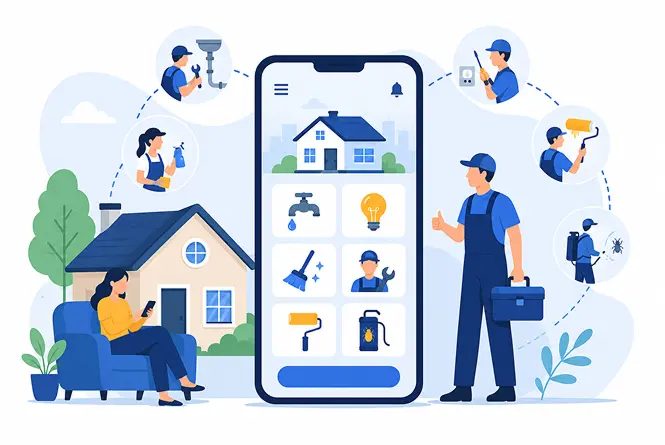
- Two-Sided Service Platform: Developed two distinct mobile app experiences—a three-tap booking application for homeowners and a smart pocket dispatcher vendor app for professionals.
- Automated Dispatch API: Integrated a custom engine that automatically scans and matches requests with the closest available professional within a precise fifteen-kilometer radius in under forty milliseconds.
- Synchronized Cloud Dashboard: Tied the entire ecosystem to a centralized cloud database, providing real-time visibility into worker availability, live routing updates, and street-level map tracking.
- Stripe Connect Split-Payments: Eliminated the manual invoicing delay by instantly processing cards upon job completion, taking the platform fee, and routing balances directly to vendors.
Execution And Development Journey
- We kicked off the procedure with a deep technical inspection to look under the hood of their spreadsheet driven chaos. Our team planned out a custom home service app development strategy to replace manual copy pasting and localized WhatsApp groups with automated backend workflows.
- Next, we engineered a robust cross platform frontend using React Native alongside a lightweight Node backend. This optimized tech stack ensured the server could comfortably manage thousands of concurrent location pings and incoming customer bookings without dropping any critical marketplace app data architecture or pipelines.
- Six weeks into testing the beta with a pilot group, we encountered the severe freezing weather battery drain. As an experienced home service app development agency, we pivoted immediately, re engineering background tracking to a smart geo fencing model that only pinged five kilometer boundaries.
Technologies We Used
- Frontend Framework

React.js
- Backend Framework

Node.js

Express.js
- Database

postgresql
Our Results
Contractor Onboarding Optimized:Contractor Onboarding Optimized:
5,241 verified service professionals successfully transitioned to the new marketplace vendor application with zero churn reported during migration because we proactively solved the winter background GPS battery drain issue right away completely.
Dispatch Bottleneck Eliminated:
Manual coordination lag dropped from forty five minutes to under three minutes as the custom geo fencing algorithm instantly matched homeowners with the nearest available local field technician within their specific neighborhood.
Administrative Overhead Reduced:
Administrative workload dropped by eighty five percent because automated routing and live tracking allowed the dispatch team to stop copy pasting text messages and shift focus to long term regional vendor growth.
Payment Delays Cleared:
Paper invoicing friction dropped to zero days because the Stripe Connect integration allowed field contractors to receive their earnings instantly upon job completion instead of waiting for a classic two week period.
Frequently Asked Questions
Explore answers to the most common questions about our services, workflows, and support. Clear information, all in one place.
How did you solve the smartphone battery drain for workers in the cold?
Constant GPS tracking drains batteries fast in freezing Canadian winters. Instead of live-polling, we used smart geo-fencing that only pings the server when crossing specific 5-kilometer boundaries , keeping phones alive through long shifts.
Was it hard to get over 5,000 independent contractors to adopt the new platform?
Adoption hits 100% when you fix their biggest headaches. By solving the sub-zero battery issue early and implementing automated Stripe payments for instant payouts instead of two-week delays, contractors enthusiastically adopted the app.
What is the biggest factor when budgeting for a project like this?
When estimating on-demand app development cost Canada, the backend logic is the primary variable. Engineering a robust engine to handle thousands of concurrent background location pings and calculate instant geospatial matching requires deep investment.
Can this same architecture work for other local service industries?
Absolutely. Whether you are contacting emergency plumbers, snow removal crews, or home servicing teams, the core routing logic is identical. When researching how to build a home service app, a scalable foundation is key.
How does the system handle massive spikes in service requests during extreme weather events?
The backend uses Node.js and Express to comfortably process over 10,000 concurrent API requests. Paired with PostgreSQL and PostGIS, it executes complex geospatial technician matching in under 40 milliseconds without breaking a sweat.
More Proven Case Studies
We showcase additional real-world projects that highlight our expertise, problem-solving approach, and measurable results delivered for clients across different industries.