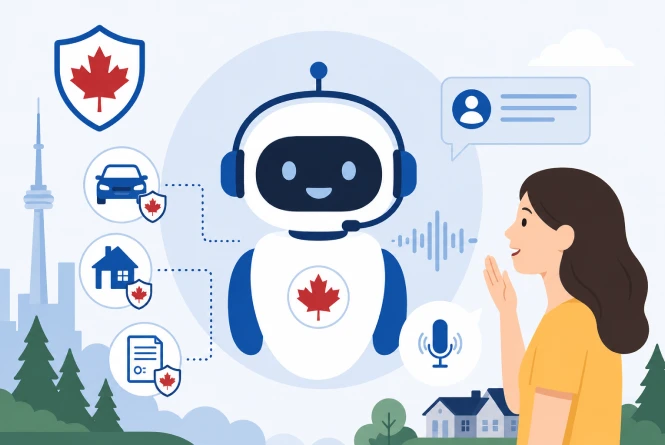




AI Voicebot for a Canadian Insurance Company
A prominent Toronto-based insurance provider recently launched a highly competitive auto and home policy bundle across Ontario and Alberta. While this massive sales win brought in 12,000 new monthly policyholders, it unexpectedly pushed their contact centre capacity to its limit.
New clients faced frustrating 45-minute hold times just for routine account verifications, leaving internal agents completely burned out. Realizing rapid hiring wasn’t sustainable, the team sought custom AI voicebot development to automate customer onboarding calls using advanced natural language processing.
Platform
Mobile Application
Industry
Social Media
& Messaging
Country
India
Services
UI/UX Design &
App Development
Client's Problem Statement
- Extreme Customer Wait Times: Surging call volumes across Canada caused devastating 45-minute hold times for new policyholders trying to complete routine verifications, deeply damaging the company’s initial customer onboarding satisfaction.
- Prohibitive Scale Overhead Costs: Managing the massive influx of 12,000 new monthly policies manually meant hiring 45 full-time agents, an overhead expense that completely wiped out their local profit margins.
- Severe Support Agent Burnout: Human agents spent nearly their entire shifts acting as repetitive data entry clerks instead of handling high-value insurance claims, leading to low morale and extreme strain.
- High Customer Attrition Rates: Because clunky legacy systems created dead air and massive call queues, frustrated Canadian policyholders frequently abandoned phone lines before ever reaching a live human support agent.
Challenges
- The Repetitive Script Loop: Highly trained customer support staff spent 80% of their operational shifts manually reading identical verification scripts to check Canadian postal codes, email addresses, and provincial driver's licence numbers.
- Legacy CRM System Lag: The internal 15-year-old database software was notoriously slow and clunky, requiring a frustrating 90-second delay just to pull up or modify a single new client profile.
- Bilingual Linguistic Nuances: Onboarding callers from bilingual hubs like Ottawa or Montreal frequently blended English and French mid-sentence ("Franglais"), causing rigid, traditional out-of-the-box voice menus to fail completely and hang up.
- Strict Canadian Privacy Mandates: Because the voice channel captures highly sensitive driver's licence and policy information, engineering a fully PIPEDA compliant voicebot architecture with strict data sovereignty rules was absolutely non-negotiable.
Solution
- Conversational AI for Insurance: Deployed an intelligent, human-like voicebot capable of understanding natural conversational context, regional accents, and human speech patterns, removing the need for clunky "press button" phone systems.
- Bilingual Voicebot Integration: Configured an enterprise-grade Dialogflow CX engine meticulously tuned to recognize both Canadian English and Québécois French, allowing seamless language switching mid-call without session interruptions.
- Secure NLP Integration Layer: Engineered an encrypted custom Node.js middleware translator that captured conversational audio inputs, parsed relevant text, and safely pushed updates straight into the legacy database within 1.5 seconds.
- PIPEDA Compliant Cloud Hosting: Anchored the entire voice automation environment within the AWS Canada (Central) region, utilizing military-grade AES-256 data encryption in transit paired with a strict zero-retention temporary audio storage policy.
Execution And Development Journey
- Our engineering team started by diving deep into raw call logs alongside the Toronto operations staff. We needed to hear the exact friction policyholders experienced. This discovery phase revealed a fundamentally broken manual workflow rather than a simple lack of effort from their own team.
- Three weeks into our active development, we hit a massive architectural wall regarding unique Canadian linguistic realities. While standard engines handle flat translations, they choked when bilingual callers from Ottawa naturally slipped into conversational "Franglais" or used hyper-local Canadian insurance terminology during their onboarding calls.
- Compounding this critical challenge, the provider's 15-year-old legacy CRM couldn't process simultaneous data inputs during these language shifts. This technical limitation triggered severe API timeout errors, leaving frustrated policyholders trapped in awkward dead air for up to eight long seconds on their active phone calls.
- We resolved this complex legacy CRM AI integration by designing a custom context-switching engine within our Node.js middleware layer. Trained on 1,500 local dialect variations with asynchronous payload handling, it seamlessly kept sessions active, compressed data, and updated records in a blistering 1.4 seconds flat.
Technologies We Used
Our Results
Resolution Rate Accelerated:
The intelligent voicebot successfully achieved 70% customer onboarding call automation across multiple provinces, securely collecting, verifying, and updating critical policyholder records in real-time without requiring any manual human contact centre staff intervention.
Customer Wait Times Plummeted:
Average inbound contact centre hold times dropped by a massive 95%, dramatically falling from an exhausting 45 minutes down to just under 2 minutes for every new Canadian policyholder on line.
Legacy Database Maintained Stability:
The custom Node.js middleware layer processed thousands of incoming daily requests entirely flawlessly, ensuring zero legacy system crashes while consistently maintaining a swift 1.4-second automated data write processing speed per call.
Bottom-Line Profitability Protected:
The national insurer scaled onboarding capacity completely seamlessly without adding any personnel to their initial 45-agent hiring forecast, delivering substantial long-term conversational AI business value in Canadian insurance brand customer support operations.
Frequently Asked Questions
Explore answers to the most common questions about our services, workflows, and support. Clear information, all in one place.
How does insurance conversational AI handle English-French language switching during calls?
Standard automated systems usually fail when a caller switches languages, but our solution was custom-engineered for the reality of Canadian bilingualism. By implementing a sophisticated bilingual voicebot integration within the custom Node.js middleware, the AI monitors conversational context dynamically. If a policyholder from a bilingual region uses a mix of English and French phrases (“Franglais”), the engine detects the shift instantly without dropping the call.
How did you ensure the automated voicebot met strict Canadian data privacy regulations?
To achieve a completely PIPEDA-compliant voicebot architecture, we hosted the entire development and processing ecosystem locally within the AWS Canada (Central) region, ensuring all sensitive data remains strictly on Canadian soil. Additionally, the system uses AES-256 encryption for data in transit and a strict zero-retention data policy: once the AI transcribes information and passes it to the database, temporary audio files are immediately deleted.
Can modern AI handle legacy CRM integration without breaking existing systems?
Yes, absolutely. We solved this common enterprise concern by developing a lightweight, custom middleware layer that handles data asynchronously. This layer takes heavy voice inputs from the AI, compresses the data payloads by 65%, and queues requests systematically, allowing a smooth legacy CRM AI integration without crashing or lagging your core business systems.
What kind of measurable return on investment does NLP contact centre automation offer?
Beyond improving customer satisfaction, the conversational AI business value in insurance operations is substantial. For this provider, automating frontend data collection allowed them to process thousands of monthly sign-ups without expanding call centre headcount by the projected 45 full-time agents, keeping overhead completely flat and freeing human staff for complex claims.
What’s the difference between custom AI voicebots and traditional phone menus?
Traditional interactive voice response systems (IVR) rely on rigid menus (“Press 1 for English”) that force users through frustrating paths, causing high hang-up rates. In contrast, custom AI voicebot development uses advanced Natural Language Processing (NLP) to understand human speech naturally, allowing customers to state their problem immediately just like talking to a real human agent.
More Proven Case Studies
We showcase additional real-world projects that highlight our expertise, problem-solving approach, and measurable results delivered for clients across different industries.