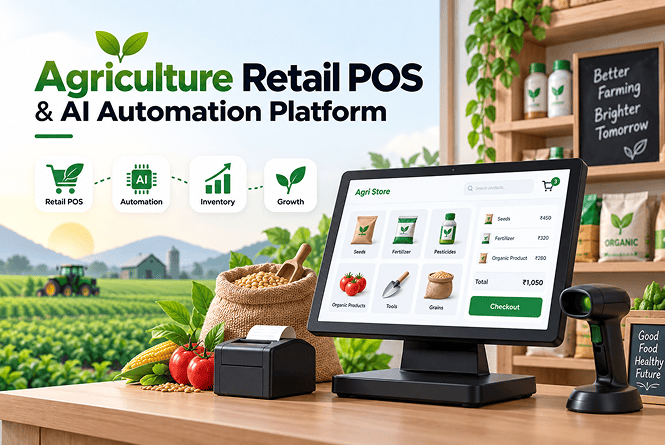





Agriculture Retail POS & AI Automation Platform
Agriculture retailers running multi-store networks often lose money to disconnected point-of-sale terminals, manual ledgers and guesswork inventory planning. Seasonal demand spikes during planting and harvest windows expose these gaps fast, leaving stores understocked on fertilizer when farmers need supplies most.
This case study examines an Agriculture Retail POS and AI Automation Platform built to unify checkout, inventory and payments for agri-dealers. The solution pairs offline-first POS software with machine learning demand forecasting for regional farm supply retailers running daily transactions.
Platform
Mobile Application
Industry
Social Media
& Messaging
Country
India
Services
UI/UX Design &
App Development
Client's Problem Statement
- Manual ledger recordkeeping caused severe inventory discrepancies, delayed stock reordering and frequent out-of-stock events for seeds and fertilizer during critical regional planting and harvesting seasons, steadily damaging long-term farmer trust.
- Disconnected point-of-sale hardware blocked real-time data synchronization between checkout terminals, centralized warehouse databases and back-office accounting software, forcing store staff into slow, error-prone manual reconciliation work each and every week.
- Inconsistent demand forecasting tied up working capital in slow-moving chemical inputs while perishable biological supplies expired unsold, compounding financial losses alongside poorly monitored, inconsistently enforced customer store credit limits daily.
- Unreliable internet connectivity across remote farming hubs triggered frequent checkout crashes and transaction stalls, frustrating rural customers who needed fast, trustworthy service during short seasonal agricultural buying windows each year.
Challenges
- Heterogeneous Offline-First Synchronization: The platform needed to process point-of-sale transactions reliably during regional connectivity blackouts, then reconcile every store's data across a multi-node backend without conflicts once networks came back online.
- Edge-Based AI Predictive Inference: Running demand forecasting, perishable shelf-life tracking and automated replenishment models close to checkout terminals meant avoiding latency spikes that would slow down sales during busy market days.
- Complex Multi-Channel Payment & Credit Integration: Agri-retailers needed one security-hardened transaction system that could unify mobile money rails like M-Pesa, bulk trade payments, digital wallets and long-standing farmer store credit ledgers.
- Enterprise Identity & Access Governance: Hundreds of territorially dispersed retail terminals and warehouse facilities needed unified single sign-on, granular role-based accessing control and immutable audit logging over the entire network.
Solution
- Hybrid Offline-First POS Engine: A cross-platform retail POS interface with local SQLite storage lets store staff process sales, generate digital receipts and sync data automatically once connectivity returns, with zero downtime.
- AI-Driven Demand Forecasting & Inventory Automation: Machine learning models analyze purchase history, seasonal weather trends and crop cycles to generate optimized restocking orders automatically, reducing both overstocking and costly stockouts.
- Omnichannel Payment & Identity Management: Keycloak CIAM handles secure sign-on alongside direct M-Pesa mobile payments and WhatsApp messaging for digital invoicing, OTP authentication and real-time transaction notifications.
- Centralized Business Intelligence & ERP Synchronization: An API-first microservice architecture backend links every POS terminal to core ERP modules, unifying ledger reporting, consumer credit track and multi-store inventory optimization.
Execution And Development Journey
- Engineers began with field research across rural retail branches to understand daily operating conditions. They then built a hybrid offline-first client using local SQLite caching, so stores kept processing sales through frequent power outages and network drops without losing a single transaction record or receipt.
- Later sprints added containerized machine learning microservices to the cloud backend, automating supply replenishment from historical demand patterns and seasonal crop cycles. The rollout finished with enterprise security work, connecting Keycloak single sign-on and mobile payment APIs directly to central accounting software for every store.
Technologies We Used
- Frontend Language

React.js

Flutter
- Backend Framework

Node.js

GraphQL API
- Database

postgresql

redis
Our Results
Performance Improved:
Offline-first POS caching cut average customer checkout times by 40%, letting store staff complete transactions in under twenty seconds even during peak seasonal market rush periods without checkout delays or lost sales revenue.
Accuracy Improved:
AI-driven demand forecasting raised inventory stock accuracy by 35%, sharply reducing manual auditing errors and preventing seed and chemical stockouts during critical regional planting seasons across every connected agri-retail store network location nationwide.
Efficiency Improved:
Automated inventory reordering and credit management cut manual administrative work by 20%, freeing branch staff to focus fully on farmer advisory services and long-term customer relationship building across every regional store territory served.
Reliability Improved:
Offline-first sync architecture delivered 99.9% system uptime across remote rural locations, keeping transaction logging and revenue collection running continuously through extended internet outages and regional power grid failures during every long planting season.
Key Performance Indicator
| Operational Metric | Before Implementation | After Implementation | Measured Impact |
|---|---|---|---|
| Average Checkout Duration | 35 seconds per transaction | 18 seconds per transaction | 48.5% faster checkout |
| Inventory Stock Accuracy | 68% matching precision | 98% matching precision | 30.0-point accuracy gain |
| Inventory Carrying Costs | Excessive capital lock-up | Optimized automated reorders | 35.0% cost optimization |
| System Availability / Uptime | 82.0% (frequent network drops) | 99.9% (offline-first reliability) | 17.9-point uptime boost |
| Back-Office Administrative Labor | 25 hours/week per branch | 5 hours/week per branch | 80.0% labor reduction |
Frequently Asked Questions
Explore answers to the most common questions about our services, workflows, and support. Clear information, all in one place.
What is an Agriculture Retail POS and AI Automation Platform?
It is retail software that combines point-of-sale checkout with machine learning automation for agri-dealers. It manages sales, tracks inventory, forecasts seasonal demand and keeps working offline when rural internet connections fail.
Does agriculture POS software work without internet access?
Yes, offline-first agriculture POS software stores transactions locally on the device using engines like SQLite, then automatically syncs sales, inventory and payment data to the cloud once connectivity returns.
How does AI demand forecasting help farm supply retailers?
AI demand forecasting studies past sales, seasonal weather and crop cycles to predict what seeds, feed or chemicals a store will need, cutting both overstock and stockouts during planting and harvest.
Can farm retail POS systems handle mobile money and store credit?
Yes, modern agriculture retail POS platforms integrate mobile money gateways like M-Pesa alongside digital wallets and customer store credit ledgers, unifying every payment type into one secure transaction record.
What results can AI automation deliver for agri-retail businesses?
Retailers commonly see faster checkout times, higher inventory accuracy, lower administrative workload and stronger system uptime, based on measured gains from AI-powered offline POS deployments in agricultural retail networks.
More Proven Case Studies
We showcase additional real-world projects that highlight our expertise, problem-solving approach, and measurable results delivered for clients across different industries.