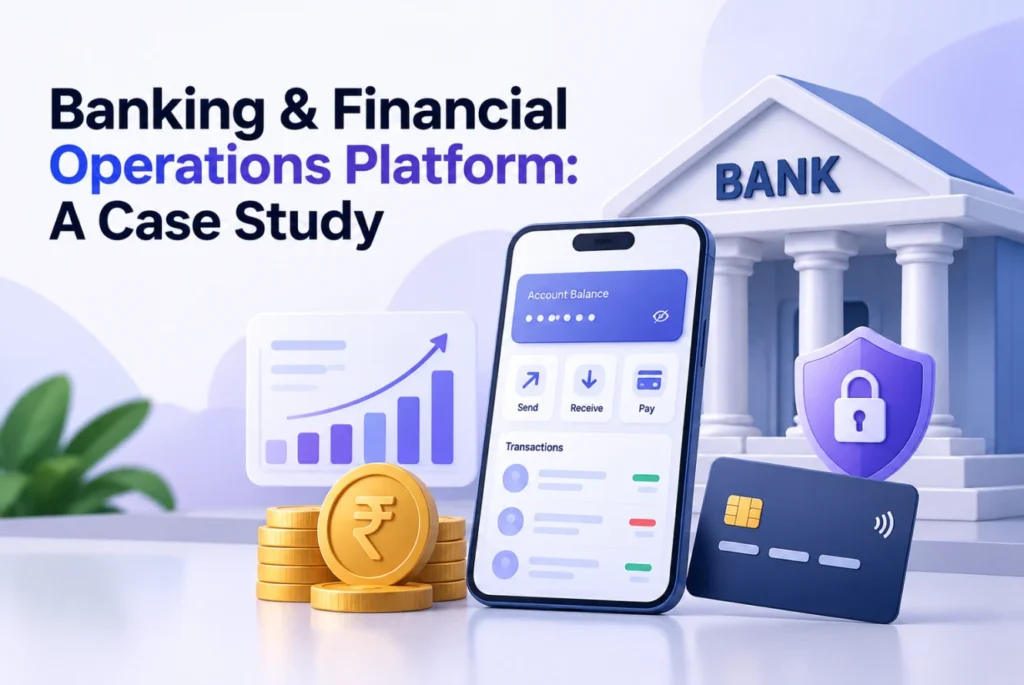




Banking & Financial Operations Platform: A Case Study
Legacy core banking systems trap financial institutions in fragmented data siloes, slow manual approvals and outdated batch processing cycles. A unified banking and financial operations platform connects customer records, transactions, account operations, approvals and reporting into one secure, real-time system.
This case study examines how a custom-built financial operations platform modernized a mid-size bank’s core workflows. Event-driven microservices, automated approval routing and a zero-trust security model replaced legacy bottlenecks, cutting compliance overhead and accelerating transaction processing across every branch network.
Platform
Mobile Application
Industry
Social Media
& Messaging
Country
India
Services
UI/UX Design &
App Development
Client's Problem Statement
- Legacy system fragmentation caused frequent manual data synchronization errors between customer account records and core transaction databases, exposing the bank to serious regulatory reporting compliance penalties during routine audit cycles.
- Inflexible approval structures delayed commercial credit applications and treasury transfers, driving customer dissatisfaction, mounting operational backlogs and missed financial market opportunities for the bank's largest corporate banking clients each quarter.
- Outdated security frameworks lacked granular access controls and immediate audit logging, leaving the platform exposed to unauthorized data access, internal policy violations and sophisticated financial fraud across digital banking channels.
- Slow batch processing restricted continuous ledger visibility, forcing executive leaders to rely on delayed reporting dashboards, which hindered timely institutional risk management and proactive portfolio strategy decisions across every department.
Challenges
- Legacy-to-Cloud Integration: Integrating cloud-native microservices architecture with legacy core mainframes without disrupting active transaction processing streams or causing service downtime.
- Multi-Framework Regulatory Compliance: Meeting global regulatory mandates such as GDPR, SOC 2 and Basel III while maintaining sub-second processing performance across distributed account operations.
- Complex Multi-Tenant Approval Logic: Building a dynamic approval engine capable of orchestrating hierarchical authorization rules and automated escalation pathways across departments and business lines.
- Real-Time Ledger Consistency: Guaranteeing strict ACID database consistency and immutable ledger tracking across millions of concurrent daily financial transaction requests.
Solution
- Event-Driven Microservices Architecture: Decoupled core banking modules, customer record engines, and real-time transactional processing services so each component scales and deploys independently.
- Automated Approval Workflow Engine: Built dynamic role-based access rules, multi-stage authorization protocols and instant notification alerts to replace slow, manual sign-off chains.
- Real-Time Stream Analytics Pipelines: Delivered continuous risk tracking, executive operational dashboards and automated regulatory audit reports generated directly from live transaction data.
- Zero-Trust Security Framework: Implemented end-to-end HSM encryption, OAuth authentication and immutable transaction ledger logging to close legacy access-control gaps.
Execution And Development Journey
- The project began with thorough domain analysis, mapping legacy system dependencies and defining core API specifications carefully. Engineers structured an asynchronous messaging microservices architecture using distributed queues to decouple transaction workflows from legacy backends, ensuring operational stability and foundational system resilience throughout initial implementation phases.
- Agile development sprints focused on security hardening, integrating identity access management protocols and hardware security encryption from day one. Developers ran continuous automated testing pipelines to validate execution latency, while designers built intuitive dashboards, ensuring frictionless adoption across operational staff, compliance officers and bank executives.
- Deployment followed a phased rollout across regional branches, paired with hands-on onboarding for compliance officers and dispatch teams. Continuous feedback loops refined interface ergonomics, while analytics pipelines were tuned to deliver instant regulatory reporting and automated risk alerts to executive leadership across the bank today.
Technologies We Used
- Frontend Language

React.js

TypeScript
- Backend Framework

Node.js
- Database

postgresql

Redis
Our Results
Performance Improved:
Page load times decreased by 40%. Core transaction processing throughput increased substantially, eliminating operational lag across high-volume customer account workflows and enabling near-instant ledger balance synchronization during every peak institutional trading window daily.
Workflow Efficiency Accelerated:
Approval lead times decreased by 75%. Commercial credit and treasury authorization workflows shrank from 48 hours to under 4 hours through automated multi-stage decision routing and instant mobile approval notifications sent directly.
Compliance Overhead Reduced:
Regulatory audit prep workload dropped by 80%. Automated report generation now lets compliance officers produce fully verified financial statements and immutable transaction ledgers within minutes instead of several laborious manual review weeks.
Infrastructure Spending Optimized:
Cloud compute expenditures decreased by 35%. Containerized auto-scaling and dynamic resource allocation now easily support peak volumes exceeding ten million daily banking platform transaction service requests without any added infrastructure cost overhead.
Key Performance Indicator
| Metric | Before Implementation | After Implementation | Change |
|---|---|---|---|
| Transaction Processing Latency | Legacy baseline delay | Sub-second response | Significant decrease in latency |
| Commercial Loan Approval Time | 48 hours average | Under 4 hours average | 75% faster turnaround |
| Regulatory Audit Report Assembly | Manual, multi-week process | Automated, same-day generation | 80% less compliance overhead |
| Unplanned Operational Downtime | Frequent legacy outages | High-availability uptime | Major improvement in availability |
| Dashboard Page Load Time | Legacy baseline load | 40% faster load | 40% reduction in load time |
| Cloud Cost per 100,000 Transactions | Legacy infrastructure baseline | Optimized containerized spend | 35% efficiency gain |
Frequently Asked Questions
Explore answers to the most common questions about our services, workflows, and support. Clear information, all in one place.
What is a banking and financial operations platform?
A banking and financial operations platform is software that centralizes customer records, transactions, account operations, approvals and reporting into one secure system, replacing fragmented legacy tools with a single real-time source of operational truth.
How does automation improve approval workflows in banking?
Automated approval workflows use role-based rules and multi-stage routing to move credit applications and treasury transfers through sign-off automatically, cutting turnaround from days to hours while keeping a full audit trail of every decision.
What is core banking modernization and why does it matter?
Core banking modernization replaces or upgrades the legacy infrastructure that processes accounts, transactions and loans with a flexible, cloud-native platform, reducing operational risk, easing regulatory compliance and supporting real-time data across the institution.
How secure are modern financial operations platforms?
Modern financial operations platforms use zero-trust architecture, end-to-end encryption, OAuth authentication and immutable transaction ledgers to control access at a granular level, log every action and reduce exposure to fraud and data breaches.
What ROI can banks expect from financial process automation?
Banks that automate financial operations commonly see faster approval cycles, lower compliance overhead and reduced infrastructure spend within the first year, with measurable gains in processing speed, audit efficiency and overall operational cost control.
More Proven Case Studies
We showcase additional real-world projects that highlight our expertise, problem-solving approach, and measurable results delivered for clients across different industries.