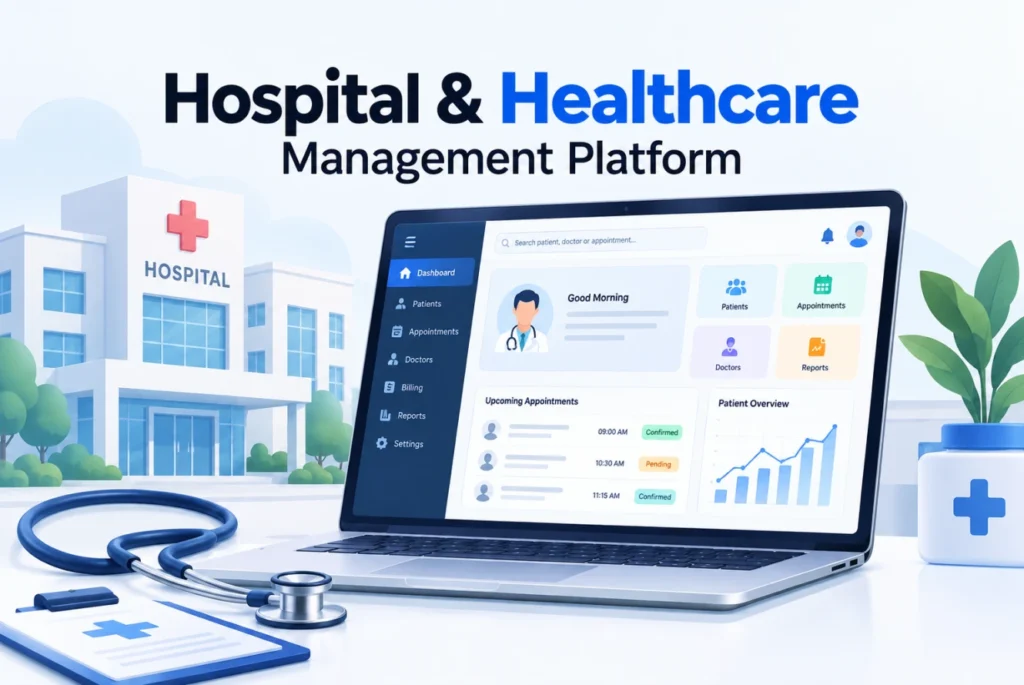




Hospital & Healthcare Management Platform
Hospitals juggling six disconnected applications for patient intake, scheduling, billing and pharmacy inventory struggle with data silos and slow workflows. A multi-specialty healthcare provider needed one unified system to coordinate patient records, departments and daily hospital operations across clinical units.
The hospital management platform unifies electronic medical records, appointment scheduling, billing and pharmacy management inside one HIPAA-compliant architecture built on HL7 FHIR standards. Automated reminders, real-time analytics and role-based access control help clinical teams make faster decisions while cutting overhead.
Platform
Mobile Application
Industry
Social Media
& Messaging
Country
India
Services
UI/UX Design &
App Development
Client's Problem Statement
- The hospital relied on six disconnected applications to manage patient intake, billing, pharmacy inventory and scheduling, creating fragmented data silos and constant communication gaps between clinical departments and administrative teams.
- Paper-based medical records and manual billing workflows raised compliance risk, slowed insurance claims, increased transcription errors and forced staff to spend redundant administrative hours reconciling patient charts and payer documentation.
- Manual appointment booking and the absence of automated reminders drove a high consultation absenteeism rate, leaving physicians with idle time slots, lost consultation revenue and unpredictable patient volumes across departments.
- Without centralized departmental analytics, hospital executives lacked real-time visibility into bed occupancy, pharmacy stock and staffing needs, making proactive resource planning across inpatient and outpatient units difficult, reactive and inconsistent.
Challenges
- Unifying six legacy applications into one platform while preserving strict HIPAA data governance, zero downtime and complete patient record integrity across every clinical department during the entire migration.
- Synchronizing pharmacy inventory, laboratory orders and billing data across outpatient clinics in real time without introducing processing latency that could delay prescriptions or patient checkout at the front desk.
- Reducing high appointment absenteeism without expanding call-center staffing or administrative expenditure, since the hospital could not justify hiring more coordinators purely to chase patients for confirmations.
- Rolling out granular role-based access controls across multi-specialty clinical teams without interrupting active, round-the-clock patient care, since every login change had to happen while the hospital stayed fully operational.
Solution
- The team re-architected hospital operations into one cloud platform, integrating EMR, scheduling, billing and pharmacy modules into a single operational view that every department could access and trust.
- An automated patient engagement engine now delivers instant SMS and email reminders alongside real-time queue tracking, so patients know exactly when and where their appointment is happening.
- An HL7 FHIR-compliant microservices architecture handles fine-grained role-based access control and immutable audit logging, keeping the platform compliant without slowing down clinical staff during patient visits.
- Real-time operational analytics dashboards give hospital executives instant visibility into bed occupancy, pharmacy stock levels and revenue cycle throughput, replacing spreadsheets with a single live operational view.
Execution And Development Journey
- The engineering team began with exhaustive workflow discovery, mapping data pathways across all six legacy systems before writing a single line of code. Building a HIPAA-compliant foundation on AWS meant deploying multi-region PostgreSQL databases, Redis caching layers and encrypted Next.js microservices for continuous uptime.
- Development work then focused on building a high-throughput, department-aware scheduling engine paired with an automated communication pipeline. WebSockets enabled real-time patient queue updates across outpatient clinics, while automated SMS and email dispatchers instantly confirmed bookings and sent follow-up reminders to cut absenteeism before it started.
- The final phase integrated pharmacy inventory and billing engines with automated payment gateways. By applying strict role-based access controls and standardized HL7 FHIR data models, the platform reached smooth interdepartmental interoperability while keeping regulatory compliance intact across every digital clinical workflow the hospital relied on.
Technologies We Used
- Frontend Language

React.js

TypeScript
- Backend Framework

Node.js

Python
- Database

postgresql
Our Results
Absenteeism Reduced:
Appointment no-show rates dropped from 42% to 24% within the first quarter post-launch, driven mainly by automated SMS and email reminders, directly increasing physician utilization and generating meaningful additional clinic consultation revenue overall.
Administrative Overhead Cut:
Weekly manual labor hours fell from over 100 hours to just 40 hours per branch, as staff shifted away from manual billing and record entry toward automated workflows across every hospital department.
System Speed Accelerated:
Patient data retrieval latency improved from 4.2 seconds to about 1.05 seconds, a 300% performance gain that shortened intake wait times and gave physicians instant access to full patient histories.
Platform Reliability Secured:
Production incidents dropped by 92% after the entire engineering team introduced automated cross-device integration testing, while release cycles shortened from monthly to bi-weekly deployments without ever interrupting continuous, around-the-clock hospital care operations.
Key Performance Indicator
| Metric | Before | After | Improvement |
|---|---|---|---|
| Appointment no-show rate | 42% | 24% | 42% reduction |
| Weekly administrative overhead | 100+ hours/branch | 40 hours/branch | 60 hours saved weekly |
| Patient data retrieval latency | 4.2 seconds | 1.05 seconds | 300% faster |
| Release/integration testing cycle | 12 days | 3 days | 75% faster releases |
| Production incidents | 25+/year | <2/year | 92% reduction |
| Page load speed (LCP) | 3.8s | Sub-second | 70%+ faster |
Frequently Asked Questions
Explore answers to the most common questions about our services, workflows, and support. Clear information, all in one place.
What is a hospital management platform?
A hospital management platform is software that unifies patient records, appointment scheduling, billing, pharmacy inventory and departmental workflows into one system, replacing multiple disconnected tools with a single source of truth for clinical and administrative teams.
How much does a custom hospital management system cost to build?
Enterprise-grade custom hospital management platforms typically range from roughly $150,000 to over $500,000 depending on modules, integrations and compliance scope, while off-the-shelf systems cost less upfront but limit customization for multi-specialty hospitals.
Can automated reminders really reduce appointment no-shows?
Yes. Hospitals that add automated SMS and email reminders alongside real-time queue tracking commonly report no-show reductions in the 30–40% range, since patients receive timely confirmations and can reschedule before missing a visit.
What is HL7 FHIR and why does it matter for hospital software?
HL7 FHIR (Fast Healthcare Interoperability Resources) is a data exchange standard that lets a hospital management platform share patient records securely with external EHRs, labs and health networks, which is essential for interoperability and regulatory compliance.
Is a custom hospital management platform HIPAA compliant by default?
No platform is HIPAA compliant automatically; compliance depends on how it’s built. A properly engineered system needs AES-256 encryption, role-based access control, immutable audit logs, and secure infrastructure like AWS to meet HIPAA and SOC 2 requirements.
More Proven Case Studies
We showcase additional real-world projects that highlight our expertise, problem-solving approach, and measurable results delivered for clients across different industries.