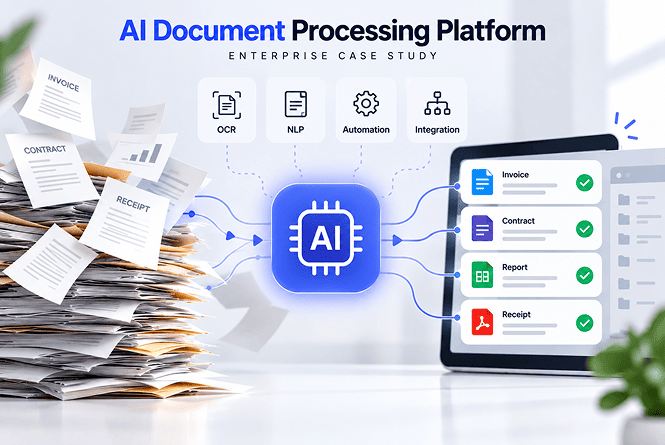





AI Document Processing Platform: Enterprise Case Study
Enterprises processing thousands of invoices, contracts and forms daily lose hours to manual data entry. An AI document processing platform automates document ingestion, extraction and validation, turning unstructured PDFs and scans into structured, searchable data enterprise systems can use instantly.
This case study examines how an enterprise deployed an intelligent document processing platform combining computer vision OCR, NLP models and human-in-the-loop validation. The result: 88% straight-through processing rate, 82% lower error rates and full ROI within seven months.
Platform
Mobile Application
Industry
Social Media
& Messaging
Country
India
Services
UI/UX Design &
App Development
Client's Problem Statement
- Manual data entry across invoices, purchase orders and contracts created severe processing backlogs, forcing finance and operations teams to spend hundreds of hours monthly keying repetitive information into enterprise systems.
- High error rates during manual extraction led to inaccurate financial reporting, frequent compliance breaches, delayed vendor payments and inflated labor costs across accounting, procurement and business units throughout the enterprise.
- Legacy document storage systems lacked centralized semantic search, forcing employees to spend hundreds of hours manually retrieving critical information buried inside unstructured files, scanned images and disorganized digital archives company-wide.
- Inconsistent document routing hindered interdepartmental collaboration, preventing real-time validation of extracted data against downstream enterprise resource planning software and customer relationship management systems across core financial, sales, and administrative operations.
Challenges
- Multi-Format Document Ingestion: Normalizing heterogeneous scans, skewed PDFs and handwritten forms without sacrificing character recognition accuracy across thousands of inconsistent document layouts and file types processed daily.
- Low-Latency Scalable Processing: Sustaining high pipeline throughput and sub-second inference speeds during peak intake volume surges, without triggering infrastructure bottlenecks or degraded extraction accuracy in production.
- Enterprise Governance and Security: Enforcing strict data privacy and compliance standards across automated extraction pipelines handling sensitive financial records and personally identifiable operational information.
- System Integration and Interoperability: Synchronizing schema validation and real-time structured output between deep learning parsers and legacy ERP and CRM platforms without disrupting existing workflows.
Solution
- Intelligent Vision and OCR Engine: Deployed computer vision preprocessing and optical character recognition to deskew scans, analyze page layouts and accurately parse complex multi-page documents at scale.
- NLP and Deep Learning Extraction: Implemented domain-tuned transformer models to extract key-value pairs, nested line-item tables and named entities from unstructured invoices, contracts, and forms.
- Human-in-the-Loop Validation Workflow: Built confidence-scoring logic that routes low-confidence extractions to human reviewers, feeding corrections back into the models through continuous retraining loops.
- Asynchronous Enterprise Integration API: Engineered high-concurrency microservices and RESTful APIs to stream verified, structured JSON data directly into ERP, CRM and downstream enterprise systems.
Execution And Development Journey
- The initial phase focused on building a scalable cloud platform capable of ingesting diverse, unstructured document streams. Engineers built automated preprocessing pipelines using computer vision libraries to correct image orientation, remove scan noise and normalize resolution before documents entered the machine learning extraction processing pipeline.
- During model training, developers combined natural language processing transformers with advanced OCR engines. Custom neural networks trained on domain-specific corporate datasets to optimize key-value extraction, layout classification and table parsing across complex, multi-page financial documents, contracts, purchase orders and vendor invoices consistently across the organization.
- System optimization introduced human-in-the-loop validation interfaces paired with real-time monitoring telemetry. Low-confidence extractions automatically route to human review queues, while continuous feedback loops retrain model checkpoints to sustain processing accuracy, straight-through processing targets and scalable throughput as enterprise document volumes kept expanding rapidly each month.
Technologies We Used
- Infrastructure & Security

React.js
- Backend Framework

Redis

Python
- Database

postgresql

Amazon
Web Serivces
Our Results
Straight-Through Processing Improved:
Automated document classification and field extraction achieved an 88 percent straight-through processing rate, eliminating manual intervention entirely for standard invoices, purchase orders and complex multi-page contracts across every enterprise onboarding workflow, company-wide.
Error Rate Reduced:
Character recognition precision reached 99.4% accuracy while the character error rate dropped by 82%, significantly improving structured data extraction quality across low-resolution scans, blurred images and faded handwritten pages daily.
Handling Time Cut:
Processing duration per document decreased by 78%, reducing average handling time from 14 minutes per invoice down to under 45 seconds through fully automated extraction and human review validation pipelines company-wide.
Operational Costs Lowered:
Total administrative document management overhead dropped by 65%, delivering full return on investment within just seven months of full enterprise platform deployment across core financial, accounting, procurement and vendor management departments.
Key Performance Indicator
| Key Performance Indicator | Before | After | Net Gain |
|---|---|---|---|
| Straight-Through Processing (STP) Rate | 12.0% | 88.0% | +633.3% Increase |
| Average Handling Time (AHT) per File | 14.0 Minutes | 0.75 Minutes (45 Sec) | 94.6% Reduction |
| Character Error Rate (CER) | 14.5% | 2.6% | 82.1% Reduction |
| OCR Field Extraction Accuracy | 78.2% | 99.4% | +27.1% Increase |
| Monthly Administrative Expenses | $145,000 | $50,750 | 65.0% Reduction |
| Average Semantic Document Search Time | 18.5 Minutes | 1.2 Seconds | 99.9% Reduction |
Frequently Asked Questions
Explore answers to the most common questions about our services, workflows, and support. Clear information, all in one place.
What is an AI document processing platform and how does this work?
An AI document processing platform is enterprise software that automates document capture, classification and data extraction. It combines optical character recognition, natural language processing and deep learning models to convert unstructured invoices, contracts and scanned files into structured, validated data ready for downstream enterprise systems.
What is the difference between OCR and intelligent document handling?
OCR converts scanned images into raw text but cannot interpret meaning or structure. Intelligent document processing goes further, using AI and machine learning to classify documents, extract key-value pairs and tables and validate context, turning simple text recognition into structured, business-ready data automatically.
Why is human-in-the-loop confirmation important in AI document processing?
Human-in-the-loop validation catches errors that automated models miss on complex, low-quality or unusual documents. Low-confidence extractions route to human reviewers, whose corrections retrain the model over time, steadily improving accuracy while keeping sensitive financial and compliance decisions under human oversight.
How much can an AI document processing platform reduce operational costs?
Results vary by document volume and process complexity, but enterprises commonly report 60 to 80 percent lower processing costs and payback periods of three to twelve months. In this case study, automated extraction and validation cut administrative overhead by 65 percent within seven months.
How do AI document processing platforms integrate with enterprise ERP and CRM systems?
AI document processing platforms integrate through asynchronous REST APIs and microservices that validate extracted fields against JSON schemas before syncing them to ERP and CRM databases. This removes manual re-entry, keeps downstream records current and lets finance and operations teams work from one verified data source.
More Proven Case Studies
We showcase additional real-world projects that highlight our expertise, problem-solving approach, and measurable results delivered for clients across different industries.