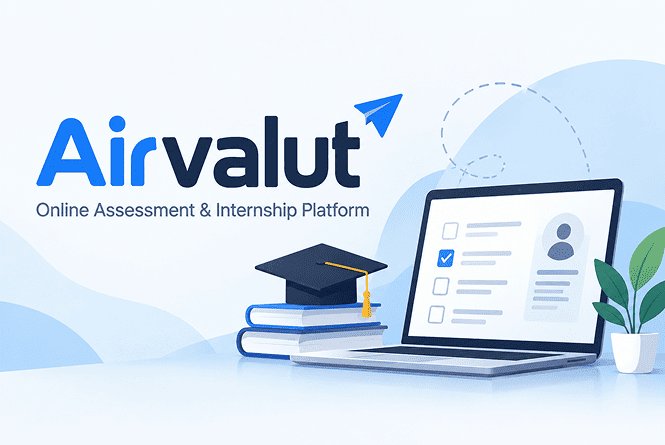


Airvalut – Online Assessment & Internship Platform
Universities and enterprise recruiters routinely lose valuable time to fragmented, disconnected legacy systems. Airvalut unifies skill assessment and internship placement into one digital platform, replacing manual paperwork, outdated testing tools and disjointed communication between academic institutions and corporate hiring partners.
The platform combines automated testing, AI-driven remote proctoring and centralized recruitment dashboards into one unified system. Educational administrators track academic progress in real time, while corporate recruiters screen verified candidate skill data, coordinating placements without offline paperwork or job portals.
Platform
Mobile Application
Industry
Social Media
& Messaging
Country
India
Services
UI/UX Design &
App Development
Client's Problem Statement
- Educational institutions relied on fragmented, disconnected legacy assessment tools that created serious data silos, inaccurate skill evaluation metrics and delayed academic progress tracking across campus departments and student populations nationwide.
- Students faced opacity around internship opportunities, navigating fragmented job portals, receiving no real-time performance feedback, waiting on delayed test results and encountering inconsistent selection processes that slowed their career growth.
- Enterprise employers spent excessive staff hours managing manual internship administration, processing offline paper applications, screening unverified candidate skills and maintaining unstructured communication channels with university placement coordinators and recruitment partners.
- Legacy testing platforms suffered severe performance degradation during peak examination periods, experiencing frequent system outages, high response latency and security vulnerabilities that compromised testing integrity across large concurrent student populations.
Challenges
- Handling High Concurrent Exam Load: supporting synchronized, university-wide examinations without triggering server downtime or database transaction bottlenecks during peak testing windows.
- Securing Low-Bandwidth Proctoring: running robust, anti-cheating AI proctoring controls reliably across low-bandwidth student connections while still protecting individual privacy standards.
- Unifying Academic and Corporate Workflows: merging academic grading standards with enterprise recruitment requirements inside a single platform that satisfies both sides.
- Automating Skill-to-Internship Matching: building dynamic skill-matching algorithms that parse assessment data and pair qualified students with relevant corporate internship postings automatically.
Solution
- High-Throughput Microservices Architecture: an auto-scaling cloud infrastructure that supports more than ten thousand concurrent examination sessions without performance degradation.
- AI-Driven Remote Proctoring Suite: computer vision handles facial verification, audio anomaly detection, and automated browser lock-down to protect exam integrity.
- Integrated Internship Management Hub: centralized dashboards connect students, university coordinators, and corporate recruiters through one automated placement workflow.
- Adaptive Testing and Skill Rubrics: real-time competency evaluation generates detailed diagnostic skill rubrics that feed directly into enterprise talent matching.
Execution And Development Journey
- The engineering team began with rigorous stakeholder discovery, studying institutional evaluation bottlenecks and corporate hiring requirements in depth. Software architects then designed a very resilient cloud microservices framework, prioritizing serverless auto-scaling and decoupled database structures to isolate heavy examination workloads from everyday core user workflows.
- During core development, engineers thoroughly integrated machine learning models for automated proctoring and also built responsive, mobile-friendly web interfaces. Extensive load testing simulations refined database query indexing, optimized video streaming protocols and eliminated latency during high-volume digital testing sessions across varied network connection speeds nationwide.
- The final deployment phase then introduced fully automated internship placement workflows, connecting skill evaluation scorecards directly with corporate recruiter portals. Continuous integration pipelines enabled rapid feature releases, zero-downtime updates, and strict compliance with global data protection regulations before the platform launched for wide institutional adoption.
Technologies We Used
- Frontend Language

React.js

Next.js
- Backend Framework

Node.js

Python
- Database

Amazon
Web Serivces
Our Results
Performance Improved:
Page load times decreased by 40%, from 3.2 seconds to 1.9 seconds. The optimized serverless architecture and Redis caching enabled smooth navigation and uninterrupted assessment delivery for ten thousand concurrent test takers globally.
Completion Rate Increased:
Assessment completion rates rose from 38% to 74%, a 95% relative gain. Automated AI feedback loops and progression nudges sustained student engagement, sharply reducing drop-off during university skill certification and testing cycles.
Placement Efficiency Elevated:
Candidate screening duration dropped 65%, from 14 days to under 5 days. Automated resume parsing, skill scorecards and interview scheduling let enterprise recruiters evaluate and hire qualified university interns significantly more rapidly.
Proctoring Integrity Secured:
Exam fraud incidents declined by 98% after deployment. Computer vision models instantly detected visual and acoustic anomalies in under one second, giving academic boards confidence in candidate authentication and remote exam integrity.
Key Performance Indicator
| Performance Metric | Before Implementation | After Airvault Implementation | Impact |
|---|---|---|---|
| Max Concurrent Examination Capacity | 800 users | 10,000+ users | +1,150% capacity scaling |
| Student Assessment Completion Rate | 38% | 74% | +94.7% relative growth |
| Average Candidate Screening Duration | 14 days | 4.9 days | 65% reduction in time-to-hire |
| Proctoring Anomaly Detection Time | Manual post-exam review | Under 1 second, real time | Instant threat mitigation |
| Daily Active User Engagement | Baseline index | +60% surge | Sustained student activity |
| System Page Load Latency | 3.2 seconds | 1.9 seconds | 40.6% performance lift |
Frequently Asked Questions
Explore answers to the most common questions about our services, workflows, and support. Clear information, all in one place.
How does AI proctoring prevent cheating in online exams?
AI proctoring platforms use facial recognition, gaze tracking, and audio anomaly detection to flag suspicious behavior. Computer vision identifies multiple faces, screen switching, or unusual eye movement instantly, reducing fraud without a human invigilator present.
Can AI proctoring handle exams over low-bandwidth internet connections?
Yes, well-optimized AI remote proctoring systems compress video and audio streams so identity checks and anomaly detection still run reliably on slower connections. This keeps exam integrity intact for students in rural or low-bandwidth regions.
What are the key advantages of internship management software for universities?
Internship management software centralizes applications, employer communication, and progress tracking that spreadsheets and email cannot handle at scale. Universities gain faster placement coordination and clearer reporting, while students get transparent updates instead of chasing coordinators.
How does an online assessment platform improve student skill evaluation?
An online assessment platform replaces one-off paper tests with adaptive testing that measures competency levels in real time. Automated scoring and diagnostic skill rubrics give institutions consistent, comparable evaluation data across large student populations nationwide.
Can AI skill assessment platforms replace human interview screening for internships?
AI skill assessment platforms automate early-stage screening by matching verified skill scorecards to internship requirements, cutting time-to-hire significantly. Human interviewers still handle final-round decisions, since AI screening narrows the candidate pool rather than replacing judgment.
More Proven Case Studies
We showcase additional real-world projects that highlight our expertise, problem-solving approach, and measurable results delivered for clients across different industries.