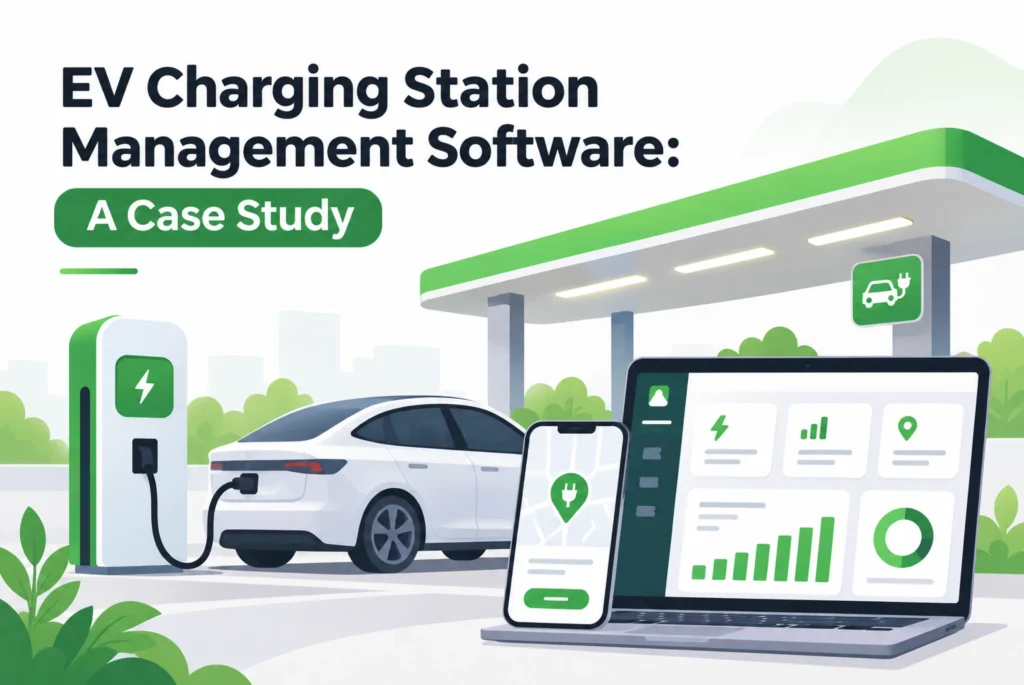



EV Charging Station Management Software: A Case Study
Drivers expect chargers that work every time and operators need software that keeps up as networks grow. This case study shows how EV charging station management software helped one operator run many chargers reliably, bill accurately and protect the grid.
We built a scalable cloud native EV smart charging platform on AWS that follows open industry standards. Read on for the problem, our build steps, the tools we used and a clear before-and-after KPI table with the final business results.
Platform
Cloud-Based EV Charging Station Management Software
Industry
EV Charging
Country
United States (USA)
Services
AWS Cloud-Native Platform Development
Client's Problem Statement
- The old all-in-one system choked during busy peak hours. It could not take in live charger data fast enough, so many charging sessions went unrecorded at sites across the country.
- Chargers used incompatible protocols. This locked the client into one hardware vendor and blocked roaming with other charge point networks, so drivers from partner networks could not use its chargers.
- Power could not be shared across busy public charging hubs. Local grid overloads, higher utility demand charges, and forced charger slowdowns at peak electricity prices became a regular, costly problem.
- Payments were unclear and billing was slow to match. Drivers saw failed charges, and the operator lost revenue every day on energy that was delivered but never recorded or billed.
Challenges
- Stable charger connections: Thousands of chargers using OCPP(Open Charge Point Protocol) 1.6-J and OCPP 2.0.1 needed always-on WebSocket links, with no single point of failure and no dropped connections.
- Smart power sharing: Dynamic load management had to split power across busy charging hubs to stop transformer overloads, while staying inside strict grid limits.
- Roaming bills that match: Billing across partner networks using OCPI(Open Charge Point Interface) 2.2.1 had to stay fast and exact, with no gaps, delays or disputes between networks.
- Audit-ready records: Every charging session needed tamper-evident financial logging, so the operator could pass audits and prove each bill when a driver or partner asked.
Solution
- Event-driven gateway: A WebSocket gateway behind Network Load Balancers keeps charger links open, while AWS IoT Core and AWS Lambda move telemetry and commands. This is the core of our AWS IoT Core microservices EV charging build.
- Containerized microservices: Amazon ECS with AWS Fargate splits billing, user management and telemetry into separate services. This keeps the OCPP compliant software architecture stable, even when one service is under heavy load.
- Smart charging profiles: Algorithms send power limits to chargers, using site grid limits stored in Amazon DynamoDB. This dynamic load management for EV grid optimization keeps each site safe without stopping sessions.
- Audit-ready records and roaming: Amazon Aurora PostgreSQL with audit logging, plus write-once copies in Amazon S3, protects session records. OCPI modules connect the platform to partner networks for roaming.
Execution And Development Journey
- We started by splitting the old all-in-one code into small services, one piece at a time, using the Strangler Fig pattern. Charger connection handling was separated from billing and user services, so serverless endpoints could track live charger status without slowing core transactions across sites.
- Next, our team added OCPP messaging for both 1.6-J and 2.0.1 chargers. Commands go out through AWS Lambda and Amazon SQS queues, which process messages reliably and prevent database locks during peak hours, a key step in building a scalable OCPP 2.0.1 EV charging backend.
- Then we built dynamic load management and billing records together. Live telemetry flows through event streams into Amazon DynamoDB, while every energy session is also saved in Amazon Aurora PostgreSQL with audit logging and write-once copies in Amazon S3, so records stay tamper-evident for audits.
- Finally, our team added OCPI 2.2.1 roaming protocol integration so drivers can charge on partner networks. We then ran heavy load tests with simulated charger traffic to check resilience and only after those passed did the platform go live across all of the operator’s sites.
Technologies We Used
- Connections and edge

AWS IoT Core

WebSockets
- Compute and microservices

AWS Lambda

Amazon ECS
- Speech to text

Amazon S3

Amazon RDS
Our Results
Availability Improved:
System uptime rose from 94.2% to 99.99%. The event-driven, serverless design removed single points of failure, so charging sessions keep running during sudden demand spikes and drivers can rely on chargers being ready.
Dashboard Speed Improved:
Average dashboard query time fell from 4.8 seconds to 0.8 seconds, an 83.3% drop. Operators now see live fleet status and charger health across all regions and can fix problems much faster.
Revenue Protected:
Unrecorded charging sessions fell from 8.5% to 0.02%, a 99.8% drop. Tamper-evident records and automated payments now match every billed energy session and cut billing reconciliation from 72 hours to near real time.
Grid Efficiency Improved:
Peak demand charges fell by 32%, and grid overload incidents dropped from 14 per month to zero. Dynamic load management profiles share site power fairly across active chargers without stopping driver sessions.
Key Performance Indicator
| Key Metric | Before | After | Change |
|---|---|---|---|
| System uptime | 94.2% | 99.99% | +5.79 percentage points |
| Dashboard query time | 4.8 seconds | 0.8 seconds | 83.3% faster |
| Unrecorded charging sessions | 8.5% of volume | 0.02% of volume | 99.8% lower |
| Maximum connected chargers | 500 | 50,000+ | 100x more capacity |
| Billing reconciliation time | 72 hours (manual) | Near real time | Automated settlement |
| Grid overload incidents | 14 per month | 0 per month | 100% fewer |
Frequently Asked Questions
Explore answers to the most common questions about our services, workflows, and support. Clear information, all in one place.
What is EV charging station management software?
EV charging station management software, also called a charge point management system (CPMS) or CSMS, is the cloud platform that connects chargers, handles billing, tracks sessions and controls power. Charge Point Operator (CPO) software gives operators one place to run their whole network.
How do you build a scalable OCPP 2.0.1 EV charging backend?
Keep charger WebSocket connections separate from billing, use queues to smooth peak traffic, and support both OCPP(Open Charge Point Protocol) 1.6-J and 2.0.1. This OCPP compliant software architecture scales better, and simulated charger traffic helps prove it before launch.
How does dynamic load management prevent grid overloads?
Dynamic load management for EV grid optimization watches a site’s power limit in real time and sends smart charging profiles to chargers. Each car gets a fair share, so transformers stay safe. A cloud native EV smart charging platform does this automatically.
What is OCPI 2.2.1 roaming?
OCPI 2.2.1 is an open standard that lets charging networks share locations, prices and billing data. With OCPI 2.2.1 roaming protocol integration, drivers from partner networks can charge at your stations and your team can bill them correctly.
What uptime do EV chargers need?
US federal NEVI(National Electric Vehicle Infrastructure)-funded chargers must reach more than 97% average annual uptime per charging port. This platform reached 99.99% system uptime, though port-level uptime can differ from system uptime, so it helps to track both.
More Proven Case Studies
We showcase additional real-world projects that highlight our expertise, problem-solving approach, and measurable results delivered for clients across different industries.