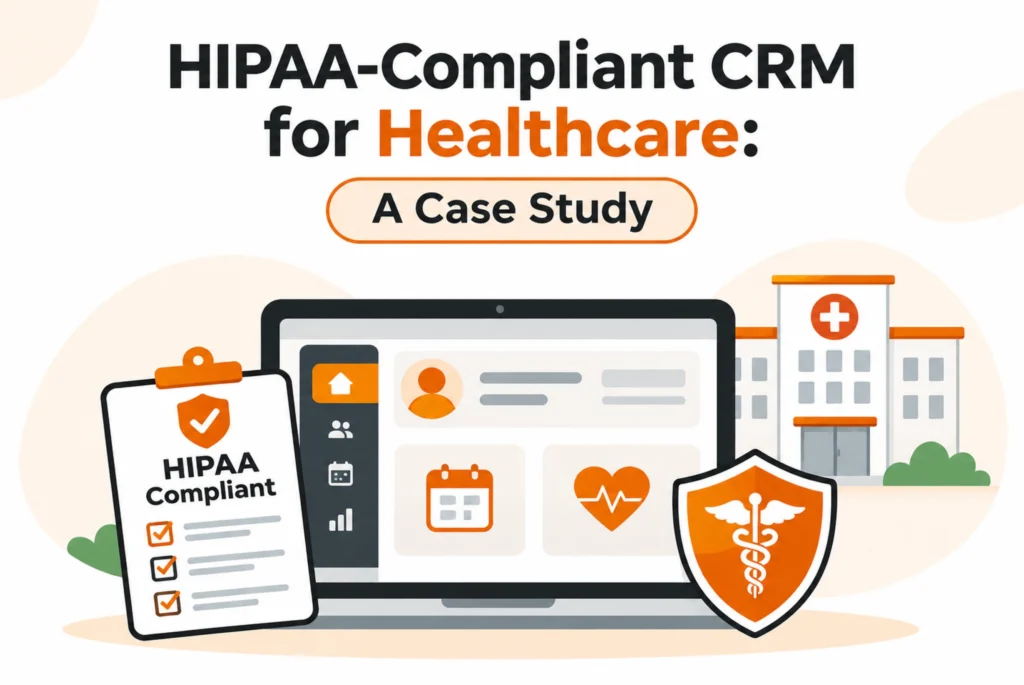




HIPAA-Compliant CRM for Healthcare: A Case Study
Patients now expect timely reminders, easy scheduling and quick answers, but healthcare teams must protect every single piece of private health data. This case study shows how a HIPAA-compliant CRM for healthcare met both needs for one regional health system.
The team built a cloud-based patient relationship management (PRM) platform that connects to the EHR (Electronic Health Record) in both directions using FHIR (Fast Healthcare Interoperability Resources). Read on for the problem, our build steps, the tools with the full results.
Platform
Cloud-Based Healthcare CRM
Industry
Healthcare Providers
Country
United States (USA)
Services
HIPAA-Compliant Cloud Solutions
Client's Problem Statement
- Clinical records lived in the EHR, while patient outreach lived in separate marketing tools. Teams could not send timely, personal messages along the patient journey without risking private health data.
- The old on-premises system was slow, hard to scale, and a growing security risk. Each year, meeting federal privacy rules for patient data got harder and more costly to manage.
- Older hospital and clinic systems sent data as HL(Health Level)7 v2 messages, which modern tools could not read. Staff re-typed information by hand, which caused delays, errors and out-of-date patient records.
- Patient portal use stayed under 30% and missed appointments piled up. Without clear tracking of patient preferences and consent, outreach was hit-or-miss and campaign spending was very hard to justify.
Challenges
- Protecting health data: Every system touching PHI (Protected Health Information) needed encryption at rest and in transit, strict access roles, and a signed Business Associate Agreement (BAA) with each cloud and software vendor.
- Converting old data formats: HL7 v2 messages from older hospital systems had to become modern FHIR data in real time, without losing details or slowing down the clinical record.
- Two-way EHR sync: The CRM had to send updates to the EHR and react to clinical events, without hurting EHR speed or adding extra work for clinicians.
- Keeping marketing and PHI apart: Public web forms and ads had to capture new leads securely, without placing tracking cookies on portals that contain patient information.
Solution
- Secure cloud foundation: A hardened cloud landing zone runs inside a private network. It enforces AES-256 encryption at rest and TLS 1.3 in transit, with BAAs in place for every vendor.
- Interoperability pipeline: Serverless queues and a conversion engine turn HL7 v2 messages into FHIR R4 data in real time and store them in a managed FHIR data store.
- Two-way EHR-CRM sync: Bidirectional EHR CRM integration uses FHIR APIs to connect with systems like Epic, Oracle Health and athenahealth. Clinical events, such as a missed visit, trigger the right outreach.
- Identity and audit controls: Single sign-on, multi-factor login and role-based access limit PHI to approved staff. Continuous audit logs record every request, query and API call.
Execution And Development Journey
- We started by signing Business Associate Agreements with every cloud and software vendor. Then we built a hardened cloud landing zone with AES-256 encryption at rest and TLS 1.3 in transit and set up single sign-on, multi-factor login and role-based access for all admin users.
- Next, we set up secure serverless queues and a conversion service that turns old HL7 v2 messages into FHIR R4 data in real time. A managed FHIR data store was added, with copies in a second region to protect patient data if one region fails.
- In weeks six and seven, engineers linked the CRM to the cloud FHIR APIs through private network endpoints. They turned on two-way sync with the EHR, then tuned caching and connection pooling so large patient message campaigns would not slow down the main clinical record system.
- In the last weeks, the team ran vulnerability scans, penetration tests and full compliance audits. After the checks passed, the platform went live, constant monitoring began and staff onboarding started. Public web pages also received FAQ and health page schema for better AI search visibility.
Technologies We Used
- Cloud and network

AWS

Google Cloud
- Data intake and conversion

AWS Lambda

Azure Event Hubs
- Identity and access

Microsoft Entra ID

Amazon Cognito
Our Results
Patient Portal Adoption Increased:
Portal use grew from under 30% to as high as 90%. Automated digital onboarding and multi-channel reminders made it easy for patients to sign up and stay engaged with their care.
Rollout Speed Improved:
Full enterprise deployment took 8 to 10 weeks instead of the usual 12 to 18 months. Pre-built cloud landing zones and ready FHIR converters cut cost and helped teams see value sooner.
Clinician Time Saved:
Clinician screen time dropped by 16% as routine, non-clinical tasks moved to automated CRM portals. Care teams now have more time for direct patient conversations and less time clicking through the EHR.
Reliability Improved:
The new platform now delivers 99.99% availability, up from frequent legacy downtime. A high-availability, multi-region, geo-redundant cloud design keeps patient messaging and EHR sync running even during planned maintenance or regional cloud issues.
Key Performance Indicator
| Key Metric | Before | After | Change |
|---|---|---|---|
| Patient portal adoption | Under 30% | Up to 90% | Up to 3x highers |
| Full rollout time | 12–18+ months | 8–10 weeks | Much faster launch |
| Clinician screen time | EHR-only workflows | 16% lower | 16% reduction |
| System availability | Frequent legacy downtime | 99.99% | Highly available |
| Patient data updates | Manual, batch updates | Real-time, two-way sync | +Always current |
Frequently Asked Questions
Explore answers to the most common questions about our services, workflows, and support. Clear information, all in one place.
What makes a CRM HIPAA-compliant?
No CRM is compliant on its own. You need a signed Business Associate Agreement, encryption, strict access controls, audit logs and safe daily use by your team. A HIPAA-compliant CRM for healthcare is one that is set up and run this way.
How does a healthcare CRM integrate with an EHR like Epic?
The CRM connects to the EHR through FHIR APIs or HL7 feeds. Preferences and appointment updates flow into the EHR, while clinical events, such as a missed visit, trigger outreach in the CRM. A middle FHIR store protects EHR speed.
What is the difference between a healthcare CRM and an EHR?
An EHR holds clinical records, such as diagnoses and visit notes. A healthcare CRM manages patient relationships, such as reminders, outreach and satisfaction surveys. They work best when linked, so each system does its own job.
How do you convert HL7 v2 to FHIR?
Capture the incoming HL7 v2 messages with a secure queue, then send them through a conversion engine that maps each message into FHIR JSON data. This HL7 v2 to FHIR conversion can run in real time and feed a managed FHIR store.
Is encryption mandatory under HIPAA?
Under today’s Security Rule, encryption is an addressable safeguard, so you must use it or document a good reason not to. HHS has proposed making it mandatory, but as of late 2026 that update is not final. Encrypting PHI is the safe choice.
More Proven Case Studies
We showcase additional real-world projects that highlight our expertise, problem-solving approach, and measurable results delivered for clients across different industries.