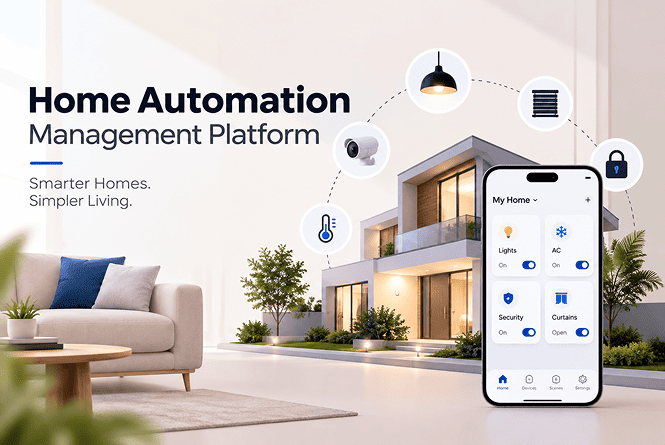



Home Automation Management Platform
Modern smart homes run on fragmented ecosystems, forcing homeowners to juggle over a dozen separate apps for lighting, security and climate. Mismatched wireless protocols and clunky onboarding routines turn simple setup into a frustrating, error-prone chore for everyday residential users.
This case study reviews a Home Automation Management Platform built to unify connected smart devices under one centralized digital system. The solution bridges Matter, Thread, Zigbee and Wi-Fi hardware with cloud automation workflows for a single, low-latency control layer everywhere.
Platform
Mobile Application
Industry
Social Media
& Messaging
Country
India
Services
UI/UX Design &
App Development
Client's Problem Statement
- Homeowners juggled more than fifteen fragmented mobile applications for lighting, security, climate and appliances, causing high setup abandonment rates and constant support ticket volume spikes across every single product deployment.
- Unstable protocol communication across legacy radio frequencies caused command execution delays exceeding two full seconds, rendering local home automation routines completely unreliable and frustrating for active daily residential consumers everywhere.
- High device onboarding drop-off rates hurt the business, with 38 percent of consumers failing to complete initial Bluetooth and Wi-Fi pairing procedures, triggering costly product returns and negative online reviews.
- Frequent over-the-air firmware updates repeatedly bricked smart hardware in customer homes because of unvalidated deployment pipelines, creating heavy operational support overhead and lasting brand reputation damage across global consumer markets.
Challenges
- Cross-Protocol Interoperability: Bridging heterogeneous wireless standards, including Matter over Thread, Zigbee 3.0, Bluetooth Low Energy and Wi-Fi, into one unified operational system without introducing translation bottlenecks or added latency.
- Edge and Cloud Data Synchronization: Managing real-time telemetry across thousands of local edge gateways and cloud MQTT broker clusters while preserving low bandwidth use and preventing network congestion at scale.
- Frictionless Multi-Device Provisioning: Engineering an intuitive mobile onboarding pipeline that automates device discovery, removes manual configuration errors and minimizes setup drop-offs across diverse operating systems and hardware.
- Fail-Safe Firmware Deployment Architecture: Designing an enterprise-grade over-the-air update mechanism capable of managing staged rollouts, canary deployments and automated rollbacks to guarantee fleet-wide reliability.
Solution
- Unified Multi-Protocol Gateway Engine: Engineered a centralized edge software architecture with an enterprise MQTT broker and native Matter over Thread abstraction layers to achieve low-latency local command processing.
- Guided BLE Proximity Onboarding: Developed a streamlined mobile onboarding experience using Bluetooth Low Energy auto-discovery, interactive visual setup guides, and real-time network connection validation checks for every device.
- Cryptographically Signed Staged OTA Pipeline: Built a safe firmware update pipeline enforcing digital signature verification, staged rollouts from 1% to 10% to 100%, continuous health monitoring and automated fallback triggers.
- Localized Rule Engine and Analytics: Integrated a localized automation rule engine paired with cloud predictive analytics, enabling real-time energy monitoring, automated HVAC scheduling and cross-device scene orchestration.
Execution And Development Journey
- Engineers began with exhaustive architectural discovery centered on low-latency local execution across every connected device. They built a hardware abstraction layer that standardized multi-protocol payload formats, letting legacy Zigbee devices and modern Matter nodes communicate seamlessly through a single centralized primary edge gateway controller system.
- Next, the engineering team built a high-throughput cloud MQTT broker infrastructure to ingest real-time device telemetry at scale, while mobile developers crafted guided Bluetooth Low Energy setup routines with progressive visual feedback and automatic network detection, dramatically simplifying installation for non-technical homeowners across every region.
Technologies We Used
- Front-End Interface

Swift

Tailwind CSS
- Cloud Infrastructure

Node.js

Python
- Connectivity

Zigbee 3.0

Wi-Fi
Our Results
Performance Improved:
Command execution latency dropped from 1.8 seconds to under 120 milliseconds, delivering near-instant responsiveness across lighting, climate and security automation triggers for every connected home on the platform network across all served regions.
Onboarding Improved:
Device setup completion rose from 62% to 94% within thirty days, driven by BLE-assisted pairing flows, automated network discovery and interactive visual setup guides that eliminated all setup confusion entirely for first-time users.
Support Load Reduced:
Customer care ticket volume dropped by 60% across active deployments, thanks to self-healing mesh topology, proactive diagnostic alerts and stabilized cross-protocol messaging within the newly centralized home automation management platform system architecture.
Reliability Improved:
Over-the-air update success reached 100% across 50,000 deployed units, eliminating hardware bricking entirely through cryptographically signed firmware, staged rollout channels and automated rollback fallback monitoring protocols during every single scheduled maintenance update cycle.
Key Performance Indicator
| Performance Metric | Before Implementation | After Implementation | Net Impact |
|---|---|---|---|
| Device Onboarding Completion Rate | 62.0% | 94.0% | +32.0-point increase |
| Customer Support Ticket Rate | 45 tickets per 1,000 devices | 18 tickets per 1,000 devices | 60.0% reduction |
| End-to-End Command Latency | 1,800 ms (1.8 seconds) | 120 ms (0.12 seconds) | 93.3% reduction |
| Over-the-Air Deployment Success | 91.2% (field bricking risk) | 100.0% (zero bricked units) | Failure fully eradicated |
| Average Residential Energy Waste | Baseline household consumption | 21.0% reduced electrical load | 21.0% cost reduction |
| System Telemetry Capacity | 12,000 messages/minute | 60,000 messages/minute | 400.0% throughput increase |
Frequently Asked Questions
Explore answers to the most common questions about our services, workflows, and support. Clear information, all in one place.
What is a Home Automation Management Platform?
A Home Automation Management Platform is a centralized software system that unifies connected devices across protocols like Matter, Thread, Zigbee and Wi-Fi. It lets homeowners control lighting, security, and climate from one interface.
Why does smart home device onboarding fail so often?
Smart home onboarding usually fails due to protocol switching friction, complex Wi-Fi credential handshakes and unguided Bluetooth pairing steps. Guided BLE onboarding with visual setup flows resolves this and raises completion rates significantly.
How does Matter over Thread compare to Zigbee for latency?
Matter over Thread delivers lower latency than Zigbee because Thread is an IP-addressable mesh network that skips central hub processing. Zigbee needs hub translation, which adds delay as device count grows across a home.
How do smart home platforms prevent OTA firmware bricking?
Safe OTA pipelines prevent bricking by verifying digitally signed firmware before deployment and rolling updates out in stages, starting at a small percentage of devices with automatic rollback if problems appear.
What results can a centralized smart home platform deliver?
A well-built home automation platform can cut command latency to under 150 milliseconds, lift onboarding completion above 90%, reduce support tickets by more than half and lower household energy use.
More Proven Case Studies
We showcase additional real-world projects that highlight our expertise, problem-solving approach, and measurable results delivered for clients across different industries.