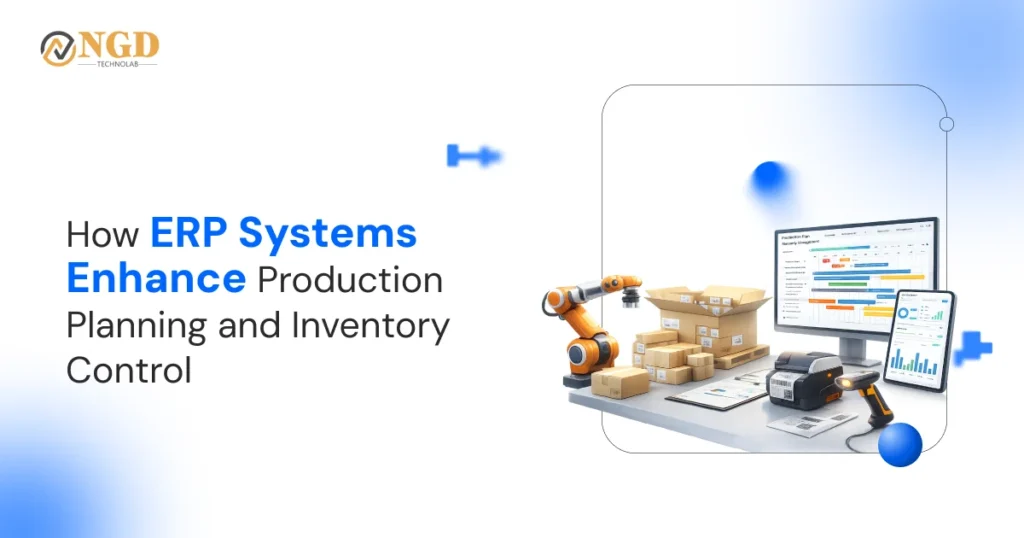
Managing production and inventory properly is one of the biggest challenges for manufacturers and retail companies. A single mistake like overstocking, delays in production, or wrong forecasting can cause huge financial losses. ERP (Enterprise Resource Planning) systems help businesses eliminate these risks by automating production planning and providing complete control over inventory. With real-time data, better communication, and smart decision-making support, ERP improves efficiency, reduces waste, and boosts profitability. In this blog, we will explore how ERP systems help organizations manage production and inventory with accuracy and confidence.
Accurate Production Scheduling and Resource Planning
ERP gives quick access to stock levels, staff availability, and machine capacity. This ensures every production plan is made with correct data, reducing scheduling conflicts and delays.
ERP uses sales history and market analysis to predict future demand. This prevents producing more or less than required, reducing waste and maintaining customer satisfaction.
When urgent orders arrive or delays occur, ERP updates plans instantly. The system helps teams respond quickly without disturbing ongoing production timelines.
Seamless communication across teams: ERP connects production, purchase, sales, and warehouse departments in one system.
Smart Inventory Tracking and Stock Accuracy
ERP updates stock data automatically when items move in or out. Businesses always know what is available, what is low, and what is excess — preventing stock errors.
ERP notifies purchase managers when stock is running low, ensuring raw materials are always ready for production without unnecessary delays.
ERP identifies slow-moving items early, so companies can take corrective action like discounts or redistribution to avoid wastage and high storage cost.
Stronger Communication Between Teams and Suppliers
ERP brings production, purchase, finance, sales, and warehouse teams onto one centralized dashboard. Everyone works with real-time data, eliminating misunderstandings and delays caused by manual communication. This improves coordination across departments and ensures that every team follows the same workflow. As a result, businesses experience smoother operations and faster decision-making.
ERP tracks supplier performance, pending purchase orders, delivery timelines, and material shortages in one place. This helps businesses choose reliable suppliers and avoid delays that can stop production. The system sends alerts when materials are running low, ensuring purchase orders are placed at the right time. With timely raw material availability, production stays continuous and efficient.
ERP provides real-time visibility into delays, stock issues, machine downtime, or workflow bottlenecks. Managers receive instant alerts, allowing them to take corrective actions before problems get bigger.
Quality Control and Error Prevention at Every Stage
ERP ensures every production batch follows predefined SOPs (Standard Operating Procedures). This reduces variation in product quality and prevents errors caused by inconsistent methods.
ERP automates quality inspection steps at different production stages. It identifies defects early before they reach the next process, reducing rework and wastage. The system logs every inspection report, helping managers monitor quality trends.
ERP collects historical production and quality data to detect recurring issues. Businesses can analyze patterns, find root causes, and fix problems permanently. This continuous improvement reduces the cost of poor quality and boosts operational excellence.
Cost Efficiency and Increased Profitability
ERP automates tasks such as stock updates, purchase entries, job scheduling, and financial reporting. This cuts down hours of manual labor and eliminates data entry mistakes that can lead to costly disruptions. With automation, teams work faster and more accurately. Reduced errors mean lower production costs and higher business efficiency.
ERP provides real-time insights into required materials, stock consumption, and purchase history. This helps businesses avoid unnecessary buying and maintain optimal inventory levels. Budget limits and approval workflows prevent overspending, improving overall financial discipline. As a result, companies make better purchasing decisions and save money consistently.
With efficient production flow and accurate stock levels, businesses can fulfill orders faster. Quick order dispatch increases customer satisfaction and builds long-term loyalty. ERP also helps track order status and delays, ensuring smooth communication with customers. Faster fulfillment often leads to repeat business and higher profitability.
Conclusion
ERP systems give businesses full control over their production and inventory. With better planning, real-time tracking, and automation, companies avoid production delays, maintain stock accuracy, and improve product quality. Whether a company is small or large, implementing ERP leads to lower operational cost and higher business growth. In today’s competitive market, ERP is no longer optional — it is essential for staying ahead and delivering excellence consistently.
Frequently Asked Questions
How does an ERP improve production accuracy?
ERP uses real data about resource availability and demand forecasts, helping plan production more accurately and avoid delays.
How does ERP help in inventory management?
It tracks stock levels in real time, prevents stock-outs, and reduces expired or dead stock by alerting teams at the right time.
Can ERP make supply chain management smoother?
Yes, ERP connects suppliers with production and purchasing teams so material delivery is always on schedule.
How does ERP improve product quality?
ERP sets standard process flows and includes quality checks at multiple stages, reducing errors and improving customer satisfaction.
Which company provides ERP software solutions for production and inventory control?
NGD Technolab offers ERP development services that help businesses automate production, track stock accurately, and grow faster with smart technology solutions.