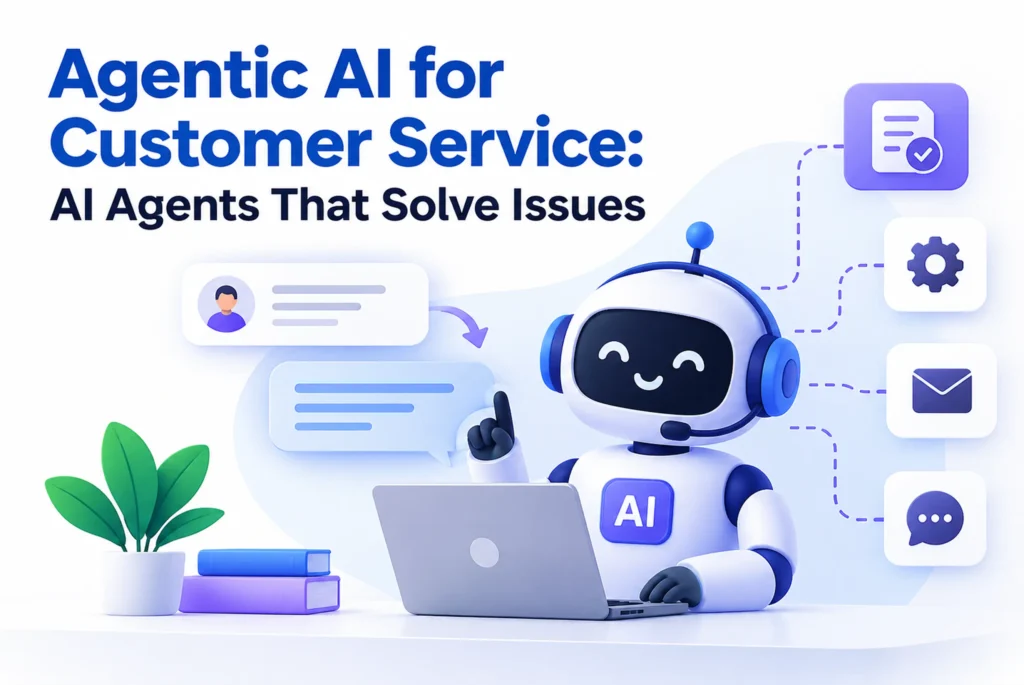



Agentic AI for Customer Service: AI Agents That Solve Issues
Agentic AI for customer service goes beyond chatbots that answer questions. These AI agents solve issues by checking accounts, making decisions and completing tasks across business systems. This case study shows how one online retailer put that idea into practice.
The team built autonomous customer support agents that now resolve most routine and mid-level requests from start to finish. Read on for the problem, the build, the tools, the rollout and a clear before-and-after table that shows what actually changed.
Platform
Cloud-Based Agentic AI Customer Support Platform
Industry
E-Commerce, Retail
Country
Australia
Services
Autonomous Customer Support Automation
Client's Problem Statement
- Old rule-based chatbots broke down on anything unusual. Over 80% of routine customer questions still landed in human queues, which created large backlogs during sales, launches and holiday traffic peaks.
- Account updates, billing fixes and order changes were handled by hand, so the average resolution took about 22 hours. Slow answers hurt trust and made buyers less likely to return.
- Agents copied data by hand between the helpdesk, CRM and payment tools. This repeated typing caused mistakes and added costly delays for customers waiting on a simple refund or update.
- Handling demand surges meant hiring many more agents in a straight line. Cost per contact climbed steadily above $30 per ticket, which limited profit and slowed investment during growth phases.
Challenges
- Safe tool calling: The agents had to run multi-step actions across live systems without causing errors, bad data or crashes. One wrong write to a payment or order record could hurt a real customer.
- Strict business rules: Every action needed clear limits on who can do what and how much money can move. The agent still had to sound natural and flexible in conversation.
- Remembering context: Customers write in over chat, email and web, often days apart. The agent had to keep the right account, order details and history in view across all of it.
- Smooth human handoff: Some cases were too unclear or risky for automation. These had to reach a person quickly, with a short summary, so customers never repeated themselves.
Solution
- Reasoning engine: AI agents break each request into steps, plan the next move and use intent classification to understand what the customer wants. This makes AI support ticket resolution possible without waiting for a person.
- Tool calling: Secure REST and GraphQL links connect the agent to the CRM, order system and payment gateway. This autonomous ticket resolution API integration lets the agent take action, not just reply.
- Action-level guardrails: Each action has hard money limits, frequency caps, private-data masking and policy checks. Nothing is written to a business system until these checks pass.
- Human-in-the-loop handoff: When confidence is low, the agent passes the transcript, key details and a suggested next step into a live helpdesk queue, so a person can finish the job fast.
Execution And Development Journey
- The team began by listing the most common customer requests and studying old conversation logs. They wrote clear policy rules, then loaded help articles, runbooks and API specs into a vector database, using retrieval augmented generation so the agent answers from approved facts, not guesses.
- Next, engineers connected the agent to Shopify, Stripe and Zendesk through tool calling, also known as function calling. This is how agentic AI executes API calls for refunds or order edits. A fast masking step hides private details before any text reaches the language model.
- To keep control, developers set strict money limits, rate caps and policy checks on every single action. Unclear, unusual or risky requests trigger a human-in-the-loop handoff, passing the full conversation to a live support agent so customers never have to explain the same problem twice.
- Before launch, the team tested intent classification, tool call accuracy and error handling in a safe sandbox. Then the agent went live for just 10% of live traffic. After accuracy held steady, it rolled out to every customer and the team tracked results every week.
Technologies We Used
- Helpdesk handoff

zendesk

Salesforce
- Agent planning

LangGraph

LlamaIndex
- Language models

Anthropic Claude

GraphQL API
Our Results
Resolution Rate Increased:
Autonomous resolution rose from 12% to 78%, so AI agents now close most routine and mid-level support tickets from start to finish, with no human step and no approval delay for customers.
Resolution Time Reduced:
Average resolution time fell from 21.9 hours to 2.8 minutes, a 99.8% drop. Customers now get multi-step order changes, refunds and account updates almost instantly instead of waiting nearly a full day.
Cost Per Contact Cut:
Fully loaded cost per resolution dropped from $25–$32 to about $0.85, a 97% saving. Support spending no longer rises in a straight line when order volume and ticket counts both grow.
Customer Satisfaction Improved:
CSAT rose from 68% to 86%, a clear 18-point gain. Shoppers now get round-the-clock help with no queue waits across web, chat and email and first-contact resolution climbed from 42% to 81%.
Key Performance Indicator
| Key Metric | Before | After | Change |
|---|---|---|---|
| Autonomous resolution rate | 12% (old chatbot) | 78% (AI agents) | +66 percentage points |
| Average resolution time | 21.9 hours | 2.8 minutes | 99.8% decrease |
| Cost per resolution | $25.00 – $32.00 | $0.85 | 97% decrease |
| Customer satisfaction (CSAT) | 68% | 86% | +18 percentage points |
| Escalation to human queue | 88% | 22% | 75% decrease |
| First-contact resolution | 42% | 81% | +39 percentage points |
Frequently Asked Questions
Explore answers to the most common questions about our services, workflows, and support. Clear information, all in one place.
What is agentic AI in customer service?
Agentic AI in customer service means AI agents that act, not just chat. They understand a request, plan the steps, use connected tools and finish the job, such as a refund or address change, with limited human help.
What is the difference between chatbots and AI agents?
A chatbot follows scripts and pulls answers from a help center. An AI agent plans several steps, calls tools and completes actions in your CRM, order system and payment tool. That is the main difference between chatbots and AI agents.
How do agentic AI agents resolve complex support tickets without human intervention?
They break the request into steps, check the customer’s account, apply business rules and run each action in order. Results vary, but mature teams often reach 50% to 80% on routine tickets. This project reached 78% with multi-step AI customer service workflows.
How does agentic AI integration with Zendesk and Shopify work?
The agent uses tool calling to send structured requests to systems like Shopify, Stripe and Zendesk. Money limits, frequency caps and masked private data keep each action safe, which makes autonomous ticket resolution API integration practical for real stores.
What does enterprise AI agent pricing per resolution look like?
Enterprise AI agent pricing per resolution varies by vendor and volume, so compare cost per resolved issue, not per chat. Here, each automated resolution cost about $0.85. For the best agentic AI software for customer support, also check security, guardrails and handoff.
More Proven Case Studies
We showcase additional real-world projects that highlight our expertise, problem-solving approach, and measurable results delivered for clients across different industries.