


Ecommerce Returns Automation: Faster Refunds, Fewer Tickets
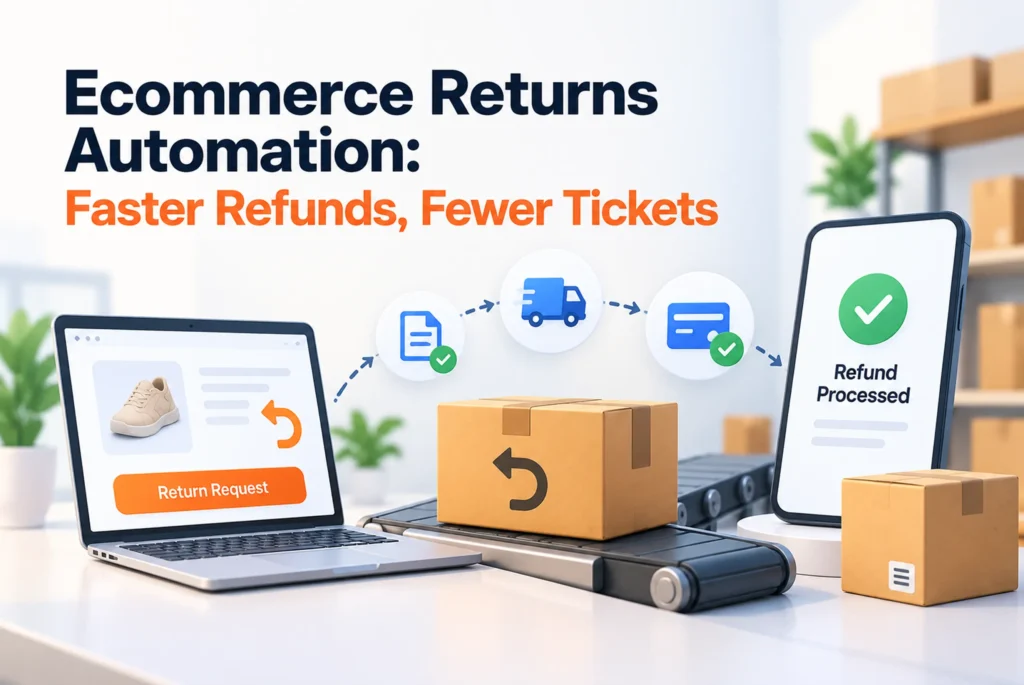
Ecommerce returns automation replaces slow, manual return handling with a self service return portal, clear rules and connected systems. This case study shows how one online brand built an automated refund system that cut support tickets and sped up refunds.
Returns are a big deal online. The NRF expects 19.3% of online sales to come back in 2025 and 76% of shoppers prefer instant refunds or exchanges. Below, we show how reverse logistics automation helped the brand meet that demand.
Platform
Cloud-Based E-Commerce Returns
Industry
E-Commerce, Retail, Reverse Logistics
Country
United States
Services
Self-Service Return Portal Development
Client's Problem Statement
- Support agents spent over twenty minutes on each return request, answering status questions and fixing refunds by hand. Queues kept growing, leaving the team little time for other customer needs.
- Refunds took eight to fourteen days to arrive. Customers waited, got frustrated, and wrote asking where their money was, which created more tickets and weakened repeat buying after a return.
- The helpdesk, warehouse team and payment gateway did not share data. Staff re-keyed details by hand, which caused wrong payouts and uneven policy decisions from one sales channel to another.
- Without any tools to check claims, the store lost real money every month to fake returns, items that never came back and return shipping fees that were waived by mistake.
Challenges
- Disconnected systems: The older warehouse management system (WMS) and ERP had to talk to the helpdesk without delays or mismatched data. Reliable WMS sync was the base for everything else.
- Complex return rules: Policies change by product type, country, discount level and partial orders. Each rule had to run on its own and follow ecommerce return policy best practices.
- Return fraud detection: The system had to catch sudden return spikes, empty boxes and swapped items before any money went out. NRF data says about 9% of returns are fraudulent, so the risk is real.
- Getting shoppers to switch: Customers were used to emailing support. They needed to trust the new portal enough to use it without hurting customer satisfaction (CSAT) scores.
Solution
- Self service return portal: A mobile-friendly portal lets shoppers find orders, start returns, get paperless QR code labels and track shipments at any hour, with no agent involved.
- Rules engine for automated return merchandise authorization: A configurable engine checks purchase age, SKU category, customer history and fraud signals, then approves or flags each return merchandise authorization.
- Two-way API setup: Webhooks link the Shopify store, warehouse, helpdesk and payment gateway API. This ecommerce refund API integration, along with carrier label generation, triggers refunds the moment an item is scanned.
- Instant exchange and store credit: Before a label is created, shoppers see size or color swaps and store credit offers, which gives them a reason to keep the order.
Execution And Development Journey
- The began by auditing current return times, regular return reasons and existing order steps. Next, developers built one central, rule-based policy engine. It checks return windows, order values, product categories and customer account tiers, so support agents no longer approve routine returns by hand.
- After that, the team launched the branded portal, which gives shoppers instant return approval, QR code shipping labels and exchange ideas. Deep REST API links joined the portal to Shopify, the warehouse system and payment processors, so each action updated every connected tool at once.
- AI support agents then took over everyday customer questions, giving status updates and starting refunds on their own. Fraud checks looked at return speed, order age, buying history and product category risk and quickly sent odd cases straight to a human support manager for review.
- Before full launch, the team ran A/B tests on exchange flows, webhook reliability and warehouse receipt alerts. Real-time webhooks plus an hourly reconciliation job kept stock counts right after returns, stopped duplicate refunds, and kept accounting, support, and inventory data matching across all three systems.
Technologies We Used
- Self-service portal

React.js

TypeScript

- Policy engine

Node.js

Python
- Reverse logistics

DHL carrier APIs

FedEx
Our Results
Support Tickets Reduced:
Inbound tickets fell by 80% as the portal and tracking alerts answered receipt, approval and refund status questions, cutting where is my refund tickets in Shopify and freeing agents for harder cases.
Refund Speed Improved:
Average refund time dropped from 8.3 days to 2.7 days. Faster payouts built trust and 71% of shoppers bought again within sixty days of finishing a return, a sign of stronger CSAT.
Handling Time Improved:
Manual work per return dropped by 90%, from around twenty-two minutes to under two minutes for routine automatic approvals and about six minutes for exception cases that agents still review by hand.
Revenue Retained:
Instant exchange flows turned 40% of return requests into replacement orders instead of refunds. This protected sales, lowered net refund payouts, and kept customers shopping across the brand’s large, busy direct-to-consumer product catalog.
Key Performance Indicator
| Metric | Before (Manual) | After (Automated) | Impact |
|---|---|---|---|
| Return handling time | 22–28 minutes per request | Under 2 minutes (6 for exceptions) | 90% decrease |
| Time to issue a refund | 8.3 days (7–14 range) | 2.7 days (2–5 range) | 67% decrease |
| Monthly return support tickets | 100% baseline | 20% of baseline | 80% decrease |
| 60-day repeat purchase after a return | 29%–41% | 67%–72% | 76% relative increase |
| Returns converted to exchanges | 0% (refund by default) | 40% | +40 percentage points |
| Partial refund calculation | 8–15 minutes per bundle | Under 30 seconds | 97% decrease |
| Fraudulent claims caught | Under 15% | Over 85% | 5x+ more caught |
Frequently Asked Questions
Explore answers to the most common questions about our services, workflows, and support. Clear information, all in one place.
What is ecommerce returns automation?
It is the use of software to handle return steps without staff doing each one by hand. That covers return requests, approvals, label creation, warehouse updates and refunds. A return merchandise authorization (RMA) is simply the approval that lets a customer send an item back.
How do you automate ecommerce refunds?
Start with clear return rules, then connect your store, warehouse and payment gateway API. The system approves eligible returns, creates the label and triggers the refund once the warehouse scans the item. Staff only review unusual or high-risk cases.
How does returns automation reduce ecommerce support tickets?
Most return tickets are status questions, like “where is my refund?” A self service return portal with live tracking and automatic updates answers these before they reach an agent. In this case study, that change cut support tickets by 80%.
How long does an automated refund take to reach the every customer?
In this case study, the store issued refunds in about 2.7 days. Banks add time on top of that. Stripe says card refunds usually appear on a customer’s statement 5 to 10 business days after they are issued, so tell shoppers both timelines.
Can returns automation help stop return fraud?
Yes, in part. The NRF and Happy Returns 2025 report found that about 9% of returns are fraudulent, and 85% of retailers use AI to detect or prevent it. Rules that flag return spikes, empty boxes and swapped items help and staff review whatever gets flagged.
More Proven Case Studies
We showcase additional real-world projects that highlight our expertise, problem-solving approach, and measurable results delivered for clients across different industries.