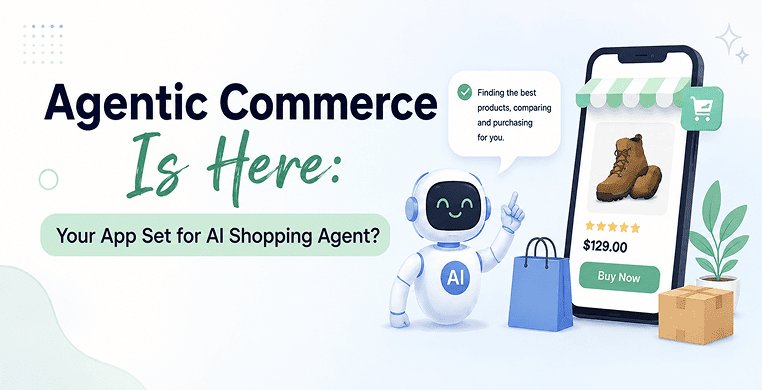
Somewhere between a customer typing “best waterproof hiking boots under $150” into ChatGPT and an AI agent actually comparing, selecting and buying those boots on their behalf, e-commerce quietly changed shape. That gap is closing fast and most storefronts still aren’t built for what’s on the other side of it.
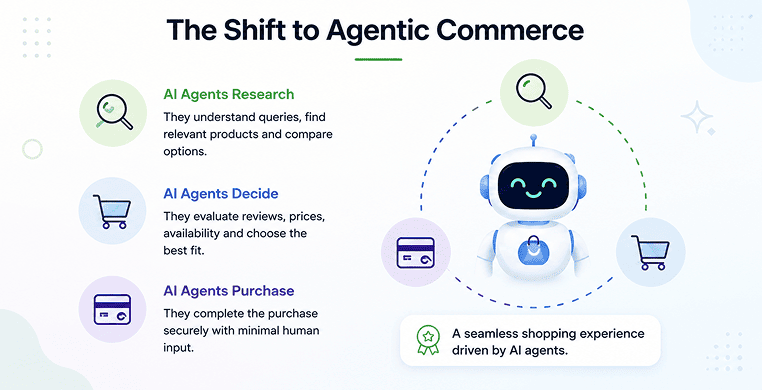
Agentic commerce is what happens when AI agents don’t just help people find products — they research, compare and complete purchases with minimal human input at each step. It’s no longer a future scenario. Google, OpenAI, Shopify and a coalition of major retailers have already shipped the infrastructure for it.
The question for any app or online store right now isn’t whether this shift is coming. It’s whether your product data, checkout flow and analytics stack are actually visible to the agents doing the shopping.
The Numbers Behind the Shift
The scale here is hard to overstate. McKinsey estimates agentic commerce could mediate $3 trillion to $5 trillion in global consumer spending by 2030, with as much as $1 trillion of that in orchestrated U.S. retail revenue alone.
Consumer behavior is already moving in that direction — Adobe Analytics tracked an 805% year-over-year jump in AI-referred traffic to U.S. retail sites on Black Friday 2025, and Salesforce found that roughly 20% of all online orders during Cyber Week 2025 were associated with AI tools or agents.
That’s not a niche behavior anymore. Assistants like ChatGPT, Google’s AI Mode, Amazon’s Rufus and Perplexity have moved from answering shopping questions to actively driving purchase decisions. For merchants and app developers, that means product visibility increasingly depends on whether an AI agent can read and trust your data — not just whether a human can browse your site.
Two Protocols, One Fast-Moving Landscape: UCP vs. ACP
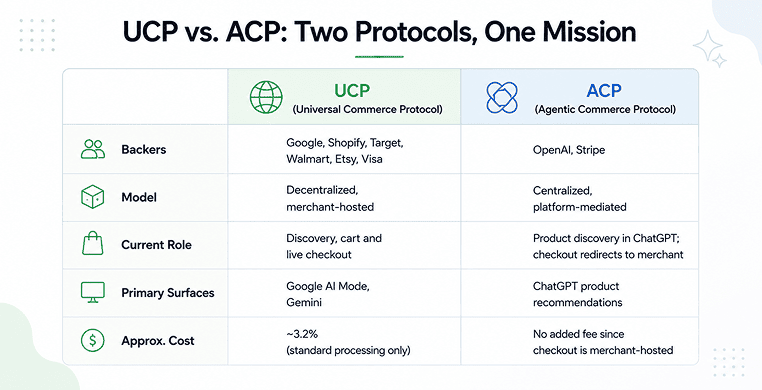
Right now, two competing standards define how agents actually talk to storefronts.
Universal Commerce Protocol (UCP), developed by Google alongside Shopify, Target, Etsy, Walmart and more than 20 other companies, is a decentralized, open standard. Merchants host a manifest file at /.well-known/ucp on their own domain and agents pull live inventory, pricing and order data directly from that endpoint.
UCP covers the full commerce lifecycle — discovery, cart, checkout and post-purchase support — and settles payments through Google Pay via the Agent Payments Protocol (AP2), with no added platform fee beyond standard processing costs of roughly 3.2%.
Agentic Commerce Protocol (ACP), built by OpenAI and Stripe, takes a more centralized approach. Merchants sync a product catalog feed to OpenAI’s infrastructure and Stripe handles payment authorization through a Shared Payment Token so agents never touch raw card details.
Here’s the part worth getting right: ACP originally powered “Instant Checkout,” letting ChatGPT users complete a purchase without leaving the chat. OpenAI shut that specific feature down in March 2026, about six months after launch, citing limited flexibility and low merchant adoption — only a handful of retailers had gone live with it.
ACP itself didn’t disappear; it now functions primarily as a product discovery and recommendation layer inside ChatGPT, with checkout handed back to the merchant’s own site. UCP, by contrast, went live with real in-protocol checkout at several major U.S. retailers in May 2026 and is the standard currently powering agentic transactions inside Google’s AI Mode and Gemini.
The practical takeaway: UCP is the protocol actually completing transactions today, while ACP remains valuable for getting your products surfaced and recommended inside ChatGPT’s enormous user base, even without in-chat checkout.
Merchants running both tend to see meaningfully higher agent-referred traffic than those supporting only one, since each protocol reaches a different discovery surface.
| UCP (Universal Commerce Protocol) | ACP (Agentic Commerce Protocol) | |
|---|---|---|
| Backers | Google, Shopify, Target, Walmart, Etsy, Visa | OpenAI, Stripe |
| Model | Decentralized, merchant-hosted | Centralized, platform-mediated |
| Current role | Discovery, cart and live checkout | Product discovery in ChatGPT; checkout redirects to merchant |
| Primary surfaces | Google AI Mode, Gemini | ChatGPT product recommendations |
| Approximate cost | ~3.2% (standard processing only) | No added fee since checkout is merchant-hosted |
What "AI-Ready" Actually Means for Your Storefront
Preparing a storefront for AI shopping agents comes down to four practical layers:
1. Clean, machine-readable product data: Full JSON-LD schema markup — Product, Offer, MerchantReturnPolicy, AggregateRating — following Schema.org standards with plain-language attributes and stable identifiers like GTINs or MPNs. Vague marketing copy doesn’t parse well for an agent trying to compare specs.
2. A published UCP manifest: Hosting a profile at /.well-known/ucp exposes your cart, discounting and fulfillment capabilities to agents scanning for compatible merchants.
3. Secure identity linking: OAuth 2.0 with PKCE (using S256 hashing) lets an agent carry a shopper’s saved addresses and loyalty pricing into a session without exposing raw credentials.
4. Delegated payment support: Frameworks like AP2 let an agent complete a purchase within spending limits the user has explicitly set, rather than requiring a human to approve every transaction manually.
None of this is exotic engineering. It’s largely an extension of structured data and authentication practices most teams already have in some form — just made explicit and machine-readable rather than buried in a product description paragraph.
Why Your Analytics Dashboard Is Lying to You
Here’s a problem most teams haven’t caught yet: AI shopping agents mostly don’t show up in standard web analytics. Retrieval-Augmented Generation (RAG) bots — GPTBot, OAI-SearchBot, ChatGPT-User, Claude-Web, PerplexityBot — fetch product data directly from your pages or manifest endpoints, often without executing client-side JavaScript or triggering the tracking scripts your analytics platform relies on.
Reported click-through rates to originating storefronts from AI answers run under 1%, meaning your dashboard could be missing thousands of AI evaluations of your products every week.
The fix is server-log analytics that explicitly track these bot user-agents, log manifest hit rates and monitor how often your catalog gets pulled into agent responses. It’s the only way to see whether you’re actually part of the AI consideration set, well before that shows up in any sales number.
Getting Cited, Not Just Crawled
Traditional SEO optimizes for ranking in ten blue links. Generative Engine Optimization (GEO) and Answer Engine Optimization (AEO) optimize for something more binary — either an AI system cites your product in its answer or it recommends a competitor’s.
That depends on clear entity definitions at the top of content sections, consistent data across your product feed and landing pages and structured comparisons AI systems can lift cleanly. A mismatch between your promotional feed and your on-page schema — inconsistent pricing, a missing return policy, a stale GTIN — can quietly drop your products out of AI recommendations with no error message in any dashboard.
This kind of “silent feed disapproval” is now becoming one of the more frequent reasons a merchant loses their AI visibility without the merchant ever knowing why.
Where to Start
If you’re building this out for the first time, sequence matters more than trying to do everything at once. Start with structured data hygiene — accurate JSON-LD schema and stable product identifiers — since every downstream protocol depends on it.
Loved What You Just Read?
Let's Build Something Just as Great — For Your Business.
From web & mobile apps to UI/UX, AI solutions, and digital marketing — NGD Technolab turns ideas into scalable, real-world products. 14+ years, 550+ projects, one team you can rely on.
Then publish a UCP manifest, since it’s currently the standard actually completing agent-driven transactions. From there, layer in ACP support for ChatGPT discovery, set up server-side bot tracking so you can see agent activity your dashboard is currently missing, and revisit your product feed regularly for entity mismatches.
Agentic commerce isn’t a single feature to ship — it’s an ongoing discipline of keeping your data trustworthy enough for a machine to act on it.
Conclusion
The shift toward agentic commerce didn’t arrive with a single dramatic launch — it arrived through a string of protocol releases, quiet feature retirements and a steady climb in AI-referred shopping traffic that most teams only noticed after the fact. What’s clear now is that the agents are already browsing, comparing and in growing numbers, buying.
Whether your products show up in those decisions comes down to unglamorous groundwork: clean structured data, a published manifest and analytics that can actually see the traffic that matters. The apps and storefronts that handle that groundwork now won’t need to scramble later.
Frequently Asked Questions
What is agentic commerce?
Agentic commerce is a shopping model where AI agents research, compare and complete purchases on behalf of a user with minimal manual input at each step. Instead of a person clicking through search results and a checkout flow, an AI shopping agent handles discovery and increasingly, the transaction itself, working within limits the user has set in advance.
Exactly what is the differences between UCP and ACP?
UCP (Universal Commerce Protocol), backed by Google, Shopify and a coalition of retailers, is a decentralized standard where merchants host their own data at a /.well-known/ucp endpoint, letting any compatible agent pull live inventory and complete checkout directly. ACP (Agentic Commerce Protocol), built by OpenAI and Stripe, is centralized around ChatGPT: merchants sync a product feed to OpenAI’s platform. Since OpenAI retired ACP’s in-chat checkout feature in March 2026, ACP now functions mainly as a discovery and recommendation layer, with the actual purchase completed on the merchant’s own site.
Does ChatGPT still let you buy things without leaving the chat?
Not anymore, in the way it originally did. OpenAI shut down Instant Checkout in March 2026, about six months after launch, citing limited flexibility and low merchant adoption. ChatGPT still surfaces product recommendations and comparisons through ACP, but users are now redirected to the merchant’s own checkout to complete a purchase, rather than paying inside the conversation.
How do I make my e-commerce app ready for AI shopping agents?
Start with clean, machine-readable product data using JSON-LD schema markup and stable identifiers like GTINs, then publish a UCP manifest at /.well-known/ucp so agents can discover your inventory and capabilities directly. From there, add secure identity linking through OAuth 2.0 with PKCE, support delegated payments through a framework like AP2 and set up server-log analytics to track AI bot traffic your standard dashboard is likely missing.
Why doesn't my analytics dashboard show AI shopping agent traffic?
Most AI shopping bots — including GPTBot, ChatGPT-User, Claude-Web and PerplexityBot — fetch product data directly from your pages or manifest endpoints without executing the client-side JavaScript that standard analytics tools rely on to log a visit. That means an agent can evaluate your products dozens of times without ever appearing as a session in your dashboard. Tracking these bots requires server-log analytics that specifically monitor their user-agent strings and endpoint hit rates, separate from your normal traffic reporting.