Every time an employee pastes a client contract, a patient record or a chunk of source code into a public AI chatbot, that data leaves the company’s control. Recent research on enterprise AI use found that sensitive information now makes up roughly a third of what employees paste into tools like ChatGPT, up from about 11% just two years ago.
That’s not a hypothetical risk anymore — it’s a daily occurrence happening across most large organizations, often without IT ever finding out. Private AI for enterprise exists to close that gap. Instead of routing company data through a shared, public model, private AI runs inside an environment the business itself controls.
This article explains what that actually looks like in practice, why it matters for compliance and security, and how to think about deployment if your organization is evaluating the switch.
Why Public AI Tools Create Real Security Exposure
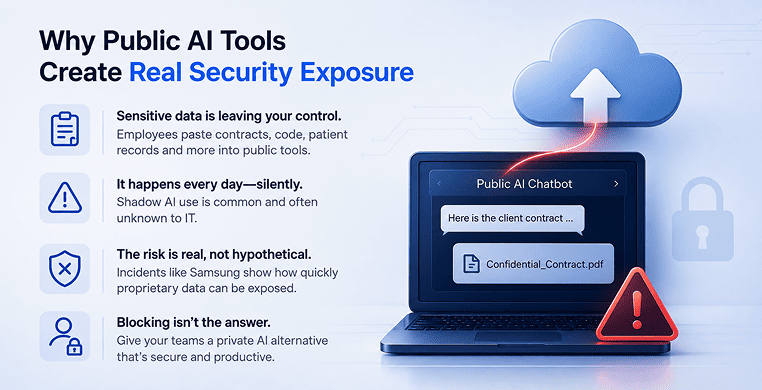
Public generative AI platforms are built for scale, not confidentiality. Prompts typically pass through shared infrastructure and depending on the account tier, that input can be logged, reviewed or used to improve future versions of the model.
For a consumer asking about recipe substitutions, that’s a minor concern. For a company handling regulated health records, financial statements or unreleased product designs, it’s a direct liability.
The Samsung Semiconductor incident from 2023 is still one of the clearest examples of how this plays out. Within a single month, engineers pasted proprietary source code, internal meeting notes and equipment measurement data into ChatGPT while trying to solve problems faster. None of it was malicious.
All of it left the company’s infrastructure the moment it was submitted. Samsung banned the tool company-wide shortly after and several major banks followed with similar restrictions.
This kind of accidental exposure is now common enough that it has its own category in enterprise security planning: shadow AI, meaning AI use that happens outside sanctioned tools and outside IT’s visibility.
Blocking public AI outright isn’t a realistic answer, since the productivity gains are too significant to ignore. The more durable fix is giving employees a private alternative that offers the same convenience without the exposure.
What "Private AI" Actually Means
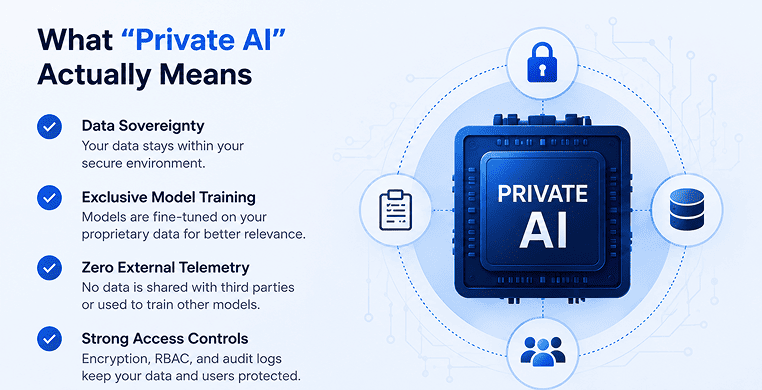
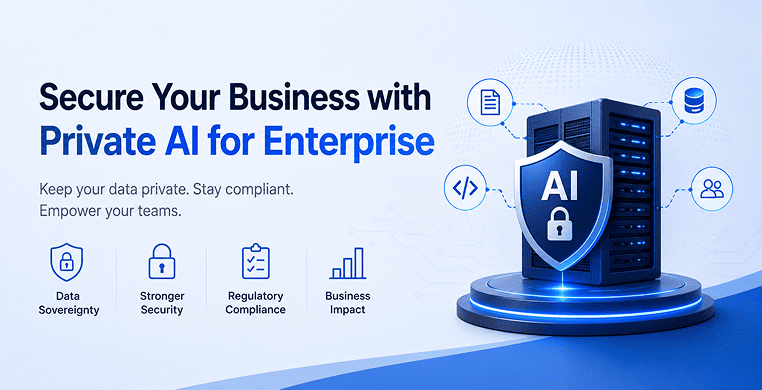
Private AI for enterprise is a dedicated computing environment where AI models are trained, fine-tuned, and operated exclusively for one organization, using that organization’s own infrastructure and data. Nothing about a prompt, a document or a model output is shared with an outside vendor’s shared systems or used to train models for other customers.
That definition matters because “private” gets used loosely in marketing materials. A vendor offering a slightly more expensive subscription tier isn’t the same as a true private deployment. The distinction comes down to a handful of architectural choices:
- Data sovereignty: The company retains full ownership and control over where data lives and who can access it. Nothing leaves the organization’s secure boundary.
- Exclusive model training or fine-tuning: Base models are adapted using the company’s own proprietary data rather than general public data, which also tends to make outputs more relevant to that company’s actual work.
- Zero external telemetry: No calls back to a third-party vendor, no usage data siphoned off for analytics the company didn’t approve.
- Strong access controls: Encryption in transit and at rest, role-based access control (RBAC), and continuous audit logging so security teams can see exactly who touched what.
None of these are exotic ideas — they’re the same principles that already govern how enterprises handle databases and internal applications. Private AI simply extends that standard to AI workloads instead of treating them as a separate, less-controlled category.
Meeting Compliance Requirements Without Guesswork
Regulated industries don’t have the option of treating data handling as an afterthought. GDPR, HIPAA and similar frameworks impose specific requirements on where personal and health data can be processed and who is allowed to see it. Public AI platforms, which often process requests in shared, multi-tenant environments, make it difficult to prove those requirements are being met.
Private AI addresses this by keeping data processing inside infrastructure the company controls and can audit directly. That doesn’t eliminate the compliance work — legal and security teams still need to document data flows, access policies and retention periods — but it removes the fundamental uncertainty of not knowing where a prompt ends up.
It also gives organizations more control over training data, which matters for reducing bias and being able to explain, in concrete terms, how a model reached a given output.
Where Private AI Delivers Measurable Value
The case for private AI looks different depending on the industry, but a few patterns show up repeatedly:
| Industry | Common Use Case | Why Privacy Matters Here |
|---|---|---|
| Healthcare | Summarizing clinical notes, processing electronic health records | Protected Health Information (PHI) can't legally sit in an uncontrolled environment |
| Financial services | Fraud detection, anti-money laundering checks, KYC verification | Transaction and identity data are highly regulated and highly sensitive |
| Legal | Contract review, case research | Privileged client documents can't be exposed to third-party systems |
| Manufacturing | Supply chain and production analysis | Operational data often reveals proprietary process details competitors would want |
In each of these cases, the underlying AI capability isn’t unusual — summarization, pattern detection, document review. What changes is where that processing happens and who can see the data involved.
Choosing a Deployment Model
Private AI isn’t a single product; it’s an architectural approach that can be implemented several ways depending on a company’s size, budget and existing infrastructure.
On-premises deployment keeps everything inside the company’s own data center. This gives the most direct control and is common in industries with strict air-gapped requirements, but it also means the company owns the hardware costs and the maintenance burden.
Virtual Private Cloud (VPC) deployment runs the model in an isolated cloud environment that’s logically separated from other tenants. This is a middle ground: still private, but without the capital expense of physical infrastructure.
Colocation facilities offer dedicated GPU hardware and high-density power in a third-party data center, which can be a practical option for companies that need serious compute without building it themselves.
Newer techniques — homomorphic encryption, secure multi-party computation and trusted execution environments — are also starting to make it possible to run computations on encrypted data without ever exposing the underlying records, even to the systems performing the processing.
These technologies are still maturing, but they point toward a future where “private” and “secure” become close to the same guarantee.
Getting Started
Moving to private AI doesn’t require replacing every AI tool a company already uses. A reasonable starting point looks like this: identify which teams are handling the most sensitive data and highest compliance exposure, pilot a private deployment for one clear use case and use that pilot to build the policy and access-control framework the rest of the organization can follow. Trying to lock everything down at once tends to just push usage back into unsanctioned tools.
Loved What You Just Read?
Let's Build Something Just as Great — For Your Business.
From web & mobile apps to UI/UX, AI solutions, and digital marketing — NGD Technolab turns ideas into scalable, real-world products. 14+ years, 550+ projects, one team you can rely on.
The underlying motivation is simple. Generative AI has become genuinely useful for enterprise work and employees are going to keep using it whether or not there’s a sanctioned option.
The question isn’t whether AI belongs in the business — it’s whether the data behind it stays under the company’s control. Private AI is the architecture that makes that possible without giving up the productivity gains that made AI worth adopting in the first place.
Conclusion
The gap between what AI can do and what a company can safely let it touch is closing fast, and private AI is what closes it. It doesn’t ask a business to choose between using AI and protecting its data — it lets both happen in the same environment, under the same controls the company already trusts for everything else it runs.
For enterprises still weighing whether the switch is worth it, the more honest question is how much longer they can afford to let sensitive data pass through infrastructure they don’t control.
Frequently Asked Questions
What is private AI?
Private AI is an AI deployment where models are trained, fine-tuned and run entirely within an organization’s own infrastructure, instead of on a public vendor’s shared servers. Prompts, outputs and training data stay inside the company’s control, which is the core difference from a standard public AI subscription.
Is private AI more secure than public AI?
Generally yes, because the risk in public AI mostly comes from shared infrastructure and unclear data retention rather than the model itself. Private AI removes that exposure by keeping data within a controlled environment, using role-based access control and encryption the security team manages directly. It doesn’t make a company immune to breaches, but it closes off the most common way sensitive data leaks: employees pasting it into a tool nobody is monitoring.
Can private AI be deployed on-premises?
Yes. On-premises deployment is one of three common models, alongside a Virtual Private Cloud (VPC) or a colocation facility with dedicated hardware. On-premises gives the most direct control and is often required for air-gapped environments, but it also means the company owns the infrastructure cost and upkeep. VPC deployment offers similar isolation with less hardware overhead, which is why many mid-sized enterprises start there.
Does private AI help with GDPR and HIPAA compliance?
Private AI makes compliance easier to demonstrate, though it doesn’t automatically satisfy every requirement on its own. Because data processing stays inside infrastructure the company can audit, security and legal teams can show exactly where data goes and who accessed it — something that’s much harder to prove with a public AI vendor. HIPAA-covered organizations still need to confirm their private deployment meets the same access-logging and encryption standards required for protected health information.
How much does private AI cost compared to public AI tools?
Costs vary widely depending on deployment model. Public AI tools are usually cheaper upfront since there’s no infrastructure to buy, but pricing scales with usage and can grow unpredictably. On-premises or colocation deployments require a larger initial investment in GPU hardware, but many enterprises find the cost becomes more predictable over time, since they’re not paying per-query fees indefinitely. VPC deployment tends to sit in between, offering isolation without the full capital expense of physical infrastructure.