Meera runs a small design studio with four people. Last month, she sat down to check her business card statement and found something strange — twelve small charges, all software, none of them big on their own, but together they added up to more than her office rent.
That’s when she asked the question a lot of business owners ask sooner or later: would it have been cheaper to just buy the software once and own it?
The short answer: cloud subscriptions cost less upfront but often cost more over time, while one-time software costs more upfront but can save you money if you stick with it long enough. The real answer depends on how long you’ll use the tool, how much your team grows, and how much you value flexibility over ownership.
What Do We Really Understand by "Cloud Subscription" and "One-Time Software"?
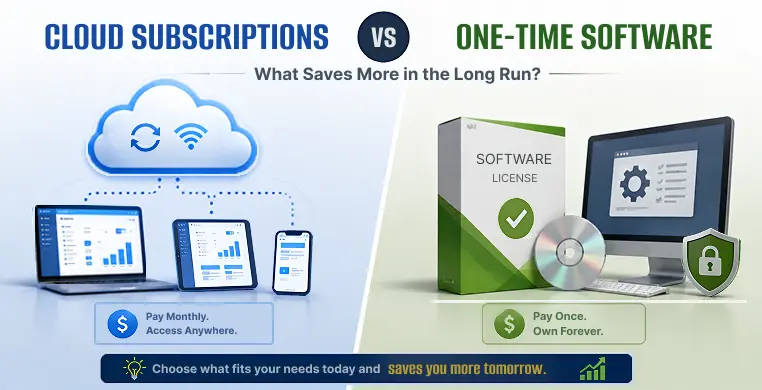
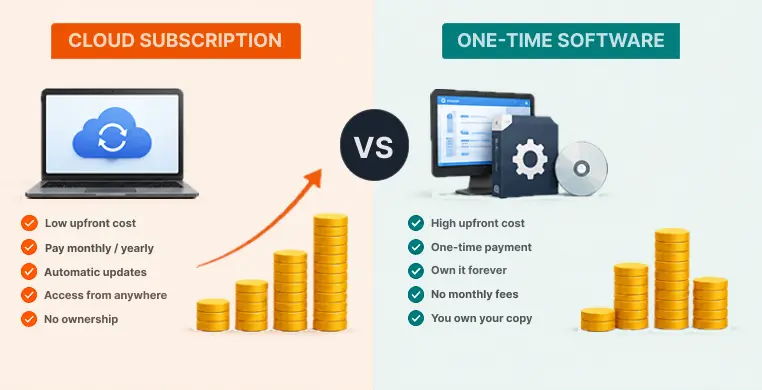
A cloud subscription, often called SaaS (Software as a Service), means you pay a monthly or yearly fee to use software that lives on someone else’s servers. You log in from anywhere, updates happen automatically, and the moment you stop paying, you lose access.
One-time software, sometimes called a perpetual license, works the opposite way. You pay once, install it on your own computer or server, and that version is yours to keep — forever, no matter what happens to the company that made it.
Both are just different ways of answering the same question: do you want to rent the tool, or do you want to own it?
How Cloud Subscription Pricing Really Works
Cloud pricing is built to feel small. A monthly plan, a per-user fee, maybe a “starter” tier that looks harmless. This is exactly why software companies love it — a steady, predictable stream of income, known as recurring revenue, is worth more to them than one big payment upfront.
But this is also where subscription fatigue creeps in. One tool at $15 a month feels fine. Ten tools at $15 a month is $1,800 a year, and most business owners can’t name half of what they’re paying for.
How One-Time Software Pricing Works
One-time software flips the model. You pay a bigger amount upfront — sometimes a few hundred dollars, sometimes a few thousand for business tools — and in exchange, you own that copy outright.
The catch is that future updates or major new versions are sometimes a separate purchase. Support isn’t always included either. But there’s no monthly bill chipping away at your budget, and no risk of losing access if you decide to stop paying for something you already own.
Cloud vs One-Time: A Quick Side-by-Side Look
| Cloud Subscription | One-Time Software | |
|---|---|---|
| Upfront cost | Low | High |
| Long-term cost | Adds up over years | Fixed, one payment |
| Updates | Included automatically | Often a separate cost |
| Access | Anywhere, any device | Usually one machine/server |
| Ownership | You never fully own it | You own your copy |
| Scalability | Easy to add users or features | Harder to scale |
The Real Number to Look At: Total Cost of Ownership
Here’s the thing most people miss: the sticker price isn’t the real price. What actually matters is the Total Cost of Ownership, or TCO — everything you’ll spend across the years you use the software, not just what you pay on day one.
Say a cloud tool costs $30 a month. Over three years, that’s $1,080. A one-time tool with similar features might cost $600 upfront. On paper, the subscription looks cheaper at first glance — but stretch it out, and the one-time option wins by $480, with nothing more to pay after that.
That’s the whole idea behind calculating TCO: add up every payment over the years you’ll realistically use the tool, then compare the totals — not just the first invoice.
When Does a Subscription Start Costing More Than Buying?
Every subscription has a break-even point — the month where your total payments finally cross what a one-time purchase would have cost. Once you’re past that point, every extra month is money you wouldn’t have spent if you’d bought outright.
Using the same numbers from above — $30 a month versus a $600 one-time tool — the break-even point lands at exactly 20 months. Use the software for under 20 months, and the subscription wins. Use it longer than that, and buying outright starts saving you money every month after.
So yes, in a lot of cases, SaaS does end up more expensive than one-time software — just not right away, which is exactly why it’s easy to miss.
The Hidden Costs Both Sides Don't Advertise
Neither option is free of surprises.
By using cloud software, the most significant risk is vendor lock-in. Once your files, workflows, and team are deep inside one platform, switching becomes painful — and vendors know it, which is often when prices quietly rise.
With one-time software, the risk shows up differently. Major upgrades can cost extra, you’re usually responsible for your own backups, and scaling up to a bigger team can mean buying more licenses all over again.
So, Which One Actually Saves More?
Honestly — it depends on how you use it, not just what it costs on day one.
A small, steady business that isn’t changing much often saves more by buying once. A fast-growing team that needs new features, remote access, and constant updates usually comes out ahead with a subscription, even with the recurring cost, because the flexibility is worth it.
A Middle Path: Lifetime Deals and Self-Hosted Options
If neither option feels quite right, there’s a middle ground. Lifetime deals (LTDs) let you pay once for permanent access to a tool, often from smaller, independent software makers looking to fund growth early on. They’re some of the best one-time purchase options if you can find the right one.
Self-hosted software is another route — you run the tool on your own server instead of the vendor’s cloud, trading a bit of setup effort for full control and no recurring bill. It’s worth looking into as a direct alternative to expensive SaaS subscriptions, especially for teams comfortable managing their own tech.
Loved What You Just Read?
Let's Build Something Just as Great — For Your Business.
From web & mobile apps to UI/UX, AI solutions, and digital marketing — NGD Technolab turns ideas into scalable, real-world products. 14+ years, 550+ projects, one team you can rely on.
Quick Checklist Before You Decide
- How long will you actually use this software?
- Will your team grow in the next two to three years?
- Do you need it across multiple devices or locations?
- Can you live without automatic updates?
And if you’re already stuck paying for tools you barely use, the simplest fix is often the most overlooked one: go through your card statement once a quarter and cancel anything you can’t remember opening last month.
Key Takeaways
- Cloud subscriptions cost less to start but add up quietly over the years.
- One-time software costs more on day one but can be cheaper long term if you use it for years.
- Total Cost of Ownership — not just the price tag — is what really decides the winner.
- Subscriptions usually reach the “break-even” point faster than people expect.
- Lifetime deals and self-hosted tools are a middle ground worth checking before you commit.
Conclusion
Meera never found one perfect answer — because there isn’t one. She kept her design software as a one-time purchase since she’d use it for years, but moved her team’s project tracker to a cloud subscription because her team was growing fast and needed access from anywhere.
That’s really the whole lesson here: the cheapest option isn’t the one with the smaller number on the price tag today. It’s the one that matches how long you’ll use it and how much your needs will change. Work that out first, and the rest of the decision gets a lot easier.
Frequently Asked Questions
Is it cheaper to buy software outright or subscribe?
It depends on how long you’ll use it. If you’ll use the software for a few years, buying outright is usually cheaper in the long run. If your needs change often, a subscription can work out better despite the ongoing cost.
How do I calculate the total cost of ownership for SaaS?
Add up every payment you’ll make over the years you plan to use the tool — monthly fees, any extra add-ons, and price increases — then compare that total to what a one-time purchase would cost for the same period.
What is a software subscription vs a perpetual license?
A subscription is a repeating payment for ongoing access, usually to cloud-based software. A perpetual license is a one-time payment that lets you keep and use that version of the software forever.
Why are more software companies moving to subscriptions?
Subscriptions create steady, predictable income for software companies, known as recurring revenue. It’s more stable for their business than relying on one-time purchases alone.
How can I cancel or reduce expensive software subscriptions?
Start by reviewing your card statement for tools you’re paying for but rarely use. Cancel the ones you don’t need, and for the ones you do, check if the company offers a cheaper plan or a one-time alternative before renewing.