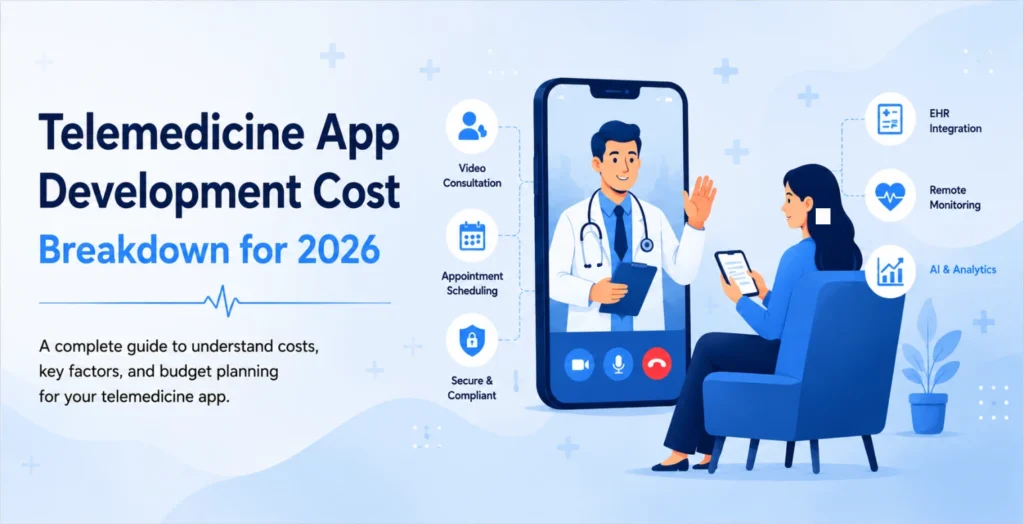
A telemedicine app can cost anywhere from $40,000 for a basic video-consultation platform to well over $500,000 for an AI-driven system with remote monitoring and full EHR connectivity. That range feels almost useless on its own, which is exactly why most cost guides fall short — they hand you a number without explaining what actually moves it.
This one breaks down where the money goes, what regulatory compliance really adds to a budget and how to compare vendor quotes without getting blindsided by hidden costs later.
The stakes for getting this estimate right are higher than they used to be. Physician use of telehealth jumped from 25.1% in 2018 to 71.4% in 2024, according to AMA survey data and virtual care has become a standard delivery channel rather than a pandemic-era workaround.
That growth is why so many health systems, clinics and digital-health startups are now budgeting for custom software instead of renting space on someone else’s platform.
What Actually Determines Telemedicine App Development Cost
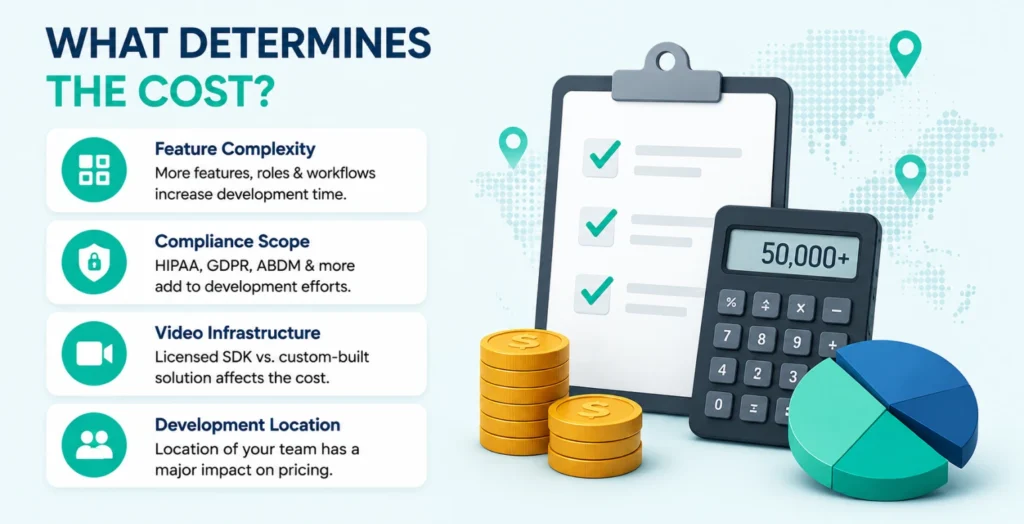
Four variables explain most of the price difference between a $50,000 build and a $400,000 one:
- Feature complexity — how many roles, workflows, and integrations the app supports
- Compliance scope — which regulations apply (HIPAA, GDPR, ABDM or several at once)
- Video infrastructure choice — a licensed SDK versus a custom-built solution
- Development location — where the engineering team is based
None of these operate in isolation. A basic scheduling app built by a US agency can cost more than an AI-powered platform built offshore, simply because location changes the hourly rate so dramatically. Understanding each driver separately makes vendor quotes much easier to evaluate.
Cost by App Complexity
Development budgets scale with what the app is actually expected to do, not just how it looks.
| App Tier | Core Features | Typical Cost | Typical Timeline |
|---|---|---|---|
| Basic MVP | Patient/doctor profiles, video calls, appointment booking | $40,000 – $90,000 | 3–4 months |
| Mid-Tier Platform | E-prescriptions, in-app chat, payments, notifications | $70,000 – $160,000 | 5–7 months |
| Advanced Enterprise | EHR/EMR integration, multi-provider dashboards, insurance verification | $160,000 – $300,000 | 7–10 months |
| AI & RPM Platform | AI symptom triage, wearable sync, predictive analytics | $250,000 – $500,000+ | 10–14 months |
A basic MVP is usually the right starting point for a solo practice or a startup validating demand. Enterprise-tier builds make sense for hospital networks or payers that need the app to plug directly into existing clinical systems from day one — trying to retrofit that later almost always costs more than building it in from the start.
Where the Development Budget Actually Goes
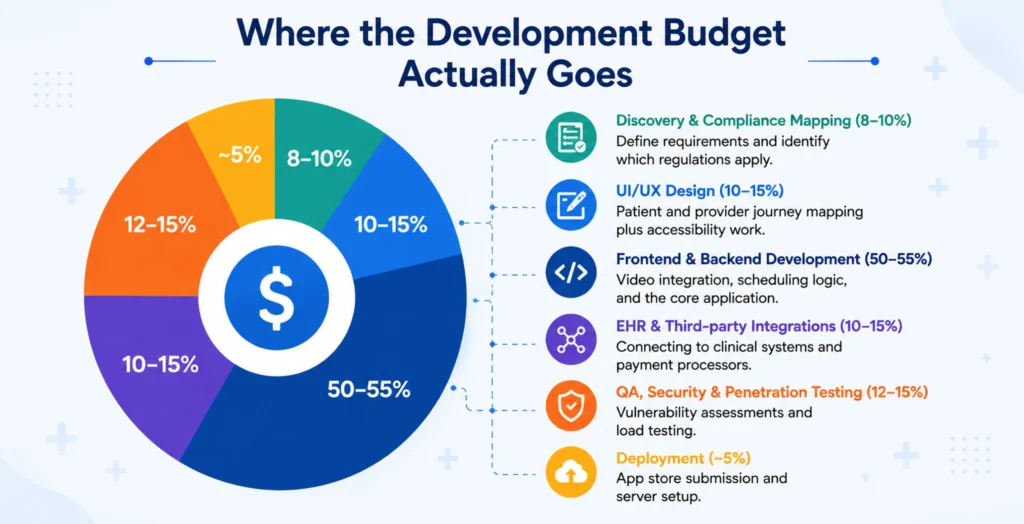
Clients are often surprised that engineering isn’t the only major line item. A realistic budget split looks something like this:
- Discovery and compliance mapping (8–10%) — defining requirements and identifying which regulations apply before writing any code
- UI/UX design (10–15%) — patient and provider journey mapping, plus accessibility work
- Frontend and backend development (50–55%) — video integration, scheduling logic, and the core application
- EHR and third-party integrations (10–15%) — connecting to clinical systems and payment processors
- QA, security, and penetration testing (12–15%) — vulnerability assessments and load testing
- Deployment (roughly 5%) — app store submission and server setup
Skipping or shrinking the QA and compliance line items to save money upfront is one of the most common mistakes in healthcare software projects — problems caught after launch are far more expensive to fix and in a regulated environment they can also trigger legal exposure.
Compliance Costs: The Line Item Most Budgets Underestimate
Healthcare software carries obligations that ordinary consumer apps don’t. In the US, HIPAA governs how patient data is stored, transmitted and accessed. In the EU, GDPR adds its own consent and data-residency rules. India’s ABDM/ABHA framework layers on additional requirements for apps operating there.
Meeting these standards generally means end-to-end encryption, signed Business Associate Agreements with vendors, multi-factor authentication and detailed audit logging — all of which take engineering time to build correctly.
As a rule of thumb, compliance work adds roughly 10–15% to the base development cost. That’s not padding; it’s the price of avoiding a data breach or a regulatory fine that would cost far more than the app itself.
Video Infrastructure: Build vs. License
Every telemedicine app needs real-time video, and there are two paths to get there. Licensing a healthcare-grade SDK such as Twilio or Vonage, gets a working video feature into the app faster and lowers upfront development cost — but it comes with per-minute usage fees that scale with call volume, which adds up over years of operation.
Building on WebRTC instead means a higher initial investment, typically $30,000 to $50,000 just for the video layer, since the team has to handle signaling, connection quality and scaling themselves. The payoff is no recurring per-minute charges.
For a platform expecting heavy call volume long-term, custom WebRTC usually wins on total cost. For a startup that needs to launch quickly and validate the concept first, an SDK is often the more sensible choice.
Regional Developer Rates
Where the development team is based has an outsized effect on the final number, sometimes more than the feature list itself.
| Region | Hourly Rate | Basic MVP | Enterprise Build |
|---|---|---|---|
| North America | $100 – $250 | $120,000 – $190,000 | $250,000 – $500,000+ |
| Western Europe & UK | $90 – $200 | $100,000 – $150,000 | $190,000 – $350,000 |
| Eastern Europe | $50 – $90 | $50,000 – $80,000 | $100,000 – $220,000 |
| Latin America | $40 – $100 | $45,000 – $85,000 | $90,000 – $200,000 |
| Asia / India | $20 – $60 | $30,000 – $55,000 | $65,000 – $150,000 |
Offshore and nearshore teams can cut costs substantially, but the savings only hold up if the vendor has demonstrable experience with healthcare compliance work. A cheaper team that has never built a HIPAA-compliant system will likely cost more in rework than a pricier team that gets it right the first time.
EHR Integration: A Project Within the Project
Connecting a telemedicine app to clinical systems like Epic or Cerner through HL7 FHIR APIs is often treated as a minor add-on, but it behaves more like its own sub-project. Costs typically run $15,000 to $60,000 depending on how much workflow customization and data mapping the integration requires.
Practices planning to connect with hospital systems down the line should scope this early, since retrofitting FHIR compliance into an app that wasn’t built with it in mind is significantly harder than designing for it from the start.
Ongoing Costs Nobody Budgets For at Launch
The initial build is only part of the financial picture. After launch, expect to pay for:
- Cloud hosting, typically $200–$500 a month for standard traffic
- Annual HIPAA risk assessments and security audits
- App store fee renewals and OS compatibility updates
- Continued per-minute video charges, if using a licensed SDK
Industry practice is to set aside 15–20% of the initial build cost every year for maintenance. On a $150,000 app, that’s roughly $22,500 to $30,000 annually — a number that catches a lot of first-time healthcare software buyers off guard because it’s rarely mentioned in the initial sales conversation.
Loved What You Just Read?
Let's Build Something Just as Great — For Your Business.
From web & mobile apps to UI/UX, AI solutions, and digital marketing — NGD Technolab turns ideas into scalable, real-world products. 14+ years, 550+ projects, one team you can rely on.
Getting an Accurate Quote
The most useful thing a buyer can do before requesting proposals is decide, in writing, which compliance frameworks apply, which clinical systems need to connect and whether video will be licensed or custom-built. Vendors quote wildly different numbers for the same vague brief but a specific one narrows the range fast.
Ask any prospective development partner to break their quote down by the categories above — design, core development, integrations, QA and compliance — rather than accepting a single lump sum. A vendor unwilling to itemize costs that way is usually a vendor worth being cautious about.
Conclusion
There’s no single correct number for what a telemedicine app should cost — only a correct number for what your app should cost, based on the features it needs, the regulations it has to meet, and the team building it. Use the tiers and cost drivers above as a starting framework, then check any vendor quote against them line by line.
A proposal that skips compliance detail, glosses over EHR integration or leaves maintenance out entirely isn’t actually a lower price — it’s an incomplete one and the missing costs tend to surface later, at a worse time to deal with them.
Frequently Asked Questions
How much does it cost to build a telemedicine app?
Most telemedicine apps cost between $40,000 and $300,000, depending on features, compliance scope and where the development team is based. A basic MVP with video calls and scheduling sits at the lower end while an enterprise platform with EHR integration and AI features can run well past $300,000.
What factors affect telehealth app development cost the most?
Feature complexity, compliance requirements (HIPAA, GDPR or both) the choice between a licensed video SDK and custom WebRTC, and developer location together account for most of the price difference between projects. Feature scope and location tend to have the largest individual impact.
How much does it cost to build a HIPAA compliant telemedicine app?
HIPAA compliance typically adds 10–15% to a project’s base development cost, covering encryption, access controls, audit logging and Business Associate Agreements. On a $150,000 build, that’s roughly $15,000 to $22,500 in additional compliance-related engineering work.
How long does it take to build a telemedicine app?
Timelines generally run 3–4 months for a basic MVP, 5–7 months for a mid-tier platform and 7–14 months for an advanced or AI-driven enterprise system. Aggressive timeline compression usually increases cost rather than reducing it.
How much does EHR integration cost for a telemedicine app?
Connecting a telemedicine app to systems like Epic or Cerner through HL7 FHIR APIs typically costs $15,000 to $60,000, depending on how much workflow customization and data mapping the integration needs. It’s often scoped as its own sub-project rather than a simple add-on feature.