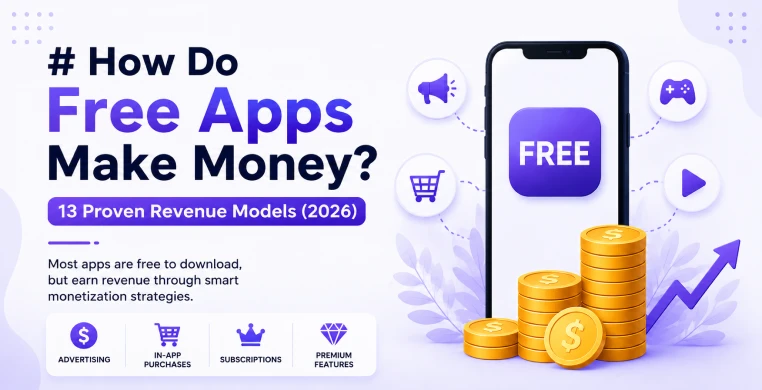
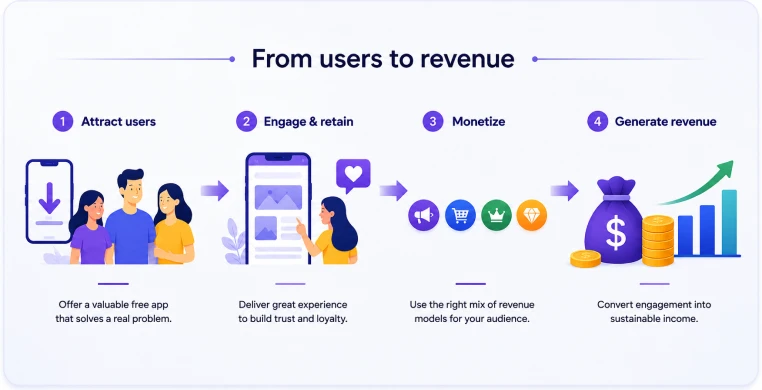
Most apps in the App Store and Google Play cost nothing to download, yet the app economy moves hundreds of billions of dollars a year. That money doesn’t come from download fees. It comes from what happens after the install: ads, purchases, subscriptions, data and a handful of other mechanisms that turn free users into paying revenue.
If you’re building an app, evaluating one as an investor or just curious how your favorite free app stays in business, here’s a plain breakdown of the 13 models actually driving that revenue.
Why Apps Are Free in the First Place
Charging upfront for a download used to be normal. It isn’t anymore. A price tag at the download screen scares off far more users than it earns in revenue, so most developers give the app away and monetize engagement instead.
That shift pushes the real business decision downstream, to retention: an app that keeps people around past day 1, day 7, and day 30 has time to convert them into revenue. One that doesn’t, never gets the chance.
Platform economics shape this too. Apple and Google both take a cut of digital transactions made through their app stores, typically 30%, dropping to 15% for smaller developers or for subscriptions past their first year. That commission is one reason so many of the models below exist outside a simple “charge for the app” approach — developers are constantly looking for ways to earn revenue the platforms don’t tax as heavily.
13 Ways Free Apps Make Money
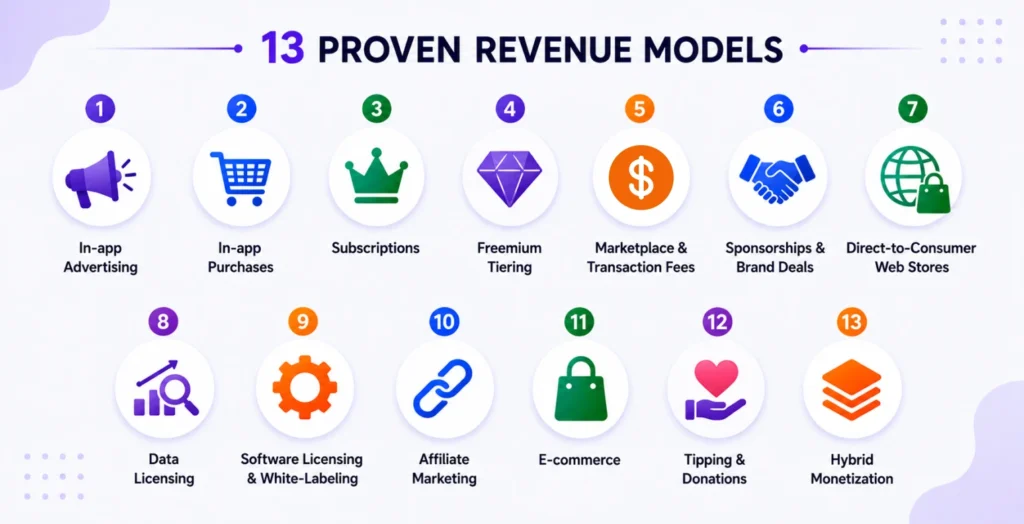
1. In-app advertising: The app sells space to advertisers — banners, full-screen interstitials between actions, native ads in a feed and rewarded videos that give users a small in-app reward for watching. Ad networks pay per thousand views (CPM), per click or per install and this passive-income setup is why hyper-casual games, news apps and utilities can stay entirely free.
2. In-app purchases: Users buy digital items directly: consumables like extra lives or in-game currency, permanent unlocks like ad removal or added content like extra levels. This is the backbone of mobile gaming and works best when the free version is genuinely fun on its own.
3. Subscriptions: A recurring weekly, monthly, or annual charge for ongoing access — streaming libraries, fitness plans, productivity tools. Because the revenue repeats instead of resetting to zero each month, subscription apps tend to earn substantially more per active user over time than apps built around one-time purchases.
4. Freemium tiering: The core product is free forever; advanced features, higher limits or export options sit behind a paywall. Canva is the textbook case — its free tier covers basic design, while Canva Pro and Canva Teams unlock premium assets and collaboration tools and the company’s subscription business alone reached roughly $4 billion in annual recurring revenue in 2025.
5. Marketplace and transaction fees: Two-sided platforms — ride-hailing, food delivery, freelance marketplaces — take a commission on every transaction between buyers and sellers instead of charging either side a subscription. No purchase, no revenue, which keeps the incentive aligned with actual usage.
6. Sponsorships and brand deals. Apps with a focused, engaged audience sell direct placements to brands: a sponsored fitness challenge, a branded course, a logo built into the interface. This bypasses ad networks entirely and usually pays better per impression than programmatic advertising.
7. Direct-to-consumer web stores: To avoid the 30% app store cut, some developers route purchases through a linked website instead of the app itself. It’s more setup work, but it keeps more margin and gives the developer direct customer data.
8. Anonymized data licensing: Apps with large user bases can sell aggregated, de-identified usage trends to research firms or industry analysts, staying within privacy rules like GDPR and CCPA. This works only at real scale and only when no individual can be identified from the data.
9. Software licensing and white-labeling: Instead of monetizing end users at all, some companies license their app’s underlying technology to other businesses, who rebrand it as their own. Banks and corporate wellness programs often buy white-label apps this way rather than building from scratch.
10. Affiliate marketing: The app recommends third-party products or services relevant to what the user is already doing — a travel app suggesting insurance, a budgeting app recommending a credit card — and earns a commission when the referral converts.
11. E-commerce: The app becomes a storefront, selling physical merchandise or digital goods directly. Creator and lifestyle apps increasingly build shopping features straight into the experience rather than sending users elsewhere to buy.
12. Tipping and micro-donations: Independent developers and open-source tools sometimes skip paywalls entirely and let users contribute voluntarily, often with a small perk — a badge, an extra feature — attached as a thank-you rather than a requirement.
13. Hybrid monetization: Most successful apps don’t pick just one model. A common pattern: ads for casual users who’ll never pay, light in-app purchases for engaged users, and a subscription tier for the smallest group willing to pay the most. Layering models this way tends to lift total revenue per user while keeping the free experience genuinely free for people who don’t want to spend.
Comparing the Core Models
| Model | How it earns money | Friction for users | Typical paying conversion |
|---|---|---|---|
| Subscriptions | Recurring fee for access | Moderate to high | Roughly 2–5% of installs |
| In-app purchases | One-off purchases of items or unlocks | Low to moderate | Roughly 1–3% of installs |
| In-app advertising | Selling ad space to advertisers | Low | Not applicable – passive |
| Freemium upsells | Paywall on advanced features | Low baseline | Roughly 2–4% of installs |
| Marketplace fees | Commission on transactions | Essentially frictionless | 100% of active buyers |
These are general industry benchmarks, not guarantees — actual conversion depends heavily on the app category, pricing, and audience.
What This Looks Like in Practice
Spotify runs one of the clearest examples of freemium done well: as of mid-2026 it had around 300 million paying Premium subscribers alongside a much larger free, ad-supported tier of roughly 480 million users, out of 777 million monthly active users total.
The free tier isn’t a stripped-down demo — it’s a real product that keeps people in the ecosystem long enough for a meaningful share to eventually upgrade.
Most top-grossing apps mix models rather than relying on one. A mobile game might run ads for casual players, sell cosmetic items to engaged ones, and offer a battle-pass-style subscription for the most invested fans — three revenue streams from three tiers of the same user base.
Loved What You Just Read?
Let's Build Something Just as Great — For Your Business.
From web & mobile apps to UI/UX, AI solutions, and digital marketing — NGD Technolab turns ideas into scalable, real-world products. 14+ years, 550+ projects, one team you can rely on.
Choosing a Model for Your Own App
There’s no universal “best” model — the right one depends on what your app does and how often people use it.
- High daily usage, low willingness to pay: advertising tends to work well, since volume makes up for low value per user.
- A product people rely on regularly: subscriptions capture that ongoing value better than one-time purchases.
- A game or creative tool with optional extras: in-app purchases let enthusiastic users spend more without forcing everyone to pay.
- A platform connecting two groups of people: transaction fees align revenue directly with the value you’re creating.
Whatever the starting point, most apps that scale successfully end up layering two or three of these models together rather than staying tied to just one. The goal isn’t picking the “right” answer once — it’s building a monetization strategy flexible enough to grow with how people actually use the app.
Conclusion
Free apps make money by putting distribution first and revenue second. The download costs nothing, but the ads, purchases, subscriptions and fees that follow add up to one of the largest consumer markets in the world.
There’s no single winning formula — the best free app revenue models are the ones that match how a specific audience actually behaves, and most apps that succeed long-term end up combining a few of these 13 approaches rather than betting on one.
Frequently Asked Questions
How do free apps make money without ads?
Apps that skip advertising usually rely on in-app purchases, subscriptions, or freemium upsells instead, charging only the users who want extra features, content, or an ad-free experience. This keeps the core app free for everyone while letting a smaller group of engaged users fund the business directly.
What percentage of freemium users convert to paying customers?
Freemium-to-paid conversion typically lands somewhere between 2% and 5% of active users, though this varies widely by app category, pricing, and how compelling the paid tier is. The remaining users still contribute value through engagement, ad views, or simply making the free tier attractive enough that others upgrade.
How does Spotify make money from free accounts?
Spotify’s free tier is ad-supported, generating advertising revenue from users who never pay while keeping them inside the platform. As of mid-2026, Spotify had around 300 million paying Premium subscribers alongside roughly 480 million ad-supported free users, with the free tier acting as a funnel that eventually converts a meaningful share of listeners to Premium.
How much commission do Apple and Google take from app purchases?
Both the App Store and Google Play typically take a 30% commission on digital transactions made through the app, dropping to 15% for developers earning under a certain revenue threshold or for subscriptions past their first year. This commission structure is a major reason developers explore models like direct-to-consumer web stores that route purchases outside the app itself.
Is a free app more profitable than a paid app?
Often, yes — a free app can reach a far larger audience, and monetizing that audience through ads, subscriptions, or purchases frequently generates more total revenue than a one-time download fee ever could. Paid apps earn money immediately but usually top out at a smaller user base, since most people are unwilling to pay before trying a product.