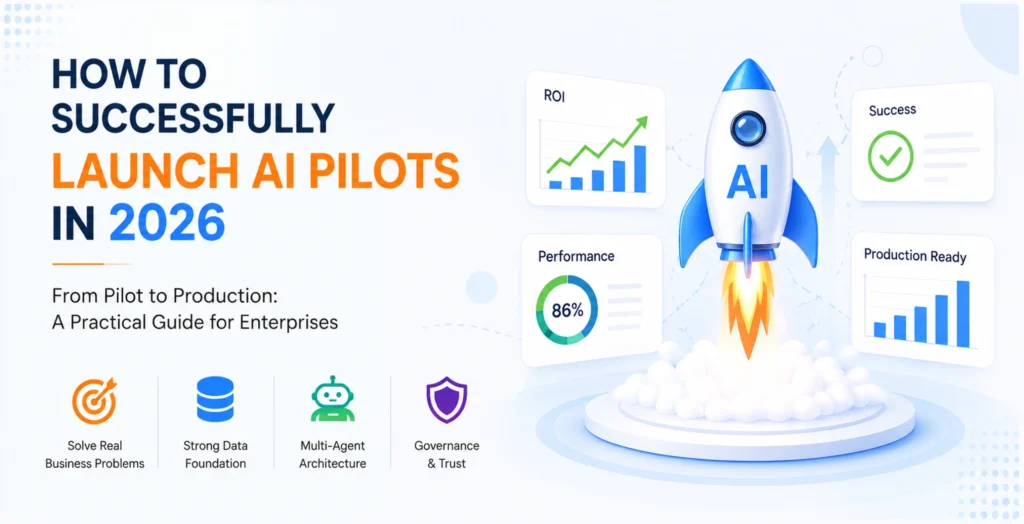
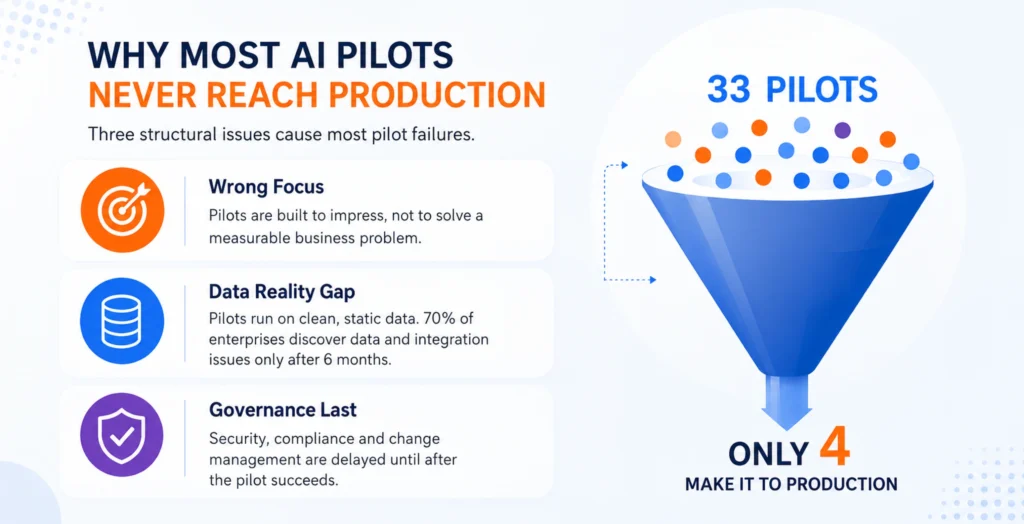
Roughly 88% of enterprise AI proofs-of-concept never make it into production, according to IDC research — for every 33 pilots a company starts, only about four graduate to live deployment. That gap isn’t a technology problem. Most pilots that stall in 2026 do so because they were built to prove a model could work, not to survive contact with real data, real users and real governance requirements.
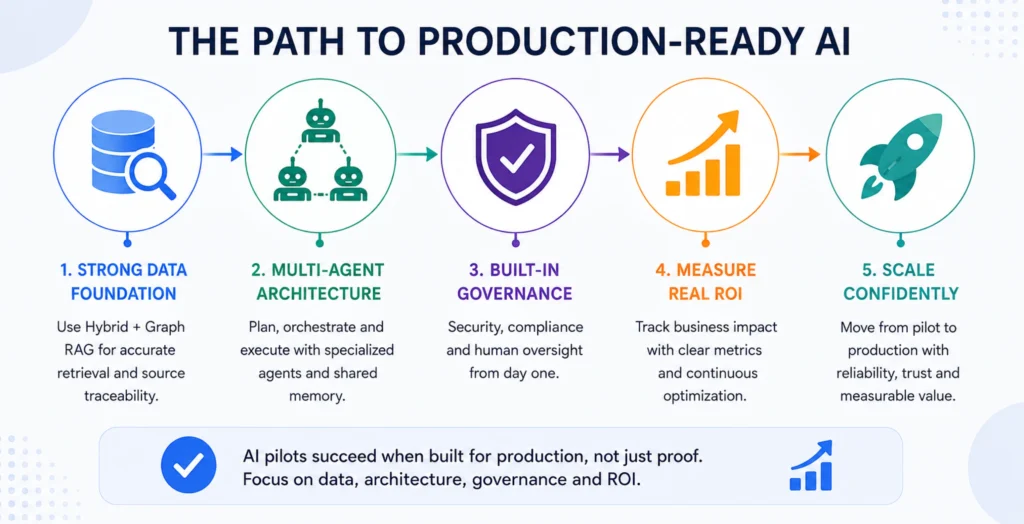
This guide breaks down why enterprise AI pilots fail and what an actual production-ready path looks like from data infrastructure through multi-agent architecture, governance, and ROI measurement.
Roughly 88% of enterprise AI proofs-of-concept never make it into production, according to IDC research — for every 33 pilots a company starts, only about four graduate to live deployment. That gap isn’t a technology problem. Most pilots that stall in 2026 do so because they were built to prove a model could work, not to survive contact with real data, real users and real governance requirements.
This guide breaks down why enterprise AI pilots fail and what an actual production-ready path looks like from data infrastructure through multi-agent architecture, governance, and ROI measurement.
Why Do Most Enterprise AI Pilots Never Reach Production?
Three structural issues account for most of the drop-off between pilot and production.
First, teams build pilots to showcase what a model can do rather than to solve one measurable business problem. Without a defined metric — reduced handle time, fewer processing errors, faster case resolution — a pilot has nothing to point to when budget reviews come around and funding quietly disappears.
Second, pilots run on clean, static, hand-picked datasets that don’t resemble production conditions. Around 70% of enterprises only discover that their data infrastructure, security boundaries or integration layer can’t support the AI system roughly six months after launch — well after the pilot looked successful in the sandbox.
Third, governance gets treated as a post-launch task. Security review, compliance sign-off and change management for the people whose workflows are being automated all get pushed to “after we prove it works,” which means the hardest parts of the project start only once leadership is already expecting a launch date.
Fix the Data Foundation Before Scaling the Model
Production-grade AI pilot to production work starts with retrieval, not the model. Naive RAG — vector similarity search alone — plateaus at roughly 70–80% retrieval precision on complex enterprise queries. It struggles with domain acronyms, numeric tables and exact-match lookups which is exactly the kind of content that fills most enterprise document stores.
The fix is hybrid retrieval: combining vector search with BM25 lexical matching, merging the two result sets through reciprocal rank fusion and reranking with a cross-encoder model.
Layering in Graph RAG — building a knowledge graph of entities and document relationships rather than treating every chunk in isolation — adds a further 15–30% improvement in retrieval precision on complex queries and it gives compliance teams paragraph-level source traceability instead of an approximate document match.
| Capability | Naive RAG (Pilot-Stage) | Production Graph RAG |
|---|---|---|
| Retrieval method | Vector similarity only | Hybrid: vector + BM25 lexical search |
| Document indexing | Fixed-length chunking | Structure-aware chunking + knowledge graph |
| Result ranking | Top-K distance, no reranking | Reciprocal rank fusion + cross-encoder rerank |
| Data connectivity | Static, batch-uploaded snapshots | Live connectors to source systems |
| Source traceability | Approximate document link | Paragraph- and page-level citation |
Skipping this step is why so many pilots that looked strong on a demo dataset fall apart the moment they meet messy real-world enterprise data.
Move From Single Agents to Multi-Agent Architecture
The architecture pattern behind most 2026 production systems has shifted from single prompt-driven chatbots toward coordinated multi-agent systems and Gartner expects roughly 40% of enterprise applications to embed task-specific agents by the end of the year, up from under 5% in 2025.
A production-ready multi-agent architecture generally has four layers:
- Reasoning engine — interprets goals and generates a plan, often using a Plan-and-Execute pattern where a strong frontier model sets strategy while smaller, specialized models handle individual sub-tasks to keep token costs down
- Orchestration layer — a coordinator agent holds the overall plan and delegates to worker agents (qualification, drafting, verification) without doing execution work itself, which avoids single points of failure
- Memory architecture — separates short-term task context from long-term episodic memory of past outcomes and decisions
- Tools and action layer — connects agents to enterprise systems, increasingly standardized through the Model Context Protocol (MCP), which lets agents discover and use tools through a shared library instead of custom point-to-point integrations
This is also where most operationalize-AI-models efforts either hold together or fall apart — a coordinator agent without clear task boundaries tends to reproduce the same brittleness a single overloaded chatbot has, just with more moving parts.
Build Governance In From Day One, Not After Launch
Only about 21% of organizations currently have a mature governance model for agentic AI, per Deloitte’s 2026 research, and Gartner projects that more than 40% of agentic AI projects will be cancelled by 2027 over unmanaged costs and inadequate controls. Governance isn’t optional overhead — it’s what keeps a working pilot from being pulled before it ever scales.
Three controls matter most for enterprise AI agent architecture:
1. Least-privilege permission isolation — each worker agent gets access only to the systems its specific task requires, not broad administrative reach
2. Real-time monitoring and kill switches — continuous tracking of token spend, API calls, and reasoning loops, with automatic shutdown if an agent runs away or breaches its parameters
3. Human-in-the-loop approval gates — routine tasks run autonomously, but high-stakes actions like financial transfers or regulatory filings require human sign-off before execution
Building these in during the pilot phase, rather than retrofitting them before a production launch, is one of the clearest differences between teams that scale and teams that stall in “pilot purgatory.”
Loved What You Just Read?
Let's Build Something Just as Great — For Your Business.
From web & mobile apps to UI/UX, AI solutions, and digital marketing — NGD Technolab turns ideas into scalable, real-world products. 14+ years, 550+ projects, one team you can rely on.
How to Calculate Real ROI on AI Agent Deployments
Vanity metrics — usage counts, model accuracy scores — don’t answer the question a CFO actually asks. Top-performing enterprises report up to a 10.3x return per dollar invested in generative AI, against a more typical 3.7x average and the median time-to-value for a scaled agent deployment runs around 5.1 months.
| KPI Category | Metric | Typical Benchmark |
|---|---|---|
| Handling efficiency | Average handle time reduction | 20–40% |
| Error mitigation | Workflow error/defect reduction | ~35% |
| Capital recovery | Median time-to-value | ~5.1 months |
| Investment return | Return per $1 invested | 3.7x average / 10.3x top cohort |
| Autonomous scale | Unassisted process completion | 35–45% |
The organizations hitting the higher end of that range track handle-time acceleration, error reduction, and direct EBIT contribution from day one of the pilot — not as an afterthought once someone asks what the project actually delivered.
A Practical Roadmap for Moving AI Pilots to Production
Getting from pilot to production reliably comes down to sequencing:
- Define one measurable business outcome before writing any code, not a general capability to demonstrate
- Test against real, messy production data — including edge cases — instead of a curated pilot dataset
- Build hybrid retrieval and, where document relationships matter, Graph RAG, rather than shipping naive vector search
- Design the agent architecture with clear orchestration boundaries and MCP-standardized tool access from the outset
- Implement permission isolation, monitoring and human-in-the-loop gates before launch, not after
- Track ROI using handle-time, error-rate and EBIT metrics from the first week of deployment, not the first review meeting
Conclusion
The gap between an impressive AI pilot and a working production system isn’t closed by a better model — it’s closed by the unglamorous work of data readiness, agent architecture and governance that most teams defer until it’s too late to matter.
Enterprises that treat production requirements as day-one design constraints, rather than post-pilot cleanup, are the ones showing up in the 12% that make it through — and the ones seeing real EBIT impact instead of a stalled demo six months later.
Frequently Asked Questions
Why do enterprise AI pilots fail to achieve quality production?
Most enterprise AI pilots fail to reach production because of structural gaps rather than model performance — fragmented data architecture, governance that gets addressed too late, and success metrics that were never clearly defined before the pilot began. Roughly 88% of proofs-of-concept stall for these reasons, according to IDC research, not because the underlying AI can’t do the task.
How long does it require to move an AI pilot to production level?
Timelines vary widely by scope, but industry data points to a median time-to-value of around 5.1 months for a scaled AI agent deployment, with some enterprise estimates running closer to 8 months when legacy system integration and governance review are involved. Narrow, well-scoped use cases tend to reach production faster than broad, ambitious ones.
What is the difference between Naive RAG and Graph RAG in AI pilot to production 2026 architectures?
Naive RAG relies on vector similarity search alone and plateaus around 70–80% retrieval precision on complex enterprise queries. Graph RAG adds knowledge-graph structure and hybrid retrieval — combining lexical and vector search with reranking — which improves retrieval precision by 15–30% and gives compliance teams paragraph-level source traceability that naive vector search can’t provide.
What governance controls do enterprises need before scaling AI agents?
Enterprises need least-privilege permission isolation so agents only access systems required for their task, real-time monitoring with automated kill switches to stop runaway processes and human-in-the-loop approval gates for high-risk actions like financial transfers or regulatory filings. Only about 21% of organizations currently have a mature governance model for agentic AI in place, which is a major reason projects get cancelled after launch.
How do you measure ROI on enterprise AI agent deployments?
ROI on AI agent deployments should be measured through business outcomes — average handle time reduction, workflow error reduction, and time-to-value — rather than model accuracy or usage volume alone. Top-performing enterprises report up to a 10.3x return per dollar invested by tracking these metrics from day one, compared with a more typical 3.7x average among organizations that measure success less rigorously.