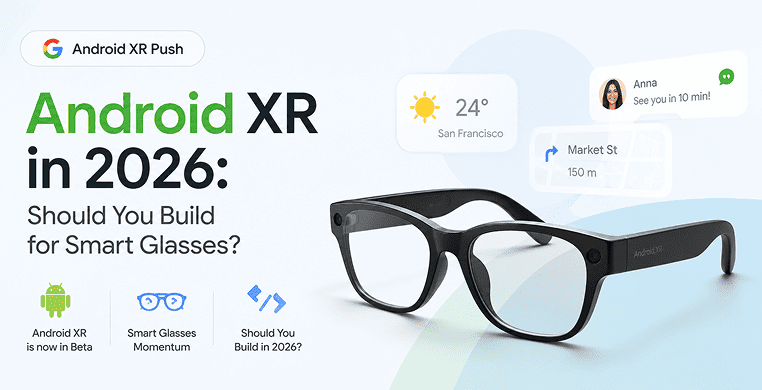
Android XR just crossed a real threshold. In August 2026, Google moved the platform’s core libraries — Jetpack SceneCore, ARCore for Jetpack XR and XR Runtime — out of developer preview and into beta. That’s the kind of milestone that usually separates a platform worth experimenting with from one worth actually building a product on.
At the same time, the first true Android XR glasses, made with Warby Parker and Gentle Monster, are expected to ship this fall and Google has already put real money behind the ecosystem through its Developer Catalyst Program.
So the question a lot of engineering leads are asking right now isn’t “is Android XR real” — it clearly is — but whether building for it in 2026 is a smart use of a roadmap slot, or a bet that’s still too early to place.
From Google Glass to a Real Platform
Google’s smart glasses history is a bit of a graveyard: Glass, Cardboard, Daydream, the shelved Project Iris. What’s different this time is that Google isn’t going it alone. Android XR was co-developed with Samsung and Qualcomm and rather than building one piece of hardware, Google built an operating system that other companies can put their own devices on top of — audio glasses, display glasses, wired AR glasses, and full mixed-reality headsets all run the same OS.
Samsung shipped the first Android XR device, the Galaxy XR headset (formerly known as Project Moohan), in October 2025 at $1,799, running on a Snapdragon XR2+ Gen 2 chip. That headset proved the platform could ship. The glasses that follow it are the part everyone’s actually watching, because glasses — not headsets — are where Google thinks the real audience is.
This is also where Android XR’s strategy diverges sharply from Apple’s. visionOS is a closed, single-hardware ecosystem tied to Apple’s own device. Android XR is closer to how Android itself grew: one OS, multiple manufacturers, each building their own hardware on top of it. It’s a slower path to a polished flagship device, but a faster path to volume, since Samsung, XREAL, Warby Parker and Gentle Monster are all shipping product on the same foundation instead of Google building everything itself.
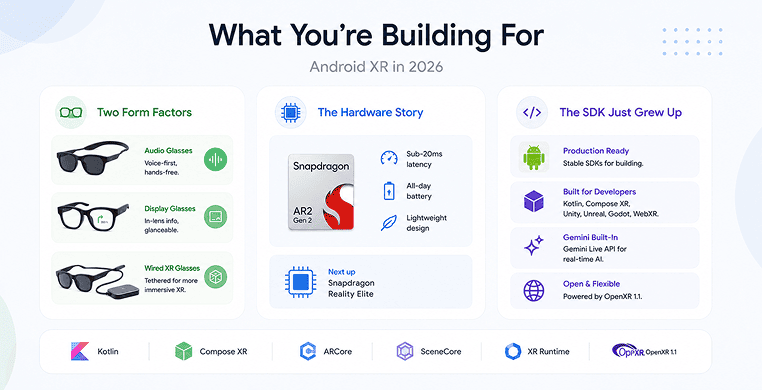
What You're Actually Building For
In May 2026, Google cleaned up its own terminology: what used to be called “AI glasses” are now audio glasses (no display, speakers and mics only) and “display AI glasses” are now display glasses (an in-lens display for glanceable information). There’s a third category, wired XR glasses, represented by XREAL’s Project Aura, which tethers to a compute puck for more immersive, higher-field-of-view experiences.
That distinction matters for planning. Audio glasses are built for voice-first, hands-free tasks — navigation, notifications, translation. Display glasses add a private, in-lens overlay for things like turn-by-turn directions or live captions. If your app idea depends on visual overlays, you’re building for a narrower, later-arriving slice of hardware than if you’re building for voice.
Display and audio glasses are expected to run on Qualcomm’s Snapdragon AR2 Gen 2 platform, which Google and Qualcomm have positioned around sub-20-millisecond motion-to-photon latency and all-day battery life rather than raw graphical horsepower — these are lightweight, all-day wearables, not standalone gaming rigs.
Wired glasses like Project Aura, by contrast, offload the heavy compute to an external puck, which is how XREAL’s device manages a notably wider field of view. It’s worth noting that Qualcomm has already announced its next chip, the Snapdragon Reality Elite, as the successor for wired XR glasses — a reminder that this hardware generation will move fast.
This is the part that changes the calculus for teams that were waiting on the sidelines. Through 2025 and early 2026, Jetpack SceneCore, ARCore for Jetpack XR and XR Runtime were developer-preview-only, meaning the APIs could shift under you release to release. As of this month, Google says those libraries are stable enough for production work, with Jetpack Compose for XR expected to follow shortly.
Underneath that, the developer story is genuinely broad. Kotlin and Jetpack Compose XR handle native spatial UI. Gemini is built into the OS itself — not bolted on — through the Gemini Live API, giving apps real-time multimodal reasoning about what the wearer sees and says.
And for teams that don’t want to build native, Android XR supports Unity’s XR Interaction Framework, Unreal Engine, Godot and WebXR through OpenXR 1.1, so an existing AR or VR codebase isn’t necessarily starting from zero.
Android XR vs. visionOS vs. Meta Horizon OS
| Google Android XR | Apple visionOS | Meta Horizon OS | |
|---|---|---|---|
| Ecosystem model | Open, multi-OEM | Closed, single-hardware | Proprietary, licensed hardware |
| Form factors | Audio glasses, display glasses, wired glasses, headsets | Headset only | Standalone VR/MR headsets |
| Native AI | Gemini (Nano on-device, Live API for real-time reasoning) | Apple Intelligence / Siri | Meta AI |
| Enterprise fleet tools | Android Management API | Apple Business Manager | Meta for Work |
| Engine support | Unity, Unreal, Godot, WebXR/OpenXR | RealityKit, limited OpenXR | Unity, native SDK |
The open model is Android XR’s biggest structural advantage and its biggest risk at once. It means faster hardware diversity and lower prices over time, the same way Android beat a single-vendor iPhone on volume.
It also means more fragmentation to test against — a display-glasses build doesn’t behave identically to a wired-glasses build, even on the same SDK.
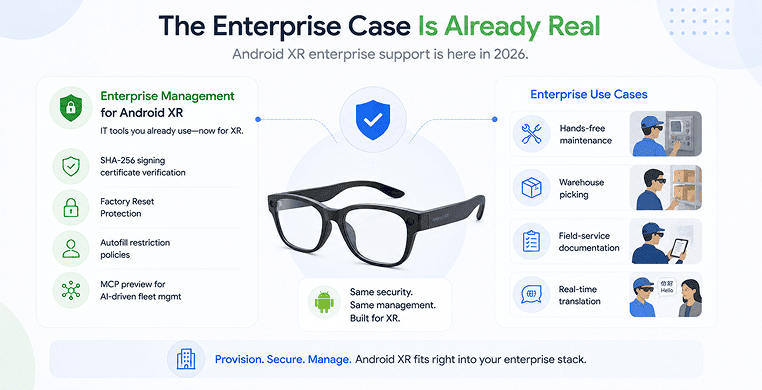
The Enterprise Case Is Already Real
While consumer glasses are still pre-launch, enterprise device management for Android XR isn’t hypothetical — it shipped earlier in 2026. The Android Management API now supports Android XR devices directly, giving IT teams the tools they already use for phones: SHA-256 signing certificate verification, Factory Reset Protection handling, autofill restriction policies and even a preview integration with the Model Context Protocol for AI-driven fleet management consoles.
That’s a meaningful signal. It means the industrial use cases everyone talks about — hands-free maintenance checklists, warehouse picking, field-service documentation, real-time translation for frontline staff — aren’t waiting on consumer adoption to become viable. A company can provision and lock down a fleet of Android XR devices today using the same enterprise mobility stack it already runs.
So, Should You Build for It in 2026?
The honest answer depends on which audience you’re chasing.
If you’re targeting enterprise or field-service workflows, the pieces are in place now: stable-enough SDKs, working fleet management and a hardware platform (Galaxy XR, plus the glasses arriving this fall) that’s actually shippable. This is the lower-risk starting point.
If you’re targeting consumer attention, the timing is trickier. The hardware only reaches real people this fall, pricing and final specs for the glasses are still not fully public and consumer habits around wearing a camera-equipped device all day are unproven — Google itself is aware this is the exact friction that killed the original Glass. Betting a full product roadmap on consumer glasses in 2026 means betting on adoption curves nobody can verify yet.
If you’re weighing cost, Google’s Developer Catalyst Program — free hardware kits and non-recoupable grants for approved projects — closed its first application window at the end of June 2026, but the underlying SDK, documentation and Google Play publishing path remain open to any developer, program or not.
A reasonable middle path many teams are taking: prototype now while the SDK is finally stable, target an enterprise or prosumer use case that doesn’t need mass consumer adoption to be worthwhile and treat the wider glasses market as something to revisit once real usage data exists after the fall launch.
Getting Started
Practically, the fastest path in is to install Android Studio with the XR extensions, pull the current Jetpack XR SDK and prototype against the XR Glasses emulator, which now mirrors real device specs for field of view and resolution.
Loved What You Just Read?
Let's Build Something Just as Great — For Your Business.
From web & mobile apps to UI/UX, AI solutions, and digital marketing — NGD Technolab turns ideas into scalable, real-world products. 14+ years, 550+ projects, one team you can rely on.
If you already have a Unity or WebXR AR project, porting it is a smaller lift than starting fresh — that cross-engine support is arguably Android XR’s most underrated advantage over a closed platform like visionOS.
Conclusion
Android XR isn’t a bet on a rumor anymore. It’s a platform with shipped hardware, a stable SDK and a real enterprise story. Whether it’s your bet to make in 2026 comes down to whether your target user is holding a badge scanner or just walking down the street — and right now, the badge scanner is the safer place to start.
Frequently Asked Questions
What is Google Android XR?
Android XR is Google’s operating system for extended reality devices, built with Samsung and Qualcomm and designed to run across headsets, wired AR glasses and standalone smart glasses. Instead of one piece of hardware, it’s a shared platform that different manufacturers build their own devices on top of, with Gemini handling the AI layer across all of them.
Is Android XR development worth it in 2026?
It depends on the audience. For enterprise and field-service tools, yes — the SDK reached beta this month and device fleet management already works through the Android Management API. For consumer apps, it’s a earlier bet: the first glasses only reach the public this fall, so real usage data doesn’t exist yet.
What's the difference between audio glasses and display glasses?
Audio glasses have speakers, microphones and a camera, but no screen — Gemini talks to you instead of showing you anything. Display glasses add an in-lens screen for glanceable visuals like turn-by-turn directions or live captions. Google has said audio glasses are launching first this fall, with display glasses following later.
How does Gemini AI work on Android XR smart glasses?
Gemini is built into Android XR at the OS level through the Gemini Live API, combined with ARCore’s visual positioning system. That pairing lets the glasses see what the wearer sees, understand spoken requests in real time and respond with contextual help — recognizing objects, translating signs or giving directions — without a phone screen involved.
Android XR vs. Apple visionOS: which is better for developers?
Neither is strictly “better” — they suit different bets. Android XR’s open, multi-OEM model means faster hardware variety, engine support for Unity, Unreal and Godot, and a lower cost of entry, but more device fragmentation to test against. visionOS offers a single, tightly controlled hardware target, which is simpler to support but limits reach to one premium device.