Software project budget overruns usually come from a short list of causes: unclear requirements, scope creep, weak estimates and surprise integrations. The good news is that each cause has a fix.
A project overrun simply means the real cost or time ended up higher than the plan. It happens a lot. McKinsey and Oxford University studied more than 5,400 IT projects, and large ones ran 45% over budget and 7% over time on average. They also delivered 56% less value than predicted. Software had the highest risk of all.
This guide covers all nine reasons and shows how to prevent software cost overruns before they hurt.
What Causes Software Development Cost Overruns?
Software development cost overruns come mostly from incomplete discovery, scope creep, optimistic estimates and surprise API or legacy integrations. Weak business-rule alignment and bad contracts add more. McKinsey also found that each extra year on a large project raised overruns by 15%.
So what causes cost overruns in tech projects? Rarely one big mistake. It is usually many small gaps across the SDLC that add up.
Here is the quick view:
| Root Cause | Primary Impact | Prevention Strategy |
|---|---|---|
| Incomplete discovery | Mid-project rework | Hands-on technical discovery sprint |
| Scope creep | Slow budget growth | Change Control Board and formal approvals |
| API integration surprises | Unplanned rewrites in QA | Test live endpoints before SOW sign-off |
| Flawed contract model | Friction and disputes | Hybrid milestone or capped T&M contract |
Reason 1: Unclear Requirements and a Weak Discovery Phase
Many teams begin building prior they truly know what they are building. Then the real needs show up halfway through, and the code has to change.
This is one of the main reasons software projects go over budget. Rework costs far more than planning does.
Ask for written user flows, screen sketches and a list of what is not included. That last list prevents many arguments later.
Fix: Run a discovery phase sprint of about three to four weeks, with hands-on architecture mapping, before you sign the final budget.
Reason 2: Scope Creep and No Change Control
In simple words, scope creep in software development means small “quick additions” pile up until the budget is gone. Each one looks harmless alone.
Say a client asks for one extra report and it takes three days. Ten of those asks cost six weeks.
The cure is a clear change request process. Every new idea gets a written estimate before work starts.
Fix: Set up a Change Control Board and approve every change in writing. This is how to block software project scope creep from spoiling your budget.
Reason 3: Optimistic Cost Estimation
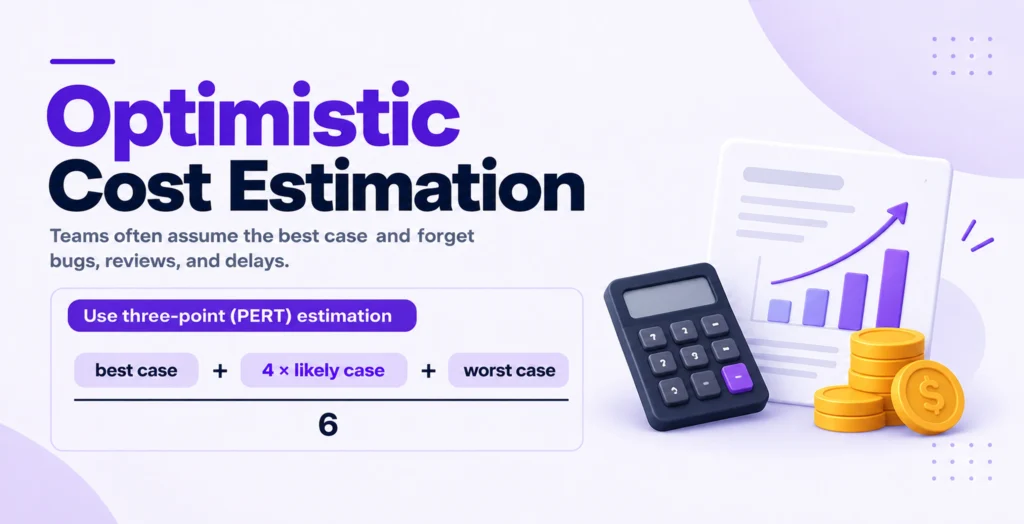
Software estimation mistakes often come from hoping for the best case. Teams assume the delighted path and forget bugs, reviews, and delays.
Try three-point (PERT) estimation. Use: (best case + 4 × likely case + worst case) ÷ 6.
For example, 40, 60, and 110 days give 65 days. That is a more honest number.
Fix: Estimate with three points and compare against past projects. This is how to assess custom software development expenses accurately.
Reason 4: Third-Party API and Legacy Surprises
Docs often look better than the real system. Then the team finds missing fields, strict rate limits or messy old data. Third-party API integration costs are a classic hidden cost in software development.
Fix: Test real API endpoints during discovery, not just the documentation. Do it before the Statement of Work (SOW) is signed, so the price reflects reality.
Reason 5: Underestimating QA, Testing, and Bug Fixes
Testing gets squeezed when time runs short. But skipped tests turn into late bugs and late bugs are expensive.
Think of a leaky roof. A small patch today is cheap, but a flooded room next winter is not.
Technical debt makes it worse. The technical debt impact on budget shows up as slower work on every later feature.
Fix: Test early (shift-left), and set aside a software architecture QA testing budget upfront. A common rule of thumb is 20% to 25%, though your needs may differ.
Reason 6: Poor Resource Planning and Team Turnover
When a key developer leaves, knowledge walks out with them. A new person needs weeks to catch up and that time costs money.
Keep clear notes, code reviews and shared docs, so no single person holds all the answers.
Fix: Add a resource buffer and cross-train people on key roles. Good software project cost management plans for people changes. It is a core part of custom software project budget control.
Reason 7: Missed Business Rules, Compliance, and Security
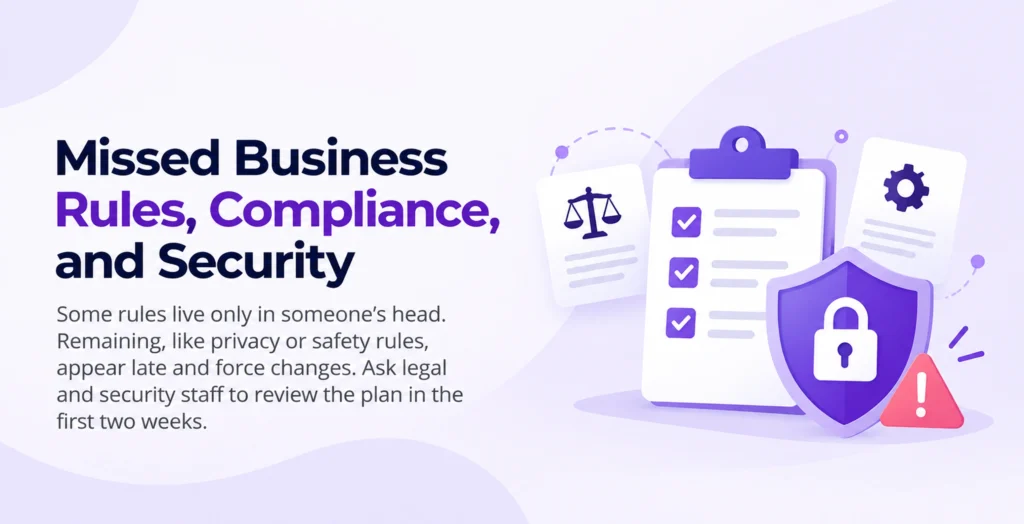
Some rules live only in someone’s head. Remaining, like privacy or safety rules, appear late and force changes. Ask legal and security staff to review the plan in the first two weeks.
Fix: Write down hidden business logic early and build compliance into Sprint 1. It is far cheaper than patching it later.
Reason 8: Poor Communication Between Business and Engineering
Business teams and engineers often hear different things. Each side assumes the other understands.
Hold a short weekly demo so leaders see real progress, not just status slides. Share progress openly too. Burn-down chart tracking shows work left against time, so problems appear early. This is also key to Agile project cost control.
Fix: Use burn-up or burn-down charts and keep one source-of-truth SOW. That is how to manage budget overruns in agile software development.
Reason 9: Choosing the Wrong Contract Model
The fixed-price SOW vs time and materials (T&M) option matters. Rigid fixed-price deals can spark fights over every change. Open T&M deals can drift without limits. Both risks grow when work is outsourced and nobody watches closely.
Fix: Use hybrid milestone-based contracts or T&M with a cap. This also helps you prevent cost overruns in outsourced software development.
Loved What You Just Read?
Let's Build Something Just as Great — For Your Business.
From web & mobile apps to UI/UX, AI solutions, and digital marketing — NGD Technolab turns ideas into scalable, real-world products. 14+ years, 550+ projects, one team you can rely on.
Your Software Project Budget Control Checklist
Use this simple software project budget control framework before kickoff, then review it monthly. It supports IT project budget overrun prevention at any size:
- Finish discovery before you commit to a final price
- Log every change through a change control board
- Estimate with three points, not one
- Test live integrations early
- Reserve a QA budget and a people buffer
- Track burn-down every sprint
- Pick a contract that shares risk
Conclusion
The reasons software projects fail financially are surprisingly repeatable. Weak discovery, scope creep, wishful estimates, hidden integrations, thin testing and poor contracts top the list.
Each cause has a simple fix. Start with discovery, control change and track progress every sprint.
If your project already feels shaky, review it against this list today. A short audit now costs far less than a big overrun later. If you lack in-house help, a software development discovery phase agency or IT project cost overrun consulting can run that audit for you.
Frequently Asked Questions
What is the main cause of budget overruns in software development?
There is rarely one cause. Incomplete discovery, scope creep, weak estimates and surprise API integrations top the list. Scope creep is the most cited. A PMI study found that 52% of projects experience it, with an average budget overrun of 27%. Fix discovery first, then control change.
Why do software development estimates fail?
Most software estimation mistakes come from guessing the best case. Teams forget bugs, reviews and delays. Use three-point (PERT) estimation instead: best case plus four times the likely case plus worst case, divided by six. Then compare the result with past projects to keep your numbers honest.
How do you prevent scope creep in custom-made software projects?
Start with a clear written scope and a list of what is not included. Then set up a change request process and a Change Control Board. Every new idea gets a written estimate and approval before work begins. This is how to stop software project scope creep from ruining your budget.
How much do software projects go over budget on average?
It depends on the study and project size. McKinsey and Oxford University found that large IT projects, those over $15 million, ran 45% over budget and 7% over time on average. They also delivered 56% less value than predicted. Smaller projects may differ, so track your own software development budget overrun statistics.
Is a fixed-price or time and materials contract better to prevent cost overruns?
Neither wins alone. In the fixed-price SOW vs time and materials debate, rigid fixed-price deals spark disputes over every change and open T&M deals can drift. A hybrid milestone-based contract or T&M with a cap, shares risk better. It also helps prevent cost overruns in outsourced software development.