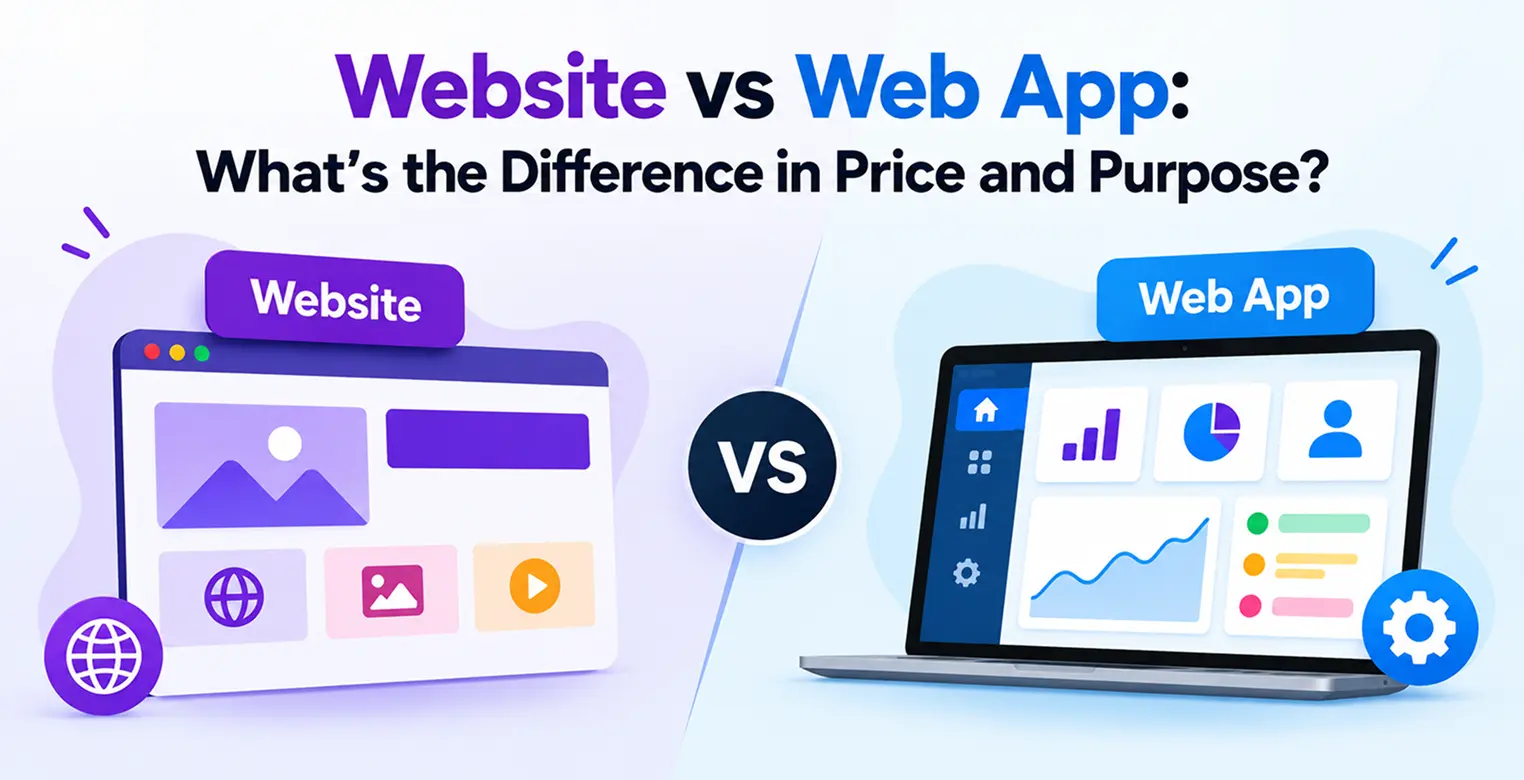
In the website vs web app debate, the short answer is this: a website tells people about you, and a web app lets people get something done. Price follows purpose. A website usually costs $3,000 to $15,000, while a custom web app often starts near $15,000 and can pass $150,000.
Those are rough numbers, but they show why the choice matters. Beneath, you will see how individually works, what you pay at launch and afterward and how to decide which one fits your business.
What Is the Difference Between a Website and a Web App?
Picture a small bakery. Its website lists the menu, the opening hours and a phone number. People read it and leave.
Now picture the bakery’s ordering page. A customer signs in, picks a cake, chooses a pickup time and pays. That page remembers who they are and what they asked for. It is a web app.
So the difference between a website and a web app is what the visitor does. On a website, people mostly look. On a web app, people work with their own information and the screen changes to match.
Hostinger draws the line in a similar way. In its guide, a store that shows and sells products is still a website, while a tool like Trello is a web app because users create and edit their own data. Some experts, such as the team at MobiLoud, say the line is blurry. They have a point.
If visitors only read, you have a website. If they log in and do tasks, you have a web app.
Purpose: What Is Each One Built For?
A website helps you get found, earn trust and collect enquiries. A dentist, a law firm or a wedding photographer usually needs nothing more. A visitor finds them on Google, checks their work and calls.
A web app exists to finish a job. Good examples are an invoicing tool, a booking portal or a customer dashboard. A SaaS product, where people pay every month to use software in the browser, is the clearest case. The software is the product.
Plenty of projects sit in the middle. An online shop has product pages, but it also has accounts, carts and payments. That makes it a hybrid and hybrids cost more than a plain brochure site.
Decide what your visitors need to do first and the right choice gets much easier.
What Happens Behind the Scenes
Most websites are made of pages. Many run on a content management system (CMS) such as WordPress, where you can change text and photos without writing code.
A web app has a busy engine room. It keeps records in a database. It creates, reads, updates and deletes them, which developers call CRUD. It also checks who is logged in and protects their data.
Simpalm lists tools like React and Node.js for this work, but you do not need to learn them. What matters is the workload. Every login screen, permission rule and live update must be designed, built and tested.
User authentication and security alone can eat a big part of a project. That is where the extra hours come from and extra hours are what you pay for.
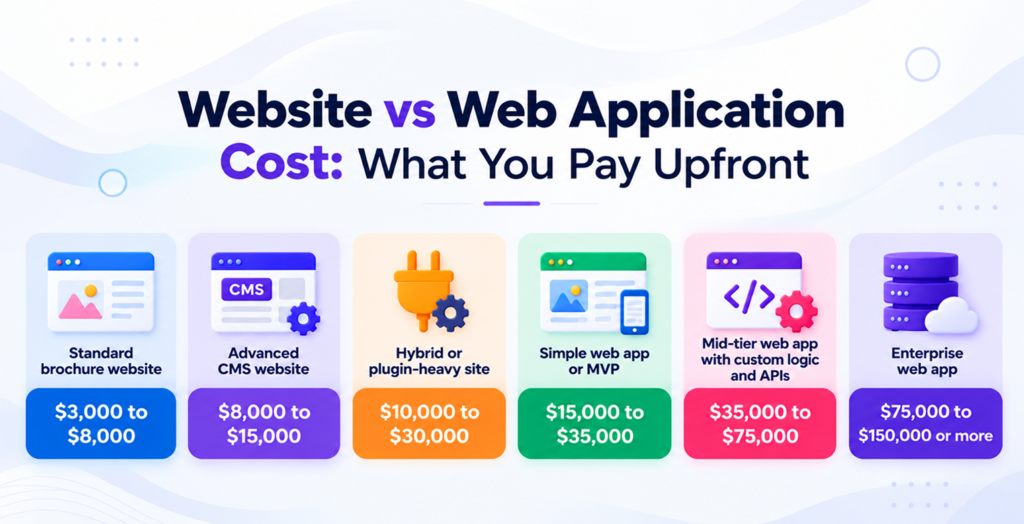
Agency guides, such as the one from Excalibur Interactive, show ranges like these. Treat them as approximate, because prices change with the team and the country.
- Standard brochure website: $3,000 to $8,000, usually 2 to 4 weeks
- Advanced CMS website: $8,000 to $15,000, usually 4 to 8 weeks
- Hybrid or plugin-heavy site: $10,000 to $30,000
- Simple web app or MVP: $15,000 to $35,000, usually 8 to 12 weeks
- Mid-tier web app with custom logic and APIs: $35,000 to $75,000, usually 12 to 18 weeks
- Enterprise web app: $75,000 to $150,000 or more, usually 18 to 24 weeks or longer
Building in India? PS Digitise lists a standard website at about ₹15,000 to ₹50,000 and a simple web app at ₹75,000 to ₹1,50,000. A mid-tier app runs ₹2,00,000 to ₹5,00,000 and an enterprise app starts around ₹6,00,000.
Use these numbers as a quick website pricing comparison and nothing more. Your web app development cost will move with every feature you add, so ask two or three teams for quotes.
A simple web app costs about the same as a heavy plugin-based website and after that the price climbs fast.
Why Web Applications Cost More Than Websites
A website page is mostly design and words. A web app is mostly rules. Rules require additional people and additional testing.
Here is what usually pushes the price up:
- A custom backend and database
- Logins and different access levels for different users
- Payments and other third-party API connections
- Security testing
- Checks across many browsers and devices
- Live features, such as chat or instant updates
If a quote shocks you, ask for a line-by-line breakdown. A good team will explain where each dollar goes.
With a web app, you are paying for how it behaves, not just how it looks.
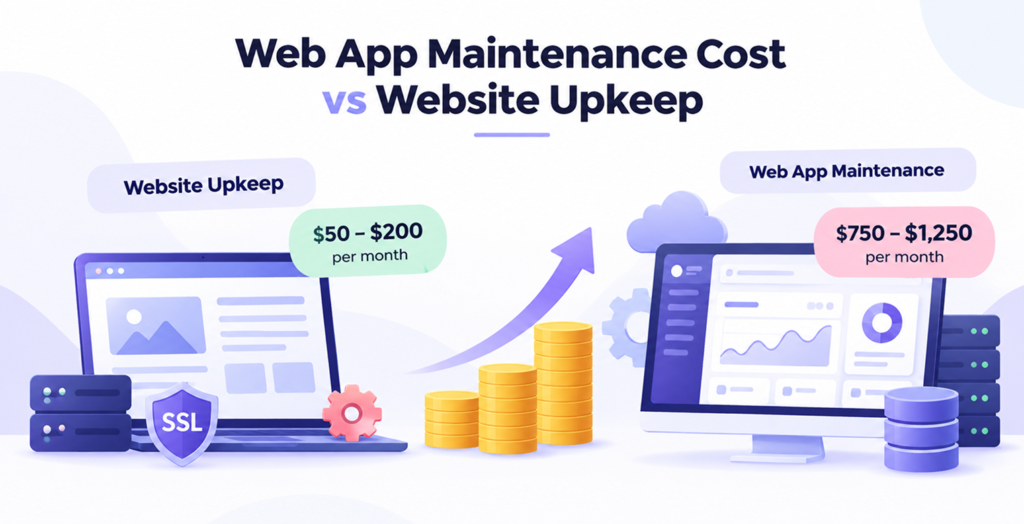
Web App Maintenance Cost vs Website Upkeep
Launch day is not the end of the bill. A simple website often needs about $50 to $200 a month for hosting, an SSL certificate and updates. Aalpha says a busy online store can reach $1,500 to $2,500 a month once you add stronger hosting, payment security and speed work.
The web app maintenance cost is higher. Closeloop points to an industry baseline of 15% to 25% of the build price each year. That is the usual annual maintenance cost percentage for web applications.
Say your app cost $60,000 to build. You should plan for $9,000 to $15,000 a year, or $750 to $1,250 a month. That covers cloud servers, database tuning, API checks and security tests.
Skipping upkeep is risky. Some benchmarks warn that ignoring an app for a year or more can lead to repair bills of $15,000 to $40,000.
Add upkeep to your budget on day one, because it is part of the real price.
Do I Require a Website or a Web Application?
Ask yourself three quick questions:
- Do my visitors need to log in?
- Do they need to save or change their own information?
- Does my business earn money from the software itself?
If you answered no to all three, a website is almost certainly enough. If you answered yes to any of them, look at a web app or a hybrid.
Many companies start small and grow. A clinic, for example, might begin with a simple site. Later, when patients ask for online appointments, it adds a booking portal.
Loved What You Just Read?
Let's Build Something Just as Great — For Your Business.
From web & mobile apps to UI/UX, AI solutions, and digital marketing — NGD Technolab turns ideas into scalable, real-world products. 14+ years, 550+ projects, one team you can rely on.
Starting with the simplest option that solves your problem keeps your first bill low and your risk small.
Pick the simplest option that solves your real problem, then grow from there.
Conclusion
The website vs web app choice comes down to one thing: what your visitors need to do. If they only need to read, a website will serve you well. If they need to sign in and finish tasks, a web app is worth the higher price.
Budget for the build, then set aside 15% to 25% a year for a web app. Write down your must-have features, collect a few quotes and start with the simplest option that works.
Frequently Asked Questions
What is a web application, and what are some examples?
A web application is software you use inside a browser, with no download needed. You log in, enter data, and the app responds, which is the core difference between a website and a web app. Common web app examples include Google Docs, Trello, online banking dashboards and SaaS tools and they all rely on user authentication and security, database actions like CRUD and RESTful APIs.
Is an online store a website or a web app?
It depends on who you ask. According to Hostinger, a store that shows and sells products is still a website, while a tool like Trello is a web app because users create and change data inside it. MobiLoud notes that some people call stores web apps because they rely so much on logins, carts and user input. In practice, an online store is a hybrid, so expect a higher website vs web application cost than for a simple brochure site.
Is a web app the same as a mobile app?
No. A web app runs in a browser and opens through a link, while a mobile app is installed from the App Store or Google Play and usually needs store approval first. Some web apps can also work like mobile apps, but they are still built and priced differently. That is why web app development cost and mobile app costs should be compared separately.
Is a website always cheaper than a web app?
Usually, but not always. A simple website built on a CMS like WordPress is often the cheapest and fastest option, with typical prices from $3,000 to $15,000. A website with plugins, payments and custom features can cost about as much as a simple web app, which starts around $15,000. For a fair website pricing comparison, list your must-have features first, then get two or three quotes. Also include web app maintenance cost in your plan, since it adds 15% to 25% of the build price each year.
Can a business have both a website and a web app?
Yes, and many do. According to MobiLoud, businesses often run both from one domain or put the app on a subdomain such as app.yourdomain.com. The website brings in visitors and leads and the web app serves customers who log in. If you are still asking “do I need a website or a web application,” start with the website and add the app when users need accounts, payments or dashboards.x