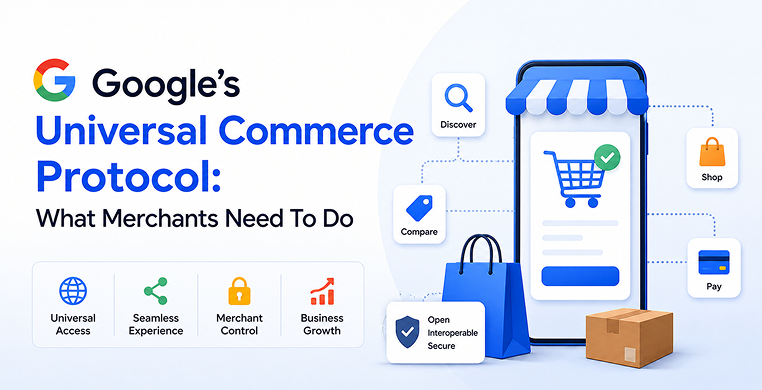
Google’s Universal Commerce Protocol (UCP) is an open standard that lets AI agents like Gemini and Search AI Mode complete a purchase directly inside the conversation, instead of sending the shopper to a merchant’s website. Google announced it on January 11, 2026 at the National Retail Federation conference and it has expanded fast enough since then that “wait and see” is no longer a free option for most retailers.
That’s really the story here. UCP isn’t a proposal or a roadmap item anymore. It’s live, it has real transaction volume behind it and Google has already said the search algorithm will favor merchants who support it.
What follows is a plain-language breakdown of what UCP does, how it connects to the other AI-agent standards you’ll hear about alongside it and the actual steps a merchant needs to take to get in front of it.
What Universal Commerce Protocol Actually Does
UCP standardizes how a conversational AI agent talks to a merchant’s backend to browse products, build a cart, apply discounts, process payment and track an order — all without redirecting to a traditional checkout page.
Google didn’t build it alone. It was co-developed with Shopify, Etsy, Target and Wayfair, and launched with more than 20 endorsing partners spanning retail and payments, including Walmart, Best Buy, The Home Depot, Visa, Mastercard, Stripe and American Express.
The protocol has moved quickly since launch. At NRF in January, only single-item guest checkout was supported. By March 2026, Google added cart support and product discovery capabilities and simplified onboarding through Merchant Center.
Then at Google Marketing Live in May 2026, the company introduced Universal Cart — letting shoppers save items across different retailers and check out in one pass using Google Pay — with launch partners including Nike, Sephora, Target, Ulta Beauty, Wayfair and Shopify merchants like Fenty and Steve Madden. Buy-now-pay-later support from Affirm and Klarna was folded directly into Google Pay at the same event.
Geographically, UCP checkout is live for eligible merchants in the United States now, with Canada and Australia expected later in 2026 and the UK to follow after that. Mainland Europe isn’t on the current rollout map. Payment currently runs through Google Pay and Google Wallet, though Google has confirmed PayPal support is coming.
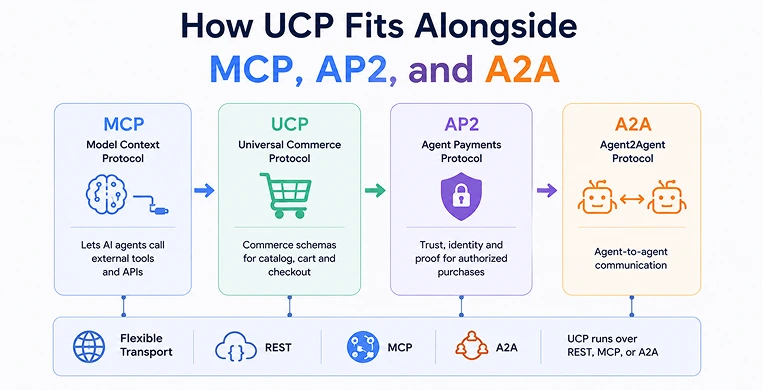
How UCP Fits Alongside MCP, AP2, and A2A
Merchants researching this often assume UCP does everything on its own, but it’s actually one layer in a stack of related agent standards, and understanding the difference matters for anyone doing technical planning.
- Model Context Protocol (MCP) is the general-purpose layer that lets a large language model call external tools, databases and APIs. It’s not commerce-specific — it’s the plumbing an AI agent uses to reach outside its own model. UCP builds on top of that plumbing with schemas built specifically for commerce: product catalogs, cart primitives and checkout sessions. In short, MCP gets the agent access to your systems; UCP tells it what to do once it’s there.
- Agent Payments Protocol (AP2) is the piece that handles trust. It links a shopper’s identity, manages credential delegation and provides cryptographic proof that a purchase made by an AI agent was actually authorized by the person behind it — which matters enormously once real money is moving without a human clicking “confirm” on every screen.
- Agent2Agent (A2A) enables a different kind of interaction: a consumer-facing agent (say, Gemini) negotiating directly with a merchant’s own business-side agent, rather than just hitting a static API.
UCP transactions can run over REST, MCP or A2A as the underlying transport, which is part of why merchants already invested in one of those ecosystems don’t have to start over.
Do Merchants Lose Control of Their Customers?
This is usually the first question a brand’s leadership team asks and the answer according to the protocol’s own specification is no. The retailer stays the Merchant of Record (MOR) for every transaction — meaning it retains full control over pricing, inventory allocation, fulfillment and importantly, ownership of the customer relationship and transaction data.
That distinction is what separates UCP from a traditional marketplace model. On Amazon or a similar platform, the platform sits between the brand and the buyer. Under UCP, Google is closer to a discovery and checkout facilitator: it’s an open protocol layer, not a store that resells your inventory under its own terms.
Merchants also don’t need to become PCI DSS compliant to accept card payments through UCP, since payment handlers like Google Pay or Shop Pay collect and tokenize the payment instrument rather than passing raw card data through the merchant’s servers.
On cost, UCP itself is free — there’s no core platform fee or per-transaction cut taken by Google. Standard payment processing fees from whichever handler you use still apply, the same as they would with any other checkout method.
Native Checkout vs. Embedded Checkout
Merchants integrating UCP choose between two architectural paths, and the right one depends mostly on how customized your existing checkout experience needs to be.
| Attribute | Native Checkout | Embedded Checkout |
|---|---|---|
| Best for | Standard e-commerce brands | Complex or highly custom storefronts |
| Where it runs | Directly inside Gemini or Search AI Mode | Secure iframe rendered within the AI surface |
| What you build | Three REST endpoints: session creation, update, completion | A hosted, tokenized checkout container |
| Branding | Google-controlled interface | Your own checkout elements preserved |
| Access | Standard UCP integration | More restricted, higher qualification bar |
Most merchants without unusual checkout logic — subscriptions, tiered loyalty pricing, complex tax rules — will find native checkout is the faster and simpler path in.
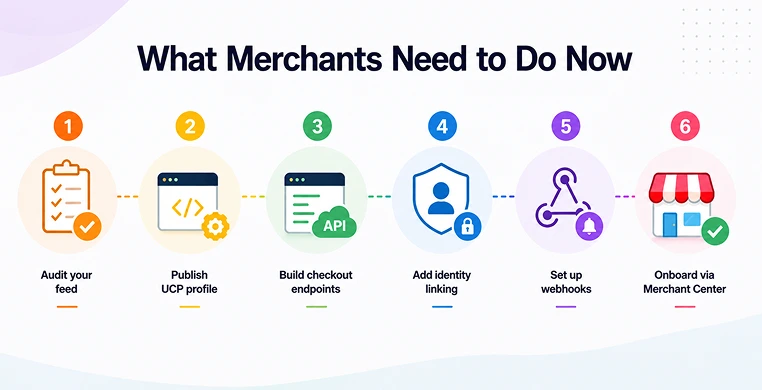
What Merchants Need to Do Now
The actual technical rollout is more approachable than it sounds, and it maps to a handful of concrete steps:
1. Audit your Merchant Center feed: UCP depends on your product data being accurate and current — pricing, inventory counts, variant attributes and standardized GTINs all feed directly into what an AI agent can see and sell.
2. Publish a UCP business profile: This is a JSON manifest hosted at /.well-known/ucp on your root domain. It’s how Google and other agents discover what your business supports: which checkout capabilities, which payment handlers and your public keys.
3. Build the native checkout REST endpoints: At minimum, that’s session creation, session update (for recalculating tax, shipping and discounts) and session completion.
4. Add identity linking, if you want personalization: This uses OAuth 2.0, with an authorization server metadata file published separately, to let returning shoppers link their account inside the AI surface for loyalty points and personalized pricing.
5. Wire up fulfillment webhooks: Order status, tracking numbers and delivery updates need to flow back to Google’s AI surfaces automatically, since customers may ask the AI agent for a status update instead of checking your site.
6. Get on the Merchant Center onboarding path: Google has simplified this twice already since January, so it’s worth checking current requirements directly rather than assuming last quarter’s process still applies.
Shopify merchants have a shortcut here: Shopify’s “Agentic Storefronts” feature manages the UCP integration centrally from Shopify Admin, meaning most Shopify-based retailers inherit support without building the endpoints themselves.
The Cost of Sitting This One Out
Google has been fairly direct about the strategic stakes: as more high-intent commercial searches move into conversational, AI-driven interfaces, algorithmic ranking will increasingly favor merchants with verified UCP endpoints over those without.
Loved What You Just Read?
Let's Build Something Just as Great — For Your Business.
From web & mobile apps to UI/UX, AI solutions, and digital marketing — NGD Technolab turns ideas into scalable, real-world products. 14+ years, 550+ projects, one team you can rely on.
That’s a meaningful shift from traditional SEO, where a slow, well-optimized product page could still convert. In an agentic checkout flow, a retailer that can’t complete a transaction natively risks simply being skipped in favor of a competitor who can.
That doesn’t mean every retailer needs to drop everything this quarter — rollout is still US-first and plenty of categories haven’t seen meaningful agentic purchase volume yet. But the technical lift isn’t trivial either and the merchants moving early are the ones shaping what “normal” looks like once broader adoption hits.
Conclusion
UCP is still young, but it isn’t experimental anymore — real retailers have been taking real orders through it since January. For most merchants, the practical move right now is a Merchant Center feed audit and a UCP waitlist application, then a choice between native and embedded checkout based on how custom your storefront needs to be. Waiting for the standard to “mature” mostly just means watching competitors capture the queries you would have shown up for.
Frequently Asked Questions
What is Google Universal Commerce Protocol?
Google Universal Commerce Protocol is an open standard, launched January 11, 2026, that lets AI agents such as Gemini and Search AI Mode complete a purchase directly inside a conversation. It standardizes product discovery, cart building, payment, and post-purchase tracking so merchants don’t need a custom integration for every AI platform they want to sell through.
How do merchants integrate checkout with Google Gemini?
Merchants integrate by auditing their Merchant Center product feed, joining the UCP waitlist through Google’s interest form, publishing a /.well-known/ucp business profile, and building three native REST endpoints for session creation, updates and completion. Shopify merchants can skip most of this through the platform’s built-in Agentic Storefronts feature.
What's the difference between Google UCP and MCP?
Model Context Protocol (MCP) is the general-purpose layer that gives an AI model access to outside tools, databases and APIs — it isn’t commerce-specific. Universal Commerce Protocol (UCP) builds on top of that access with schemas made for buying and selling, including product catalogs, cart primitives, and checkout sessions.
Do merchants lose customer data when using Google UCP?
No. Merchants remain the Merchant of Record under UCP, keeping full ownership of pricing rules, inventory, fulfillment and the customer relationship and transaction data. Google functions as a discovery and checkout layer, not a marketplace that takes over the sale the way a traditional third-party platform would.
Is Google UCP free for e-commerce retailers?
Yes. UCP itself is a free, open standard with no platform fee or per-transaction cut charged by Google. Merchants still pay the usual processing fees to whichever payment handler they use, such as Google Pay or Shop Pay, the same as they would with any other checkout method.