
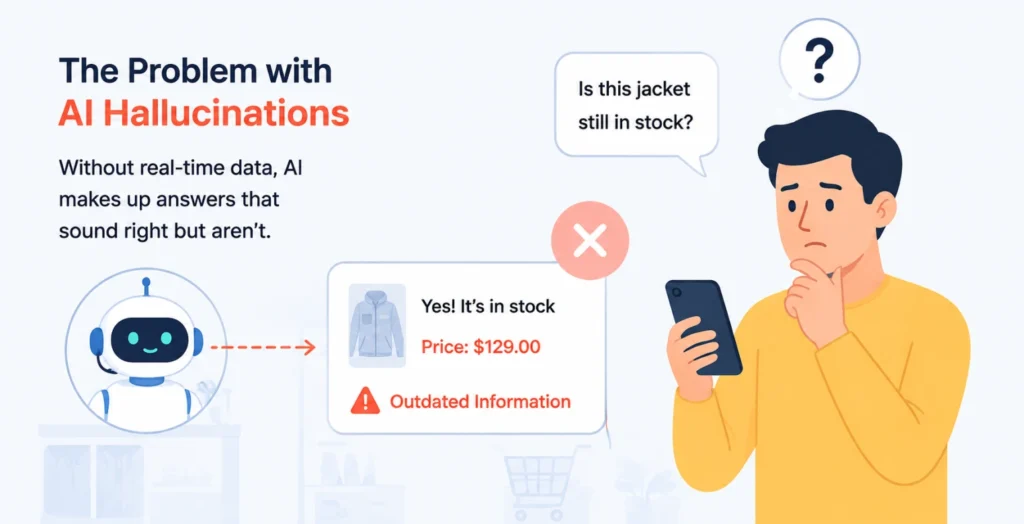
A shopper asks a retail chatbot if a jacket is still in stock. The bot says yes, describes the color and quotes a price. None of it is true. The jacket sold out three weeks ago and the price changed twice since then.
This isn’t a rare glitch. It’s a predictable outcome of how large language models work, and it’s one of the biggest reasons e-commerce brands hesitate to put generative AI in front of paying customers. The fix isn’t a smarter prompt or a bigger model. It’s retrieval-augmented generation (RAG) — an architecture that forces the AI to check real data before it answers instead of guessing from memory.
Here’s what actually causes these failures, why “just tell the AI to be accurate” doesn’t work, and what a production-ready RAG setup looks like for online stores.
Why AI Chatbots Invent Prices and Products
Large language models don’t store facts the way a database does. They’re statistical engines trained to predict the next most likely word based on patterns in their training data. When a shopper asks about a specific SKU, price or stock level, the model has no built-in way to look that up. It doesn’t know what it doesn’t know.
So when there’s a gap in its context, it fills that gap with something that sounds plausible. That’s the core mechanism behind an AI hallucination: not a bug, but the model doing exactly what it was built to do — generate fluent, statistically likely text — with no verified information to anchor it.
This is also why prompt instructions like “never quote an incorrect price” or “only answer with real products” fall apart in production. A prompt can’t hand the model information that isn’t already sitting in its context window. Telling a model to be truthful doesn’t give it access to your live inventory feed; it just gives it a rule to follow with nothing real to follow it with.
The Real Cost of Hallucinations in Online Retail
Hallucinations in a retail chatbot aren’t a single failure type. They tend to fall into four recognizable patterns, each with its own business fallout.
| Failure Type | What Happens | Business Impact |
|---|---|---|
| Price hallucination | The bot quotes an old, discounted, or made-up price | Cart abandonment at checkout, support tickets, false-advertising exposure |
| Availability hallucination | The bot recommends an out-of-stock or discontinued item | Dead-end shopping journeys, cancelled orders, lost trust |
| Attribute hallucination | The bot mixes up specs, size, or materials between similar products | Returns, shipping costs, customer complaints |
| Extrinsic invention | The bot describes a product that doesn't exist in the catalog at all | Immediate credibility damage |
Price and availability hallucinations are the most common because retail catalogs change constantly. Prices, promotions and stock counts can update dozens or hundreds of times a day. Any AI system that isn’t checking that data in near real time is working from a snapshot that’s already out of date.
How RAG Grounds AI in Real Product Data
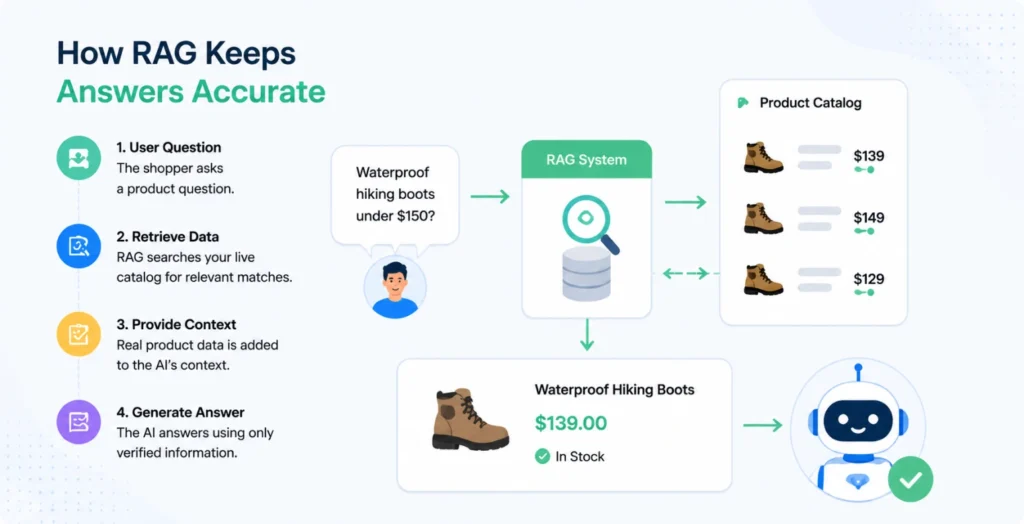
RAG for e-commerce works in four steps: the shopper’s question is converted into a numerical representation called a vector embedding, that vector is compared against a vector database of the catalog to find the closest semantic matches, the matching product records are pulled into the model’s context window and the model is instructed to answer only from that retrieved information rather than its general training.
In practice, that means a question about “waterproof hiking boots under $150” doesn’t rely on the model recalling boots from its training data. It triggers a live search across your actual product catalog, retrieves the boots that match and hands the model verified specs and current prices to answer with. This is the difference between a model recalling and a model reading — and it’s why grounded, RAG-based systems behave so differently from a plain chatbot answering off memory.
This is also why RAG tends to beat fine-tuning for catalog-driven use cases. Fine-tuning bakes information into the model’s weights, which means every price change or restock requires retraining. RAG separates the knowledge from the model, so updating the catalog is as simple as updating the vector database.
The Hidden Reason RAG Still Fails: Catalog Staleness
RAG isn’t a guarantee against hallucinations on its own. The most common cause of failure in a RAG-powered store isn’t the model — it’s a stale vector index.
Retail data changes constantly: prices shift, promotions start and end, items sell out. If the vector database is only re-indexed nightly or weekly, there’s a window where the retrieval layer is confidently serving outdated information. The model then generates an answer that’s fully consistent with what it retrieved — it’s just that what it retrieved was wrong.
Standard evaluation methods, which mostly check whether the model’s answer matches what it retrieved, often miss this problem entirely, because the retrieved chunk itself was already out of sync with the live catalog.
Building a Production-Grade RAG Pipeline
A retrieval setup that actually holds up under real shopping traffic needs a few specific design choices:
- Event-driven re-indexing: Instead of a scheduled batch update, changes to price, stock, or product data in the PIM (Product Information Management) or ERP system trigger an immediate update to the vector index. This closes the staleness gap that causes most price and availability errors.
- Structured, attribute-aware chunking: Cramming an entire product page into one embedding blurs the details. Better setups keep structured fields — price, stock count, dimensions — as separate, tightly scoped chunks, while product descriptions are split into smaller passages so retrieval stays precise.
- Hybrid search with re-ranking: Pure vector similarity search can struggle with exact SKU codes or model numbers, since it’s built for semantic closeness rather than exact matches. Combining vector search with traditional keyword search, then re-ranking the results, improves precision for these exact-match cases.
- Guardrails and fallback responses: When retrieval confidence is low, the system should default to a safe fallback — “let me check that for you” — instead of letting the model guess. Keeping the model’s output settings conservative (lower randomness) also reduces the chance of creative, unsupported answers.
Standard RAG vs. Agentic RAG
Basic RAG follows a straight line: the shopper asks something, the system retrieves relevant context once and the model answers. That works well for straightforward lookups but starts to strain under multi-step requests, like “find me a gift under $50 that ships by Friday and matches what I bought last time.”
Agentic RAG extends the pattern with reasoning and tool use. Instead of a single retrieval pass, the system evaluates what the shopper actually needs, plans out the steps required and calls multiple systems — a pricing engine, a shipping/carrier API, a live inventory check — before responding.
It’s a heavier architecture, but it’s what makes multi-step, personalized retail interactions possible without the AI drifting away from verified data. Market researchers tracking this space have pointed to it as one of the fastest-growing categories in enterprise AI spending, though exact projections vary widely between analysts, so treat any single forecast figure with some caution.
Loved What You Just Read?
Let's Build Something Just as Great — For Your Business.
From web & mobile apps to UI/UX, AI solutions, and digital marketing — NGD Technolab turns ideas into scalable, real-world products. 14+ years, 550+ projects, one team you can rely on.
Getting This Right
None of this requires a total rebuild of your tech stack, but it does require treating retrieval as seriously as the language model itself. The questions worth asking before deploying any AI shopping assistant: How fresh is the data it retrieves from? What happens when it can’t find a confident match? And is anyone actually testing it against the scenario that matters most — a shopper asking about something that changed an hour ago?
Get the retrieval layer right, and the “AI hallucination” problem in e-commerce mostly disappears. The model was never the part inventing things. It was answering the only way it could with the information it had.
Conclusion
AI hallucinations in online retail aren’t a model problem — they’re a data problem wearing a model’s face. Fix the retrieval layer, keep the catalog synced in near real time, and the invented prices and phantom products stop showing up on their own. That’s a far more durable fix than chasing a better prompt every time something breaks.
Frequently Asked Questions
What is RAG in e-commerce?
RAG, or retrieval-augmented generation, is an AI architecture that pulls live product data from a vector database before generating a response, instead of relying on what the model memorized during training. For e-commerce, this means answers about price, stock and specifications are grounded in the actual catalog rather than a guess.
How does RAG stop AI from inventing prices and products?
RAG converts a shopper’s question into a search against the current product catalog and feeds only the matching, verified records into the model’s context. Because the model is instructed to answer from that retrieved data rather than its training memory, it has far less room to invent a price or a product that doesn’t exist.
Why do AI chatbots hallucinate prices in the first place?
Language models predict the next likely word based on training patterns, not a live lookup. Without RAG, a chatbot has no way to check today’s actual price, so it produces a plausible-sounding number instead of a verified one. This is a structural limitation of the model, not a rare bug.
Is RAG better than fine-tuning for e-commerce AI accuracy?
For fast-changing data like pricing and inventory, RAG for e-commerce is generally the better fit, because updating a vector database is far quicker than retraining a fine-tuned model. Fine-tuning still has a role in shaping tone and response style, but it isn’t built to keep up with hourly catalog changes.
What causes catalog staleness in a RAG system?
Catalog staleness happens when the vector database isn’t updated as fast as the real PIM or ERP system behind it — often because indexing runs on a nightly or weekly schedule instead of reacting to changes instantly. Event-driven re-indexing, triggered the moment a price or stock level changes, is the standard fix for AI retail pricing accuracy.