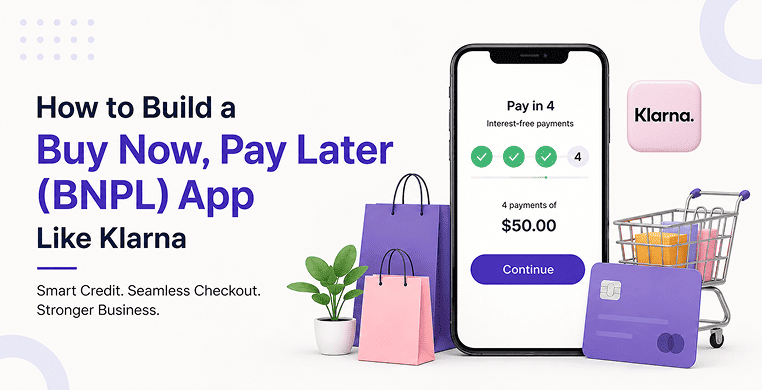
Building a BNPL app isn’t really a payments project — it’s a lending business with a checkout widget attached. The technical bar is higher than most fintech ideas because you’re handling real credit decisions, real money movement and real regulatory exposure the moment a user taps “Pay in 4.” If you’re evaluating BNPL app development, here’s what actually goes into building a platform like Klarna or Affirm, from the backend architecture down to what it will cost.
Why BNPL Is Still Worth Building
The buy now pay later market hasn’t slowed down. Estimates vary depending on whether analysts measure provider revenue or total transaction volume, but most industry reports put the market somewhere in the $10 billion to $45 billion range in 2025, with growth rates commonly cited between 20% and 30% a year through the early 2030s.
According to Global Market Insights, Klarna alone held roughly a fifth of the market in 2025, with the top five providers — Affirm, Klarna, Afterpay, PayPal Pay Later and Zip — controlling around two-thirds of it combined.
What keeps merchants interested isn’t the brand names, it’s the checkout math. Retailers that add a BNPL option at checkout routinely see conversion rate improvements in the 20% to 30% range, along with a meaningful bump in average order value.
That’s the core pitch you’re building a platform around: consumers get predictable, often interest-free installments, and merchants get more completed sales.
The Core Architecture You're Actually Building
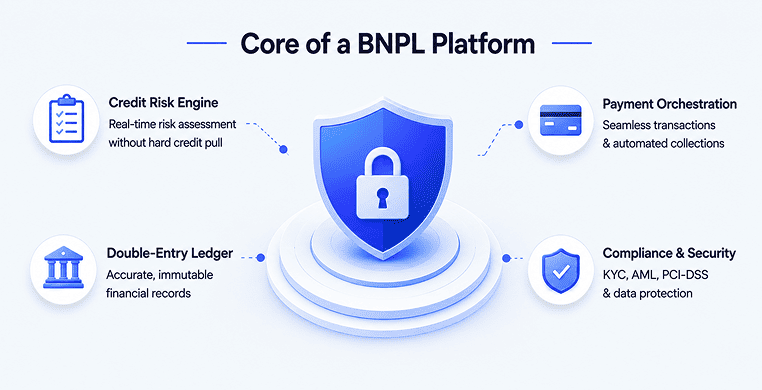
A BNPL platform is a distributed system built around three jobs happening in near real time: verifying who the buyer is, deciding how much credit to extend and moving money correctly. Most production platforms build this backend in Node.js (often with NestJS), Go, Python (FastAPI) or Java (Spring Boot), backed by an ACID-compliant relational database like PostgreSQL or a distributed SQL engine, since financial transactions can’t tolerate race conditions during concurrent repayment attempts.
Your compute layer typically splits across two workloads with very different latency needs. Checkout session creation and widget rendering need to respond instantly to avoid cart abandonment, while credit risk evaluation can tolerate a slightly longer round trip in exchange for deeper analysis.
| Compute Layer | AWS Lambda | Cloudflare Workers |
|---|---|---|
| Best fit | Complex credit scoring, batch settlements, ML inference | Checkout widgets, session creation, API routing |
| Execution model | Firecracker microVM | V8 isolate |
| Memory | Up to 10,240 MB | Fixed 128 MB |
| Cold start | 50ms–2,000ms (mitigated by SnapStart) | Near-zero |
| Pricing | $0.20/1M requests + $0.000016667/GB-second | $5/month base + $0.30/1M requests + $0.02/1M CPU-ms |
Lambda’s flexible memory ceiling makes it the natural home for anything doing heavy computation, like a multi-bureau credit model. Cloudflare Workers’ near-zero cold start is worth more at the checkout widget, where even a 200-millisecond delay can measurably affect whether a shopper finishes the purchase.
The Double-Entry Ledger: Where Most of the Engineering Effort Goes
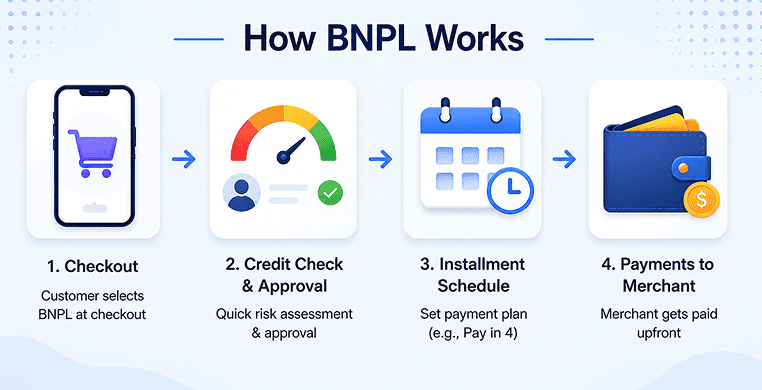
Every BNPL transaction needs to move through an immutable double-entry ledger that tracks receivables, merchant payouts, discount fees and late charges without ever losing consistency. Take a $200 purchase on a Pay-in-4 plan as an example: the platform captures the first $50 installment immediately through the payment gateway, records the remaining $150 as an active receivable, calculates the merchant discount rate — typically 2% to 8% of the order — and schedules three more automated debit or ACH pulls at roughly two-week intervals.
The merchant, meanwhile, usually gets paid out close to the full order value upfront, minus that discount rate, since guaranteed payment regardless of the buyer’s repayment schedule is a core part of the value proposition.
This is also where most of the accounting bugs in early-stage BNPL platforms originate. Every debit needs a matching credit and the ledger has to reconcile correctly even when a payment fails, a refund is issued or a chargeback comes in weeks later.
Real-Time Credit Risk Without a Hard Credit Pull
Traditional credit cards run a hard bureau pull that dings the applicant’s credit score before approval. BNPL platforms differentiate themselves by skipping that friction entirely, using soft credit inquiries layered with alternative data — device signals, past transaction history with the platform and bank account verification through open banking APIs.
A machine learning model typically processes these signals in well under a second and returns a dynamic credit limit sized to that specific purchase, rather than a single static credit line.
Merchant Integration: APIs, Plugins, and Virtual Cards
Merchant adoption depends on how easy the integration is. Most platforms offer three paths: a REST API and webhook layer for custom checkout flows, pre-built plugins for Shopify, WooCommerce, Magento and Salesforce Commerce Cloud that render installment breakdowns directly on product pages and virtual card issuance — through processors like Marqeta or Stripe Issuing — for merchants who aren’t integrated at all.
That last option generates a single-use virtual card loaded with the approved amount, letting a shopper check out anywhere that accepts standard card payments.
Regulatory Compliance and Security
Compliance requirements are non-negotiable and shape the architecture from day one. PCI DSS Level 1 applies to any platform touching card data, requiring encrypted payloads, tokenization and regular penetration testing.
KYC and AML identity verification has to run during onboarding to catch fraud and meet anti-money-laundering obligations. State-level consumer lending licenses generally apply depending on where the platform operates.
The federal picture is less settled than it may appear. The CFPB issued an interpretive rule in 2024 that would have applied Truth in Lending Act protections to Pay-in-4 products, but that rule was withdrawn in 2025 and the agency has since said it doesn’t plan to reissue it — so BNPL providers currently operate in a regulatory gray zone at the federal level, even as state regulators and consumer advocates continue pushing for clearer rules.
Building disclosure and dispute-handling features that meet TILA-style standards anyway is still the safer engineering choice, since the policy landscape can shift again.
What It Actually Costs to Build
Development cost scales with how much of the platform you’re building versus licensing. A basic MVP — manual or rule-based credit limits, a single payment gateway, and a simple admin dashboard — typically runs $30,000 to $80,000.
Loved What You Just Read?
Let's Build Something Just as Great — For Your Business.
From web & mobile apps to UI/UX, AI solutions, and digital marketing — NGD Technolab turns ideas into scalable, real-world products. 14+ years, 550+ projects, one team you can rely on.
A mid-level commercial platform with automated credit scoring, native mobile aps and e-commerce plugins runs $80,000 to $150,000. A full enterprise build with real-time AI underwriting, virtual card issuance and multi-currency support can run $150,000 to $500,000 or more.
Developer rates vary sharply by region, from $100–$250 an hour in North America down to $25–$80 an hour across South Asia, which is often the single biggest lever on total project cost. Whichever tier you’re building toward, the platforms that succeed treat the ledger and compliance layer as the foundation, not an afterthought bolted on before launch.
Conclusion
Building a BNPL app like Klarna or Affirm is less about matching a competitor’s feature list and more about getting the unglamorous parts right — a ledger that never loses a cent, a risk model that approves fast without approving recklessly and a compliance posture that holds up as the regulatory picture keeps shifting.
Start with the narrowest version that proves the lending model works, get the accounting and underwriting logic solid, and scale the merchant integrations and feature set from there.
Frequently Asked Questions
How much does it cost to build an app like Klarna?
A basic MVP with manual credit rules and a single payment gateway typically costs $30,000 to $80,000. A mid-level commercial platform with automated credit scoring and native mobile apps runs $80,000 to $150,000 and a full enterprise build with real-time AI underwriting and multi-currency support can reach $150,000 to $500,000 or more, depending on where the development team is based.
How do BNPL apps make money without charging interest?
Most BNPL platforms earn revenue primarily through a merchant discount rate, typically 2% to 8% of the order value, charged to the retailer in exchange for guaranteed payment and higher checkout conversion. Some providers add revenue through late fees, monthly account servicing charges or interest on longer 6- to 36-month financing plans and platforms with virtual card programs also capture a share of interchange fees.
What technology stack is used for BNPL platforms?
Most production BNPL platforms build their backend in Node.js, Go, Python or Java, backed by an ACID-compliant database like PostgreSQL to keep the ledger consistent. Compute typically splits between AWS Lambda for heavier tasks like credit scoring and batch settlements and edge platforms like Cloudflare Workers for low-latency checkout widgets, with native iOS and Android apps or React Native/Flutter on the frontend.
Is BNPL safe for your credit score?
Most BNPL providers run a soft credit check when approving a purchase, which doesn’t affect your credit score the way a hard inquiry from a traditional credit card would. That said, missed payments can still be reported to collections or in some cases, to credit bureaus and the CFPB has noted that a meaningful share of users report at least one late payment, so on-time repayment still matters.
How do you design a credit scoring engine for a BNPL app?
A BNPL risk engine typically combines a soft credit bureau pull with alternative data — device signals, prior transaction history on the platform, and bank account verification through open banking APIs — processed by a machine learning model in under a second. Rather than issuing one static credit line, the model outputs a dynamic limit sized to the specific purchase, balancing fast approval against fraud and default risk.