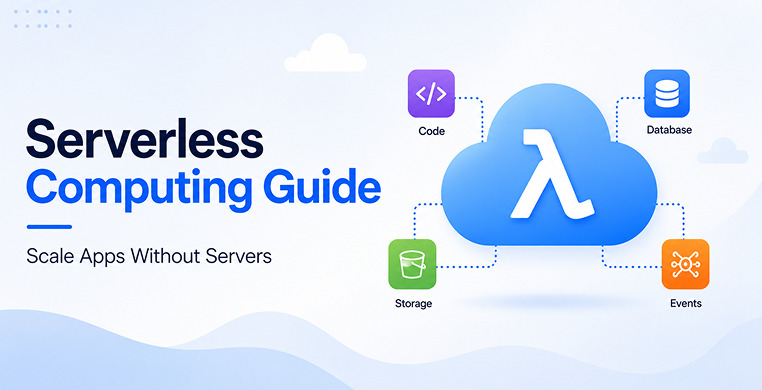
If you’re trying to decide whether serverless architecture is right for your next project, the real question usually isn’t “what is serverless computing” — it’s “will this actually save me time and money and which platform should I build on.”
Serverless app development has matured past the early hype cycle into a genuine default for event-driven backends and the platform choice now comes down to concrete trade-offs in pricing, cold start behavior and workload shape. Here’s what you need to know to build scalable apps without managing servers and how to pick the right approach for your workload.
What Serverless Architecture Actually Means
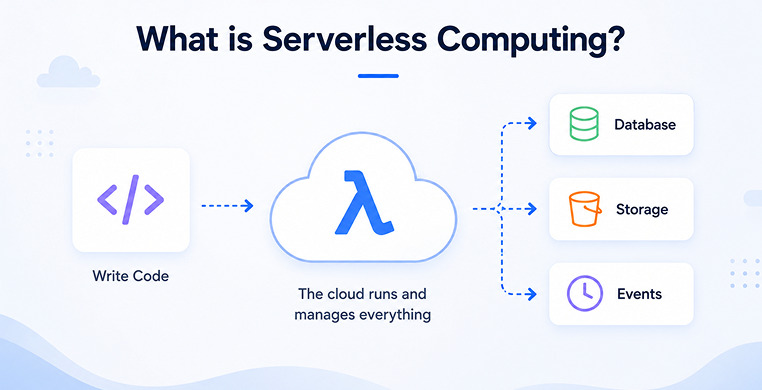
Despite the name, serverless doesn’t mean there are no servers. It means your cloud provider handles provisioning, patching and capacity planning, so your team never touches the underlying machine.
You write code as small, event-triggered units — commonly called Function-as-a-Service, or FaaS — and the platform runs them in response to an HTTP request, a file upload, a database change or a scheduled timer.
Three properties define a serverless cloud architecture:
- Stateless execution: Each function instance spins up to handle a request and disappears afterward, so nothing persists locally between invocations.
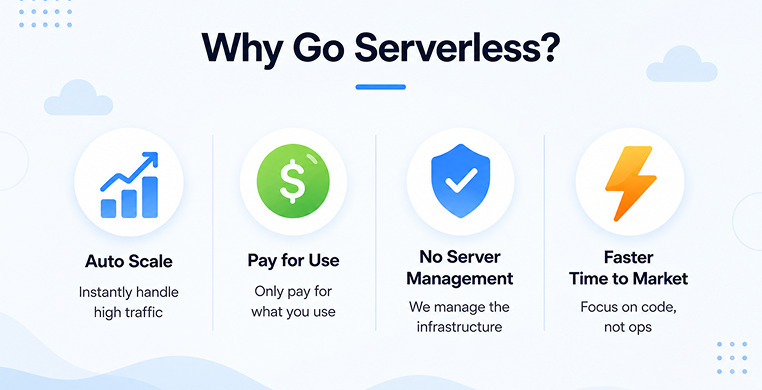
- Automatic elastic scaling: Traffic can jump from zero to thousands of concurrent requests without anyone touching an auto-scaling group.
- Pay-per-use billing: You’re charged for the milliseconds your code actually runs, not for a server sitting idle overnight.
That last point is the real draw for most teams. According to analyst estimates from firms like Grand View Research and Straits Research, the global serverless architecture market sat somewhere between $17 billion and $26 billion in 2025 and most forecasts put it on a path toward $100 billion or more by the early 2030s, growing at roughly 20% a year.
The estimates vary by research firm, but the direction is consistent: enterprise adoption is accelerating and FaaS remains the dominant slice of that spending.
AWS Lambda vs Cloudflare Workers: Choosing Your Platform
The two platforms developers compare most often — AWS Lambda and Cloudflare Workers — solve the same problem with genuinely different architectures and that difference shows up directly in your bill.
Lambda runs each function inside a Firecracker microVM, a lightweight virtual machine that gives you full isolation and a flexible runtime environment. You can allocate anywhere from 128 MB to 10,240 MB of memory and CPU power scales up proportionally as you raise the memory setting.
Cloudflare Workers takes a different approach: it runs your code as a V8 JavaScript isolate directly inside a shared process at the edge, skipping the virtual machine layer entirely. That’s the same isolation model Chrome uses to keep browser tabs separate from each other.
| Metric | AWS Lambda (x86) | AWS Lambda (ARM/Graviton2) | Cloudflare Workers (Paid plan) |
|---|---|---|---|
| Isolation model | Firecracker microVM | Firecracker microVM | V8 isolate |
| Base monthly cost | $0 | $0 | $5 |
| Request cost | $0.20 per million | $0.20 per million | $0.30 per million (after 10M included) |
| Compute billing unit | GB-seconds (wall-clock) | GB-seconds (wall-clock) | Active CPU milliseconds |
| Compute rate | $0.000016667/GB-s | $0.000013334/GB-s | $0.02 per million CPU-ms (after 30M included) |
| Free tier | 1M requests + 400K GB-s/mo | 1M requests + 400K GB-s/mo | 100K requests/day (Free plan) |
| Max execution time | 900 seconds | 900 seconds | 30 seconds |
| Cold start | 50ms–2,000ms+ | 50ms–2,000ms+ | Near 0ms |
The billing model is the part people underestimate. Lambda charges for the entire time your function is running, including any time it spends waiting on a database query or a third-party API. Cloudflare Workers only bills for active CPU time, so a function that spends most of its life waiting on I/O costs far less there.
Teams that have migrated I/O-heavy services from Lambda to Workers have reported compute cost reductions as steep as 80% for that workload profile. The reverse is true for compute-bound tasks — image processing, encryption or anything CPU-intensive tends to run 20% to 25% cheaper on Lambda’s high-memory tiers, since you can size the container to the job instead of hitting a fixed CPU ceiling.
The short version: if your app is mostly waiting on network calls, Cloudflare Workers usually wins on price. If it’s doing heavy computation, Lambda’s flexible memory allocation usually wins.
Solving the Cold Start Problem
A cold start happens when a platform has to spin up a fresh execution environment before it can run your code, typically after a period of no traffic or during a sudden spike. That startup sequence — provisioning the environment, downloading your deployment package, and initializing your application — is where most of the latency complaints about serverless computing come from.
Runtime choice matters here more than most people expect. Interpreted languages like Node.js and Python typically cold-start in 50 to 200 milliseconds. Compiled runtimes like Java and .NET, which have to load classes and initialize frameworks, can take anywhere from 200 milliseconds to well over two seconds.
Deployment package size compounds the problem — a bloated ZIP archive or container image takes longer to pull and unpack before your handler even runs.
AWS has built two specific tools to address this. SnapStart, available for Java, Python and .NET, takes an encrypted snapshot of your initialized execution environment at deployment time and resumes new invocations from that snapshot instead of booting from scratch — AWS’s own benchmarks put the improvement at up to 10x faster starts, at no additional cost.
Provisioned Concurrency takes a more direct approach, keeping a pool of pre-warmed instances on standby so requests never hit the initialization phase at all, though you pay an hourly fee for that guarantee.
If you’d rather sidestep the problem entirely, edge platforms built on V8 isolates — Cloudflare Workers being the most common example — avoid container startup altogether, since isolates share a process and boot in a fraction of a millisecond.
On the code side, regardless of platform, trimming unused dependencies through tree shaking, keeping deployment artifacts small and moving expensive setup work outside the handler function all shrink cold start time meaningfully.
When Serverless Makes Sense — and When It Doesn't
Serverless architecture is a strong fit for event-driven workloads: APIs with unpredictable traffic, webhook processors, scheduled data pipelines and anything that spends more time idle than busy.
Startups in particular benefit from not paying for capacity they don’t yet need and the elimination of server patching frees up engineering time that would otherwise go toward infrastructure upkeep rather than product work.
It’s less suited to steady, high-throughput workloads running around the clock. At that point, a traditional container platform like Amazon ECS or Fargate often comes out cheaper, since you’re paying a predictable rate for capacity you’re already using continuously rather than a per-invocation charge that adds up at scale.
Loved What You Just Read?
Let's Build Something Just as Great — For Your Business.
From web & mobile apps to UI/UX, AI solutions, and digital marketing — NGD Technolab turns ideas into scalable, real-world products. 14+ years, 550+ projects, one team you can rely on.
The practical approach most engineering teams settle on is a mix: serverless functions for spiky or infrequent work, containers for steady-state services and a clear cost model — built from your actual request volume, memory needs and execution duration — before you commit either way.
Choosing between AWS Lambda, Cloudflare Workers or a container-based alternative isn’t really about which platform is “better.” It’s about matching your workload’s traffic pattern and compute profile to the billing model that rewards it and building in the cold start mitigations that keep the whole system responsive once real users show up.
Conclusion
Serverless architecture has moved from experimental to standard practice for a reason: it removes an entire category of operational work and charges you only for what you actually use. The platform decision comes down to your workload’s shape — mostly waiting on I/O or mostly crunching numbers — and the billing model that rewards it.
Start by mapping your real request volume, average execution time and memory needs against the pricing tables above before committing to a platform, since that’s where most serverless cost surprises originate.
Frequently Asked Questions
What are the benefits of serverless architecture for startups?
Startups avoid paying for idle server capacity, since serverless computing bills only for actual execution time rather than a fixed monthly server cost. It also removes patching, capacity planning and scaling configuration from the team’s workload, which matters most when there’s no dedicated DevOps hire yet. The trade-off is less control over the underlying runtime environment, which is usually an acceptable exchange for early-stage speed.
What is the difference between serverless and containers?
Serverless functions are short-lived, event-triggered units of code that a provider like AWS Lambda spins up and tears down automatically, with billing tied to execution time. Containers, run through services like Amazon ECS or Fargate, stay running continuously and give you more control over the runtime, dependencies and long-running processes. Serverless suits spiky or infrequent workloads; containers are usually cheaper for steady, high-throughput traffic that runs around the clock.
How do you eliminate AWS Lambda cold starts in production?
The most direct fix is Provisioned Concurrency, which keeps a pool of pre-warmed function instances ready so requests skip the initialization phase entirely. For Java, Python and .NET functions, AWS Lambda SnapStart caches a snapshot of the initialized environment and can cut cold start latency by up to 10x at no added cost. Keeping deployment packages small through tree shaking and moving expensive setup code outside the handler function also reduces cold start time on every platform.
How much does it cost to migrate a backend from AWS Lambda to Cloudflare Workers?
The migration cost itself depends on how much of your code relies on AWS-specific services like DynamoDB or S3 triggers, since those integrations need to be rebuilt around Cloudflare’s ecosystem. On the ongoing bill, teams with I/O-heavy workloads — services that spend most of their time waiting on databases or third-party APIs — have reported compute cost reductions of up to 80% after moving to Workers’ active-CPU-time billing model, though compute-bound workloads often stay cheaper on Lambda.
What is the best serverless platform for enterprise apps?
There isn’t a single best serverless platform for enterprise apps — it depends on workload profile and existing cloud commitments. AWS Lambda remains the dominant choice for teams already inside the AWS ecosystem, with over 100,000 organizations using it in production and deep integration with services like DynamoDB, S3 and Bedrock for AI workloads. Cloudflare Workers is a strong fit for latency-sensitive, globally distributed, I/O-bound applications where near-zero cold starts and CPU-only billing outweigh the benefit of AWS’s broader service catalog.