An AI chatbot that hallucinates gives you a wrong sentence. An AI payment agent that hallucinates moves money. That difference is why AI payment agent hallucinations deserve a different conversation than the one most teams are having about chatbot accuracy.
As banks, fintechs and enterprises hand spending authority to autonomous agents, the definition of “hallucination” has shifted. It no longer just means a fabricated fact. It means an agent calling the wrong API, approving a transfer it shouldn’t have or acting on an instruction that was never actually given by the user.
Preventing that requires a different set of tools than prompt tuning. This guide walks through what causes these failures and the layered controls that actually stop them, drawing on how payment networks and fintech engineering teams are handling this in production today.
Hallucination Means Something Different When Money Is Involved
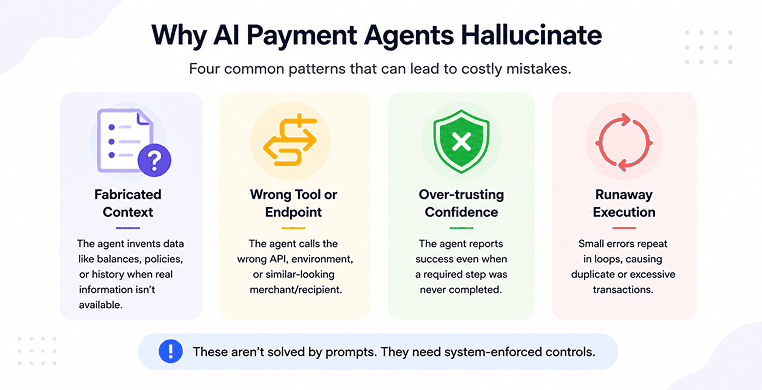
In a text-only system, a hallucination is a false statement. In an agentic payment system, it’s a false or unauthorized action. Four patterns show up repeatedly:
- Fabricated context: The agent invents an account balance, a vendor policy, or a transaction history because the real data wasn’t available in its working context.
- Wrong tool or endpoint: The agent calls a production payment API when it meant to call a sandbox, or picks a similar-sounding but incorrect merchant or recipient.
- Over-trusting its own confidence: The agent reports a transfer as completed and verified, even when a required step, like payment confirmation, never actually happened.
- Runaway execution: A small logic error compounds across a loop of automated actions, turning a minor mistake into thousands of duplicate or excessive transactions before a human notices.
None of these are solved by asking the model to “be more careful” in its system prompt. A model can read an instruction, agree with it and still violate it on the next call, because the instruction is advice the model can choose to follow, not a rule the system enforces.
That gap between what an agent is told and what it’s actually capable of doing is the real source of most AI payment agent spend controls failures.
The Problem Is Bigger Because Agents Now Actually Hold Payment Credentials
This isn’t a theoretical risk anymore. Over the past year, the major card networks rebuilt parts of their infrastructure specifically because AI agents are now initiating real transactions on behalf of consumers and businesses.
Mastercard’s Agent Pay for Machines, announced in June 2026, lets AI agents and software systems make automated payments across cards, bank accounts and stablecoins, with spending limits enforced at the network level and authorization that can be revoked in real time through the cardholder’s banking app.
Visa has taken a similar approach with its Trusted Agent Protocol and InFlow agent cards, which apply policy-governed spending boundaries to agent-initiated purchases.
Stripe’s Agentic Commerce Suite uses Shared Payment Tokens that are scoped to a specific merchant, a specific amount and a specific time window, so the agent never holds the underlying card number and the token simply stops working once the limit or session ends. The pattern across all three is the same: none of them rely on the AI model to police itself.
The spending boundary is enforced outside the model, at the payment rail, where the model has no ability to argue, reinterpret or talk its way around the rule. That’s the core lesson for anyone building fintech AI agent guardrails internally — the model proposes, and something else entirely decides.
What Actually Stops AI Payment Agent Hallucinations
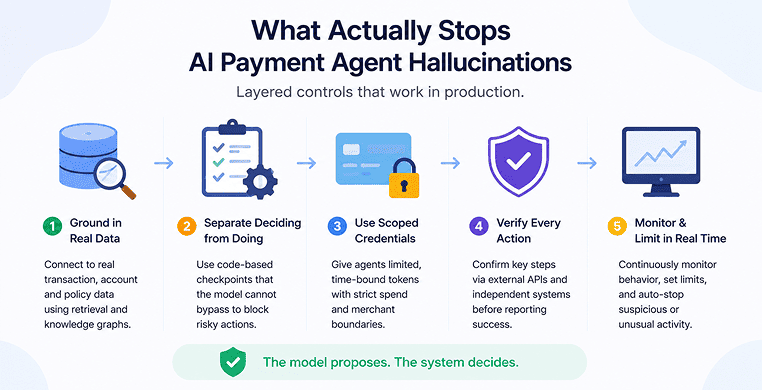
Effective protection is layered. No single control catches everything, but together they close most of the gaps.
1. Ground the Agent in Real Data
A large share of fabricated numbers and invented policies trace back to one cause: the agent didn’t have the real information, so it produced a plausible guess instead. Connecting the agent to your actual transaction records, account data and policy documents through retrieval — rather than letting it rely on general training knowledge — removes most of the incentive to guess.
Knowledge-graph-based retrieval takes this further by preserving the relationships between accounts, vendors and transaction histories, which flat document search tends to lose.
2. Separate "Deciding" From "Doing"
This is the single most important shift for preventing LLM financial hallucinations from turning into real losses. Instead of letting the model both plan and execute a payment, insert a hard, code-based checkpoint between the two.
Developers building agent frameworks often call this a symbolic or “neurosymbolic” guardrail: a rule enforced in code, not in a prompt, that the model physically cannot bypass. If a proposed transfer exceeds a threshold, targets an unapproved recipient, or tries to skip a verification step, the checkpoint blocks it regardless of what the model believes happened.
A related, softer version of this catches smaller errors: when the agent drafts something invalid, like a miscalculated fee, the system feeds the error back to the model and asks it to correct the draft, rather than letting a person catch it after the fact.
3. Use Scoped, Revocable Payment Credentials
Never give an agent standing access to a full account or a static API key. Every major agentic payment framework released in 2026 is built around narrowly scoped credentials instead: a token good for one merchant, one spending cap, one expiration window. If the agent is compromised or simply goes off track, the damage is capped by design rather than by hoping the model behaves.
4. Enforce Spend Controls at the Money-Movement Layer
| Control | What It Restricts | Why It Matters |
|---|---|---|
| Spending limits | Per-transaction and daily maximums | Caps worst-case loss even if every other check fails |
| Velocity caps | Number of transactions per minute or hour | Catches runaway loops before they compound |
| Destination allowlisting | Which accounts or merchants can receive funds | Blocks payments to unapproved or spoofed recipients |
| Tiered approval | Requires human sign-off above a threshold | Keeps a person in the loop for high-stakes decisions |
These controls sit at the wallet or signing layer, independent of the agent’s reasoning. That independence matters because standard fraud detection, built to flag unusual human behavior, often misreads a legitimate agent making dozens of small, valid transactions per hour as suspicious, while a compromised agent making one large but properly signed transfer can slip through unnoticed. Autonomous AI payment security has to account for both failure modes.
5. Add Independent Verification for High-Stakes Actions
For consequential transactions, don’t let the same agent that proposed the action also confirm it succeeded. A second, independent process — whether that’s a validator agent or a human reviewer — checking the proposed transaction against account records and policy before it’s released catches errors that a single agent, reasoning about its own work, tends to miss.
Loved What You Just Read?
Let's Build Something Just as Great — For Your Business.
From web & mobile apps to UI/UX, AI solutions, and digital marketing — NGD Technolab turns ideas into scalable, real-world products. 14+ years, 550+ projects, one team you can rely on.
6. Log Everything for Audit and Compliance
Every prompt, tool call, and payment decision should be recorded in a way that can’t be quietly edited later. Beyond the practical value during an incident review, this kind of audit trail is increasingly expected by regulators. Many banks already map AI governance controls to existing frameworks like the Federal Reserve’s SR 11-7 model risk guidance, and that expectation is extending naturally to agentic systems that touch payments.
Before You Trust a Vendor's Guardrails
If you’re evaluating a payment agent platform rather than building one, be skeptical of any vendor claiming zero hallucinations. No language model offers that guarantee and a vendor that promises it is telling you more about its marketing than its architecture. Ask instead:
- Is spending capped outside the model, at the payment rail itself?
- Can authorization be revoked instantly if something goes wrong?
- Is there a documented, measured hallucination rate, not just a claim?
- Does the system produce an audit trail you could hand to a regulator today?
A recent industry report found that only a fifth of organizations deploying AI agents have governance models mature enough to answer those questions confidently. That gap is exactly where most payment agent incidents originate — not in the model’s intelligence, but in the missing layer of control around it.
Conclusion
Stopping AI payment agent hallucinations doesn’t come down to a smarter model. It comes down to never letting the model be the only thing standing between a decision and real money moving.
Ground it in real data, enforce spend limits in code, scope every credential tightly, and keep an independent check on anything high-stakes. Get that architecture right, and a hallucination becomes a caught error not a headline.
Frequently Asked Questions
How much does it cost to build a telemedicine app?
Most telemedicine apps cost between $40,000 and $300,000, depending on features, compliance scope and where the development team is based. A basic MVP with video calls and scheduling sits at the lower end while an enterprise platform with EHR integration and AI features can run well past $300,000.
What factors affect telehealth app development cost the most?
Feature complexity, compliance requirements (HIPAA, GDPR or both) the choice between a licensed video SDK and custom WebRTC, and developer location together account for most of the price difference between projects. Feature scope and location tend to have the largest individual impact.
How much does it cost to build a HIPAA compliant telemedicine app?
HIPAA compliance typically adds 10–15% to a project’s base development cost, covering encryption, access controls, audit logging and Business Associate Agreements. On a $150,000 build, that’s roughly $15,000 to $22,500 in additional compliance-related engineering work.
How long does it take to build a telemedicine app?
Timelines generally run 3–4 months for a basic MVP, 5–7 months for a mid-tier platform and 7–14 months for an advanced or AI-driven enterprise system. Aggressive timeline compression usually increases cost rather than reducing it.
How much does EHR integration cost for a telemedicine app?
Connecting a telemedicine app to systems like Epic or Cerner through HL7 FHIR APIs typically costs $15,000 to $60,000, depending on how much workflow customization and data mapping the integration needs. It’s often scoped as its own sub-project rather than a simple add-on feature.