Most legacy system modernization framework conversations start in the wrong place: with a vendor pitching a rebuild before anyone has audited what’s actually broken. That’s how modernization budgets balloon and boards lose patience. A working application modernization strategy for CTOs starts with data, not a technology preference and it treats every application on its own terms instead of applying one strategy across the whole portfolio.
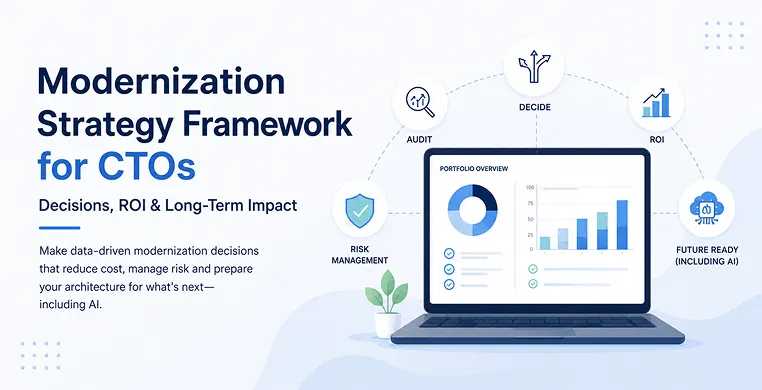
This is the framework that holds up under board scrutiny: audit the portfolio, choose the right modernization path per system, build the financial case, manage the risk and use the resulting architecture to actually support what comes next — including AI.
Why This Isn't Optional Anymore
Industry benchmarks from Gartner, Forrester and Deloitte consistently put legacy maintenance at 60% to 80% of total enterprise IT spend. That means most technology budgets are going toward keeping old systems alive not building anything new. For an organization spending $800,000 a year on IT, that can mean $500,000 or more going straight into maintenance with zero competitive return.
The signs are usually visible well before anyone runs a formal audit: release cycles that used to take days now take weeks, a shrinking pool of engineers who understand the codebase, integration work that requires custom middleware for every new tool and rising specialist contractor rates for scarce legacy skills. None of these are abstract technical concerns — they show up directly in delivery speed and operating cost.
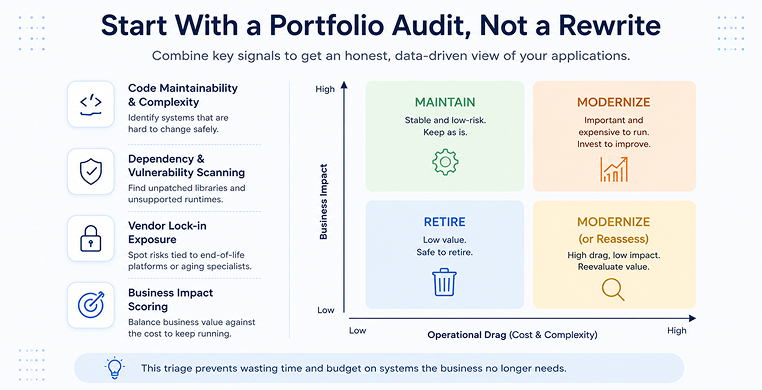
Start With a Portfolio Audit, Not a Rewrite
Before choosing a modernization path, CTOs need an honest, quantified view of the application portfolio. That means combining a few concrete signals rather than relying on gut feel:
- Code maintainability and complexity scores, which flag which systems are genuinely hard to change safely.
- Dependency and vulnerability scanning, which surfaces unpatched libraries and unsupported runtimes.
- Vendor lock-in exposure, particularly for systems tied to end-of-life platforms or a single aging specialist.
- Business impact scoring, weighing how central each application is to revenue or operations against how much it costs to keep running.
Plotting operational drag against business impact sorts every application into one of three buckets: retire it if the business value is low, maintain it as-is if it’s stable and low-risk or modernize it if it’s both important and increasingly expensive to run. This triage step is what prevents the most common modernization failure — spending months rearchitecting a system nobody actually needs anymore.
The 5 Rs: Choosing the Right Modernization Path
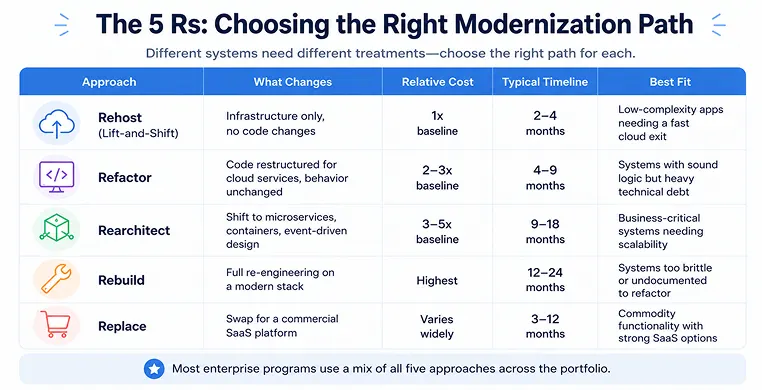
Not every legacy application needs the same treatment. A mature modernization strategy applies a different path to each system based on its complexity, business criticality and current cost of maintenance.
| Approach | What Changes | Relative Cost | Typical Timeline | Best Fit |
|---|---|---|---|---|
| Rehost | Infrastructure only, no code changes | 1x | 2–4 months | Low-complexity apps |
| (Lift-and-shift) | Code changes | Baseline | Months | Needing a fast cloud exit |
| Refactor | Code restructured for cloud services, behavior unchanged | 2–3x baseline | 4–9 months | Systems with sound logic but heavy technical debt |
| Rearchitect | Shift to microservices, containers, event-driven design | 3–5x baseline | 9–18 months | Business-critical systems needing scalability |
| Rebuild | Full re-engineering on a modern stack | Highest | 12–24 months | Systems too brittle or undocumented to refactor |
| Replace | Swap for a commercial SaaS platform | Varies widely | 3–12 months | Commodity functionality with strong SaaS options |
Rehosting is fast and cheap, but it carries every bit of existing technical debt along with it — useful mainly as a stopgap or for systems already headed toward retirement.
Refactoring and rearchitecting deliver the strongest long-term return for applications that will remain central to the business, since the cost premium over rehosting is typically recovered through lower run costs within 18 to 24 months.
Most enterprise programs end up mixing all five approaches across the portfolio rather than picking one path for everything.
Calculating the ROI
Executive sign-off requires a number, not a narrative. The core modernization ROI formula is straightforward:
ROI = (Pre-Modernization TCO − Post-Modernization TCO − Migration Cost) ÷ Migration Cost
In practice, that means comparing current infrastructure, licensing and staffing costs against the modernized state’s cloud hosting, managed services and reduced maintenance overhead.
Documented enterprise outcomes from 2025–2026 projects give a reasonable planning range: infrastructure cost reductions of 25% to 50% and payback periods typically landing between 6 and 24 months depending on scope — phased, business-case-led programs tend to land on the faster end, while full system rebuilds stretch toward the longer end.
Some organizations report substantially higher combined savings across hardware, software and staffing but those figures usually reflect best-case, fully executed transformations rather than a typical mid-scope project, so it’s worth treating them as a ceiling rather than a baseline.
The CapEx-to-OpEx shift matters here too. Moving from owned infrastructure to cloud consumption changes how the investment appears on the balance sheet, which is often as relevant to a CFO as the raw savings number.
Managing Risk Without Stalling the Business
The biggest objection to modernization isn’t usually cost — it’s the fear of breaking something that currently works. Two practices address that directly.
Zero-downtime cutover. The Strangler Fig pattern lets teams route traffic incrementally from the old system to the new one, feature by feature, instead of attempting a single cutover event. This keeps the legacy system running as a safety net until the replacement has proven itself in production.
Security and compliance as a byproduct not an afterthought. Legacy applications tend to carry outdated encryption, unpatched dependencies and audit trails that don’t meet current regulatory expectations.
A legacy system risk assessment run alongside the technical audit — checking exposure against frameworks like SOC 2, HIPAA or PCI-DSS — turns modernization into an opportunity to close compliance gaps rather than a separate project competing for budget later.
Cloud-Native Foundations and DevOps Maturity
A modernized application still underperforms if the operational practices around it haven’t caught up.
That means investing in the infrastructure layer alongside the application layer: container orchestration through Kubernetes, managed database services (DBaaS) instead of self-hosted instances, automated CI/CD pipelines that replace manual deployment processes and real-time observability to catch issues before they become outages.
Without this layer a rearchitected application on modern infrastructure still gets deployed and monitored the old way — which erases much of the benefit.
Modernization as AI Readiness
This is the part most legacy modernization conversations still leave out. Monolithic architectures with fragmented, siloed data stores can’t support the AI initiatives most boards are now asking about.
Building unified data pipelines and API-first architectures during modernization isn’t a nice-to-have add-on — it’s the prerequisite for connecting large language models, vector databases and autonomous agents to real business data later.
CTOs who treat modernization purely as a cost-reduction exercise miss this: the architecture decisions made today determine whether AI initiatives are feasible in twelve months or stuck waiting on another infrastructure project.
Loved What You Just Read?
Let's Build Something Just as Great — For Your Business.
From web & mobile apps to UI/UX, AI solutions, and digital marketing — NGD Technolab turns ideas into scalable, real-world products. 14+ years, 550+ projects, one team you can rely on.
Bringing It Together
None of these pieces work in isolation. A portfolio audit without a financial model doesn’t get board approval. A strong ROI case without a risk mitigation plan doesn’t survive the first serious incident. And a technically sound migration that ignores AI readiness just means doing this again in three years.
The CTOs who get modernization right treat it as one coordinated decision — audit, path, finance, risk, and future architecture — rather than five separate initiatives competing for the same budget.
Conclusion
A legacy system modernization framework only works when it’s sequenced correctly: know what you’re running, pick the right path per system, price it in terms the board will approve, and protect the business while you execute.
Skip any one of those steps and the project either stalls in committee or breaks something in production. Get them in order and modernization stops being a defensive IT expense and becomes the foundation the rest of the business — including AI — gets built on.
Frequently Asked Questions
What is the best legacy application modernization framework for a CTO?
There isn’t one framework that fits every system — the strongest approach is a portfolio-level process, not a single fixed method. Start with a technical debt audit that scores each application on maintainability, security exposure and business impact. Sort systems into retire, maintain or modernize. Then apply the 5 Rs (rehost, refactor, rearchitect, rebuild, replace) individually per application, based on its criticality and code condition, rather than committing the entire portfolio to one strategy. This sequencing — audit first, path second — is what separates modernization programs that get board approval from ones that stall in the planning stage.
How do you calculate the ROI of modernizing a legacy system?
The core formula is: ROI = (Pre-Modernization TCO − Post-Modernization TCO − Migration Cost) ÷ Migration Cost. In practice, that means comparing current infrastructure, licensing and staffing costs against the modernized state’s cloud hosting, managed services and reduced maintenance load. Documented enterprise projects from 2025–2026 typically show 25% to 50% reductions in infrastructure and maintenance cost, with payback periods landing between 6 and 24 months depending on scope. Phased, business-case-led programs tend to reach payback faster than full system rebuilds.
What's the difference between rehosting, refactoring and rearchitecting a legacy system?
Rehosting moves an application to the cloud with no code changes — it’s the fastest and cheapest option, but it carries all existing technical debt forward with it. Refactoring restructures the code to remove technical debt and use cloud-managed services while preserving the application’s behavior, typically costing 2 to 3 times a rehost. Rearchitecting goes further, shifting the application to microservices, containers and event-driven patterns to support real scalability, usually running 3 to 5 times the rehost baseline. Rehosting suits low-complexity or soon-to-be-retired systems; refactoring and rearchitecting are worth the premium for applications that will stay business-critical for years.
What are the main risks of legacy system migration, and how do you avoid them?
The two biggest risks are business disruption during cutover and introducing new security or compliance gaps mid-migration. A phased cutover using the Strangler Fig pattern addresses the first risk by routing traffic to the new system incrementally, feature by feature, so the legacy system stays available as a fallback until the replacement is proven. The second risk is best managed by running a legacy system risk assessment alongside the technical audit, checking exposure against relevant frameworks like SOC 2, HIPAA or PCI-DSS before migration begins, rather than treating compliance as a separate project after the fact.
How much does custom enterprise software modernization cost?
Costs scale directly with the approach and the system’s complexity. Rehosting a small to mid-size application typically runs $20,000 to $150,000. Refactoring lands in the low-to-mid six figures, often $200,000 to $500,000. Full rearchitecting or rebuilding a core business system usually starts in the mid six figures and can extend well into seven figures for complex, monolithic platforms. Large enterprise programs spanning mainframes, ERPs or regulated data can reach $1 million to $10 million or more. The single biggest cost driver isn’t the technology chosen — it’s the depth of undocumented technical debt in the existing codebase, which is why a technical audit should always come before a fixed quote