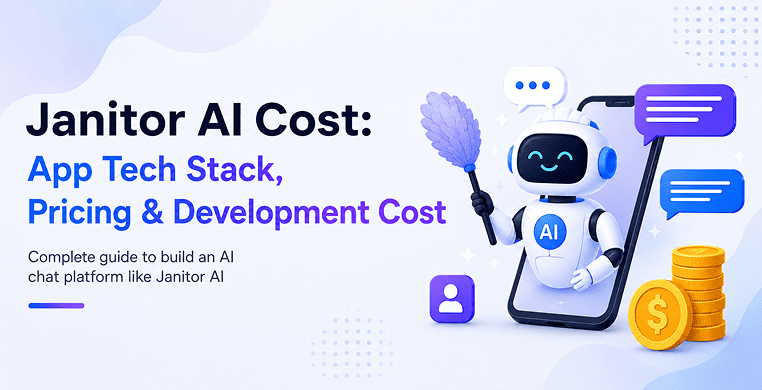
The cost to build an app like Janitor AI ranges from $40,000 for a basic MVP to more than $500,000 for an enterprise-grade platform with fine-tuned models and real-time voice.
Where your project lands in that range depends on four things: which language models you connect to, how much conversation memory you build in, how many platforms you launch on and how much ongoing infrastructure you’re willing to run yourself.
Janitor AI reached over a million users in its first week and has grown into one of the most visited character-chat platforms on the web, part of a conversational AI market projected to reach $27.29 billion by 2030.
That growth has pulled a steady stream of founders and product teams into the same question: what does it actually take to build something similar and what does it cost?
What You're Actually Building
A Janitor AI–style platform isn’t a single feature — it’s four distinct technical layers working together, and each one has its own cost profile.
- Language model integration: You can call a proprietary API like OpenAI’s GPT-4 or Anthropic’s Claude or self-host an open-source model such as Llama 3 or Mistral on your own GPU instances. APIs are cheaper to start with and require no infrastructure management, but costs scale directly with usage. Self-hosting has a higher upfront cost and ongoing GPU rental, but gives you a flat cost ceiling regardless of traffic.
- Contextual memory: Character-driven chat only feels real if the AI remembers earlier conversation. That requires a retrieval-augmented generation (RAG) pipeline backed by a vector database — Pinecone, Milvus or Qdrant are the common choices — to store and retrieve conversation embeddings. This is one of the more expensive pieces to get right, both in development time and ongoing query costs.
- Real-time messaging: Users expect responses to stream in as they’re generated, not appear all at once after a delay. That means a frontend built in React, React Native or Flutter, backed by WebSockets or Server-Sent Events for low-latency streaming.
- Moderation and safety systems: Any platform where users create and interact with AI characters needs content moderation guardrails, toxicity filtering and configurable boundaries. This is a real engineering line item, not an afterthought — it touches prompt design, output filtering and reporting workflows and it directly affects platform compliance and legal exposure.
Cost by Platform Tier

Single-number quotes don’t hold up against how differently these projects actually get scoped. Here’s how the market breaks down by complexity.
| Platform Tier | Cost Range (USD) | Timeline | Core Team | What's Included |
|---|---|---|---|---|
| Basic MVP | $40,000 – $90,000 | 2–4 months | 1 PM, 2 full-stack devs, 1 designer, 1 QA | Web app, single LLM API integration, basic character creation, standard auth, lightweight database |
| Mid-Tier Commercial App | $100,000 – $200,000 | 4–8 months | 1 PM, 1 tech lead, 3 devs, 1 AI/ML engineer, 1 designer, 1 QA | Web + mobile, RAG-based memory, vector DB integration, character marketplace, content moderation |
| Enterprise AI Platform | $300,000 – $500,000+ | 8–14+ months | 1 PM, 2 architects, 5+ devs, 2 AI engineers, DevOps, QA | Self-hosted fine-tuned LLMs, automated MLOps pipelines, real-time voice synthesis, multi-region analytics |
An MVP proves the concept works: one model connection, a working chat interface and basic user accounts. The jump to mid-tier is driven almost entirely by adding persistent memory and a mobile app — RAG pipelines and vector search aren’t cheap to build correctly.
Enterprise platforms add fine-tuning, voice, and infrastructure that scales across regions, which is where the AI/ML engineering headcount really grows.
Where Development Budget Actually Goes
Within any of these tiers, spending follows a fairly consistent pattern. Frontend and backend engineering — the core application logic, API integration and LLM orchestration — typically consumes 40% to 55% of the build budget.
Quality assurance and security audits, including load testing and moderation verification, take another 15% to 25%. Discovery and system architecture, where the AI model selection and database schema get decided, account for 10% to 15%. Deployment and DevOps setup rounds out the remaining 5% to 10%.
Regional developer rates shift these numbers substantially for identical scope. A senior engineer in North America runs $150 to $250 an hour, while the same seniority in Eastern Europe runs $65 to $120 an hour and in South or Southeast Asia, $40 to $80 an hour.
Offshore developer hourly rates for building an AI chat platform can cut labor costs by 50% or more, though that savings depends on strong project management to avoid rework.
The Cost Nobody Budgets For: Running It
Building the app is the easier half of the budget conversation. Operating it introduces costs that scale with your user base, not your feature list.
LLM inference is usually the largest recurring line item — active API consumption typically runs $1,000 to $10,000 or more per month, depending on token volume, context window length and whether you’re on OpenAI or Anthropic’s pricing tiers.
Vector indexing for conversation memory adds another $100 to $1,500 monthly, with query costs in the range of $0.10 to $0.50 per million queries at scale. Cloud hosting and database storage typically run $200 to $2,000 a month depending on traffic and media storage needs.
Beyond hosting, model retraining and fine-tuning for platforms that maintain their own models cost $5,000 to $20,000 a year in GPU compute and data annotation. Security audits and compliance work — increasingly necessary as data protection rules tighten — add another $2,000 to $10,000 annually.
Altogether, annual maintenance and operations typically run 15% to 30% of the original build cost, every year the platform stays live.
API Costs vs. Self-Hosting: The Real Trade-Off
This is the decision most founders get wrong early on. At low traffic, calling a proprietary API is almost always cheaper — you pay only for what you use, with no idle GPU cost. As monthly active users grow into the tens of thousands and message volume climbs, the equation flips: dedicated GPU instances running an open-source model start costing less per conversation than metered API calls, even after accounting for the engineering time to fine-tune and maintain them.
There’s no universal crossover point — it depends on your average conversation length and model size — but it’s worth modeling both scenarios against your actual projected usage before committing to either path.
Making the Model Pay for Itself

None of this spending makes sense without a monetization plan that scales alongside your operating costs. The platforms that succeed in this space typically combine two or three revenue channels rather than relying on one: tiered monthly subscriptions for unlimited messaging, token-based usage billing for heavier users, freemium feature paywalls that unlock advanced customization and creator marketplace revenue sharing for platforms that let users publish and monetize their own characters.
Subscription and usage-based billing work best paired together — subscriptions provide predictable baseline revenue, while usage billing captures value from your highest-cost users instead of subsidizing them. Whatever mix you choose, it needs to cover that 15% to 30% annual maintenance burden plus inference costs before it counts as sustainable.
Loved What You Just Read?
Let's Build Something Just as Great — For Your Business.
From web & mobile apps to UI/UX, AI solutions, and digital marketing — NGD Technolab turns ideas into scalable, real-world products. 14+ years, 550+ projects, one team you can rely on.
Getting to a Real Number
The honest starting point is deciding which tier your product actually needs, not which one sounds impressive. Most successful launches start at the MVP tier with a single API integration and basic memory, prove the concept works with real users and reinvest into RAG pipelines, mobile apps and eventually self-hosted models once usage justifies the infrastructure. Skipping straight to an enterprise build before you have users to support it is the most common way these projects go over budget.
Conclusion
The cost to build an app like Janitor AI comes down to how much conversation memory, moderation and infrastructure ownership your product actually needs — not a fixed price tag. Start lean, validate with a basic API integration and real users, then reinvest in the features that drive retention.
Budgeting for the 15% to 30% annual maintenance burden from day one, rather than treating the launch cost as the whole picture, is what separates projects that scale public AI chatbot from ones that stall after year one.
Frequently Asked Questions
How much does it cost to build an app like Janitor AI?
Most projects fall between $40,000 for a basic MVP and $200,000 for a mid-tier commercial app with mobile support and persistent memory. Enterprise platforms with fine-tuned models and voice synthesis can exceed $500,000. The final number depends heavily on which language model you connect to and how much custom memory infrastructure you build.
Is it cheaper to use OpenAI's API or self-host an open-source model like Llama 3?
At low to moderate traffic, calling a proprietary API is usually cheaper since you only pay for what you use. Once monthly active users and message volume climb into higher ranges, self-hosted GPU infrastructure can end up costing less per conversation, though it also adds engineering overhead for fine-tuning and maintenance that API-based models don’t require.
How much does vector database storage add to the cost of a character AI app?
Vector indexing for conversation memory through services like Pinecone or Milvus typically runs $100 to $1,500 a month, with query costs around $0.10 to $0.50 per million queries at scale. This is one of the more overlooked recurring costs, since it wasn’t part of the original MVP scope for most teams.
How long does it take to build a Janitor AI clone MVP?
A basic MVP with a single LLM API integration, standard authentication, and core character creation typically takes 2 to 4 months with a small team of two full-stack developers, a designer and a QA engineer. Adding mobile apps or persistent memory extends that timeline to 4 to 8 months.
What features push the cost of a character AI app past $200,000?
Fine-tuned proprietary language models, automated MLOps pipelines, real-time voice synthesis and multi-region database replication are the features that consistently push budgets into enterprise territory. Each of these requires specialized AI engineering talent, not just standard full-stack development, which is what drives the cost jump rather than any single feature on its own.