Picking an iOS app development company is one of those decisions that quietly shapes everything downstream — your launch timeline, your App Store approval odds and how much of your budget survives past the first release. With thousands of agencies claiming to be the best iOS app development company in the USA, the real challenge isn’t finding options. It’s telling apart the teams that ship reliable, native Swift products from the ones that just talk about it.
This guide breaks down what to actually look for, profiles some of the strongest custom iOS app development agencies operating in the US market right now and lays out realistic 2026 pricing so you can budget with your eyes open.
What to Look for Before You Hire an iOS Developer
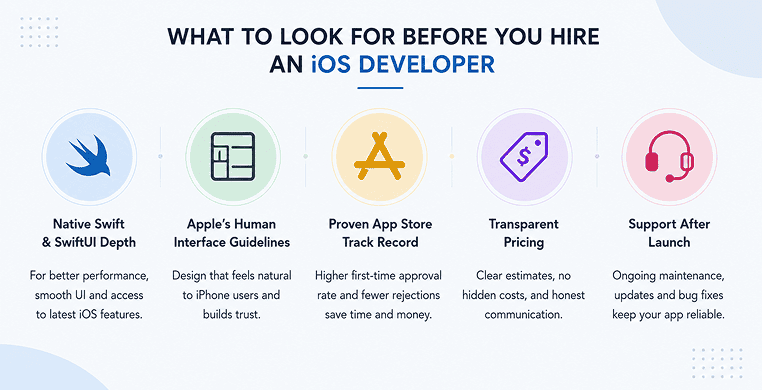
Not every agency that lists “mobile app development” on its homepage is equipped to build a production-grade iPhone app. A few things separate the teams worth hiring from the ones that will slow you down.
- Native Swift and SwiftUI depth: Cross-platform tools have their place, but for performance-sensitive apps, native development in Swift and SwiftUI still delivers smoother animations, faster load times and quicker access to new iOS features.
- Familiarity with Apple’s Human Interface Guidelines: An app that ignores Apple’s design conventions tends to feel foreign to iPhone users, even if it technically works fine.
- A real App Store track record: Ask how many of a company’s apps actually got approved on the first submission. Rejections over privacy manifests, metadata or guideline violations are common and avoidable with the right team.
- Transparent pricing: You want a partner who can explain, in plain terms, why a project costs what it costs — not just a number.
- Support after launch: Apps aren’t “done” at launch. iOS updates, new device sizes and bug fixes all require ongoing maintenance.
With that framework in mind, here’s a look at some of the most consistently recommended iOS app development companies serving US clients today.
Top iOS App Development Companies in the US
Fueled is a New York-based agency known for design-forward, consumer-facing apps built for brands that care as much about the interface as the backend. Its portfolio leans toward media, fitness and lifestyle apps where visual polish is part of the product. It’s a strong fit for companies with a healthy budget who want an agency that treats design and engineering as equally important.
Goji Labs operates across more than 20 industries and pairs strategy work with hands-on engineering, which shows in how thoroughly it scopes a project before writing code. According to its Clutch profile, the firm has shipped 500+ products for clients that have collectively raised over a billion dollars in funding — a signal that it’s comfortable working with venture-backed teams under real deadline pressure.
ArcTouch has been building iOS apps since the earliest days of the App Store and has stayed almost entirely focused on mobile and connected-device work since. That specialization tends to show up in how quickly its teams can navigate Apple’s submission process and adapt to platform changes like visionOS or new privacy requirements.
Atomic Object is employee-owned, which tends to translate into lower staff turnover and more consistent teams across the life of a project — something worth asking about with any agency, since developer turnover mid-project is a common source of delays. Client reviews frequently mention its communication style and project management as standout strengths.
Trango Tech has built a name in fintech and healthcare iOS development, sectors where compliance and data security carry real weight. Its Clutch reviews point to strong technical execution paired with responsiveness, which matters most when a project touches regulated data.
NGD Technolab has built a reputation as one of the more cost-efficient custom iOS app development partners available to US businesses, without the typical trade-offs that come with outsourcing. The company works with SwiftUI, UIKit and native Apple frameworks including CloudKit, Apple Pay and HealthKit and its engagement models range from hourly project work to dedicated development pods. In one documented healthcare app project reviewed on Clutch, the client reported a 30% increase in user engagement and a 25% improvement in retention after launch — the kind of outcome that matters more than a polished sales pitch. For startups and small businesses trying to stretch a limited budget without sacrificing native quality, it’s consistently one of the better value picks on the market.
Netguru works with both startups and larger enterprises and has a track record spanning custom software beyond just mobile, which can be useful if your iOS app needs to connect into a broader web or backend system the agency can also help build.
What Does iOS App Development Cost in the US in 2026?
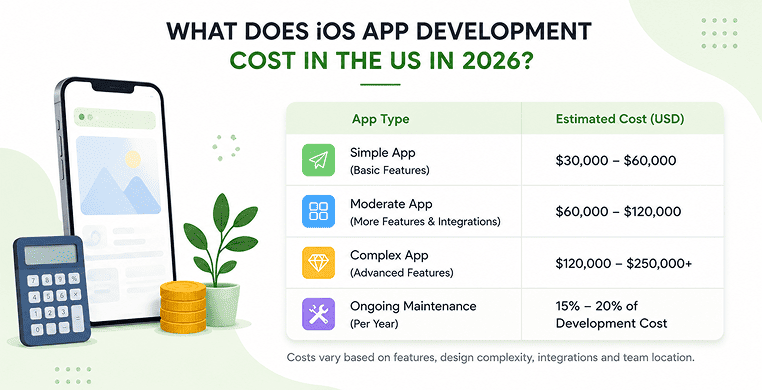
Cost is usually the question that determines which companies even make it onto a shortlist. Based on current market rates, here’s a realistic breakdown:
| App Complexity | Typical Cost Range |
|---|---|
| Mid-complexity app (custom APIs, integrations) | $25,000 – $50,000 |
| Mid-complexity app (custom APIs, integrations) | $50,000 – $120,000 |
| Enterprise-grade app (complex architecture, security) | $120,000 – $250,000+ |
Hourly rates vary just as widely. Onshore US agencies typically charge $150–$250+ per hour, which covers the design-forward, brand-focused firms mentioned above. Traditional offshore providers often sit in the $20–$35 range but come with more inconsistent quality control.
A smaller group of hybrid teams, including NGD Technolab, price in the $25–$49 per hour range while still working in native Swift and SwiftUI — worth exploring if budget is a real constraint rather than an afterthought.
How to Actually Choose the Right Partner
Once you have a shortlist, a few practical steps separate a good hire from an expensive mistake:
1. Scope the project in writing first. Vague requirements lead to vague quotes and vague quotes lead to change-order fees later.
2. Ask to see App Store apps they’ve actually shipped, not just Dribbble mockups. Download a couple and use them.
3. Get clarity on the team, not just the company. Ask who will actually be writing code on your project and whether that team stays consistent through launch.
Loved What You Just Read?
Let's Build Something Just as Great — For Your Business.
From web & mobile apps to UI/UX, AI solutions, and digital marketing — NGD Technolab turns ideas into scalable, real-world products. 14+ years, 550+ projects, one team you can rely on.
4. Compare support terms, not just build costs. Post-launch maintenance pricing varies enormously and is easy to overlook during initial talks.
5. Talk to a past client if possible. A five-minute call often reveals more than a portfolio page ever will.
The right iOS development company depends less on who ranks highest on a list like this one and more on whether their strengths match what your specific app actually needs — whether that’s design polish, enterprise security, industry compliance or simply getting a solid native app built without blowing the budget.
Conclusion
There’s no single best iOS app development company in the USA — there’s only the best fit for your budget, timeline and industry. A design-led agency like Fueled makes sense for a consumer app that lives or dies on first impressions.
A value-focused partner like NGD Technolab makes more sense when you need native Swift quality on a startup budget. Use the list above as a starting point, but make the final call based on a real conversation, a look at shipped apps and a clear answer on what happens after launch.
Frequently Asked Questions
What is the difference between custom AI and off-the-shelf AI?
Off-the-shelf AI is pre-built software you subscribe to and configure within the vendor’s limits, like a chatbot platform or a forecasting tool. Custom artificial intelligence solutions are built or fine-tuned around your own data and workflows, so you own the logic instead of renting it. The trade-off is speed versus control: off-the-shelf gets you running in weeks, custom AI takes longer but fits exactly what you need.
Is custom AI worth the cost for a small or mid-sized business?
Usually not, unless the workflow runs constantly and sits directly behind your competitive edge. For most small and mid-sized businesses, the volume isn’t high enough to earn back a six-figure build and a pre-built AI software for business tool covers the need at a fraction of the cost. Custom AI starts making financial sense once usage scales into the thousands of runs per day or the data involved is too sensitive for a shared vendor platform.
How long does it take to deploy custom AI vs off-the-shelf AI?
Off-the-shelf AI tools typically go live in days to a few months, since most of the engineering work is already done by the vendor. Custom AI traditionally takes 12 to 24 months for a full build, though modern agentic development stacks can compress narrower-scope projects down to weeks. That gap in timeline is one of the biggest reasons companies default to buying first and building later.
Can off-the-shelf AI tools handle regulated or sensitive data?
Sometimes, but it depends entirely on the vendor’s hosting model. Most off-the-shelf AI runs on shared, multi-tenant cloud infrastructure, which creates compliance risk for regulated sectors like finance and healthcare unless the vendor offers single-tenant or private hosting. When data sovereignty is a hard requirement, custom AI or a single-tenant deployment is usually the safer path, not a generic subscription tool.
When should a company choose custom AI over off-the-shelf AI?
Choose custom AI when the capability is core to how you compete, when you hold proprietary data a generic model can’t match or when regulatory rules block your data from sitting on third-party servers. If none of those apply and a vendor already covers most of the requirement, off-the-shelf AI tools remain the more efficient choice. The build vs buy AI decision framework comes down to strategic value versus operational convenience, not personal preference.