Picture this. You message a company’s chatbot to modify your flight. It asks for your booking number. You give it. It asks for your new date. You give that too. Then it says, “I’m sorry, I can’t process that. Please contact our support team.” You just spent five minutes talking to a wall.
Now picture a different assistant. You say it, “Move my flight to Friday and find me a window seat.” It verify your booking, look at seat status, rebooks the flight, gives you a confirmation, and even tells you if the new fare costs more. No hand-holding. No dead ends.
That second one isn’t a better chatbot. It’s a completely different kind of AI. And figuring out agentic AI vs chatbot technology is quickly becoming one of the most important decisions businesses make about their AI strategy.
Let’s break down what each one actually is, how they’re different, and why the difference matters more than you’d think.
What Is a Chatbot, Really?
A chatbot is a program designed to talk to you, not to do things for you. Most chatbots follow a script. You ask a question, they match it to a predefined response, and they reply. Some are simple and rule-based, working like a decision tree if you say “refund,” it shows you the refund policy.
Others are built on top of Large Language Models (LLMs) and can hold a smoother conversational flow, but they still mostly answer, explain, and guide.
Think of a chatbot as a very well-trained receptionist. It can answer common questions, point you in the right direction, and follow a set process. But if your request falls outside the script, it hits a wall.
This isn’t a bad thing chatbots are still great for FAQs, quick support, and guiding users through simple steps. They’re just not built to take independent action.
In practice, local backup acts as your private digital vault. You maintain 100% physical ownership of the hardware and data, requiring zero third-party reliance or remote permissions to access your files.
Enter Agentic AI: The Assistant That Actually Does Things
Agentic AI flips the model. Instead of just replying, it acts. It can understand a goal, break it into steps, make decisions along the way, and use tools or apps to get the job done all with very little human input.
So what is agentic AI in plain terms? It’s an AI system built to complete tasks, not just answer questions. It uses autonomous AI agents that can plan, reason through multiple steps, pull information from different sources, and carry out actions using API integrations like booking a flight, updating a spreadsheet, or resolving a customer complaint end to end.
Where a chatbot stops at “here’s some information,” agentic AI keeps going until “here’s the result.”
Agentic AI vs Chatbot: The Core Difference
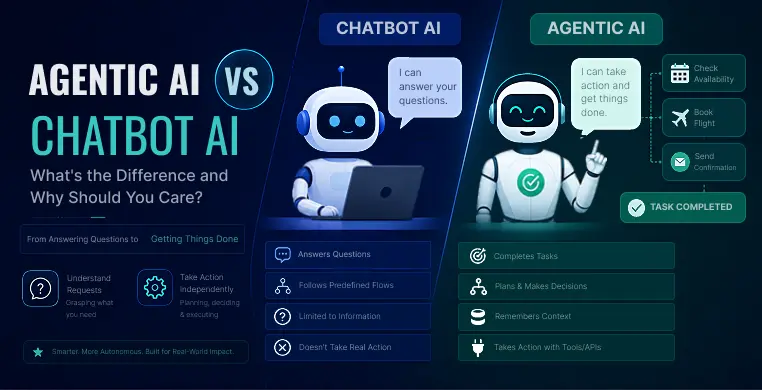
Here’s the difference between agentic AI and chatbots laid out simply:
| Chatbot AI | Agentic AI | |
|---|---|---|
| Main job | Answers questions | Completes tasks |
| How it works | Predefined responses, scripted flow | Multi-step reasoning and planning |
| Decision-making | Little to none | Makes decisions on its own |
| Memory | Often forgets context after the chat | Remembers context across steps and time |
| Takes action | Rarely – mostly talks | Yes – books, updates, executes tasks |
| Best for | FAQs, simple support, guided flows | Complex, multi-step, real-world tasks |
In short: a chatbot has a conversation. Agentic AI gets things done. That’s really the heart of conversational AI vs agentic AI one is built to talk well, the other is built to work independently.
How Do They Actually Work Behind the Scenes?
A chatbot usually works in a straight line. You send a message, it matches your intent, and it sends back a response. If it’s LLM-based, the language feels natural, but the process still ends with a reply, not a result.
Agentic AI works more like a mini project manager. It uses something called prompt chaining, where one step’s output feeds into the next step’s input, letting it work through a task piece by piece. It also relies on memory and context to remember what happened earlier in the process.
So it doesn’t lose track halfway through. And through tool use and API integrations, it can actually connect to your calendar, your CRM, your inventory system, or your email to complete the task rather than just describing it.
This is what people mean by workflow automation the AI isn’t just chatting, it’s running a small workflow on your behalf, checking each step, and adjusting if something goes wrong.
Why Should You Care? The Real Business Impact
Here’s the part that matters if you’re running a business, not just chatting for fun.
A chatbot can save your support team time on repetitive questions. That’s useful. But agentic AI can take over entire processes following up with leads, processing returns, scheduling appointments, generating reports without someone babysitting every step.
This is why so many companies are exploring agentic AI tools for business and building autonomous AI agents instead of just upgrading their old chatbot. The cost of not adopting it isn’t dramatic today.
but as competitors move faster with fewer manual steps, that gap widens. If you’re comparing agentic AI enterprise solutions, the real question isn’t “can it chat well” it’s “how much real work can it take off my team’s plate.”
Can Agentic AI Replace Chatbots?
Not entirely, and that’s a fair question to ask. Chatbots are still cheaper, simpler, and perfectly fine for basic, high-volume questions like “What are your store hours?” You don’t need a reasoning engine for that.
Agentic AI shines when the task has multiple steps, needs a decision, or touches other systems. And in most real setups, there’s still a human-in-the-loop a person who can step in, approve a decision, or take over if the AI hits something it can’t handle safely. The goal isn’t to remove people entirely; it’s to remove the repetitive, mechanical parts of the work.
So the honest answer is: agentic AI and chatbots will likely work side by side for a while, each doing what it’s best at.

Chatbot or Agentic AI: Which One Do You Actually Need?
If you’re questioning, “Do I want an agentic AI or a chatbot for customer service?” — here’s a simple way to think about it:
- If most requests are simple and repetitive, a chatbot is enough.
- If requests involve multiple steps, decisions, or actions across systems, agentic AI is worth the investment.
- If you’re migrating from chatbot to agentic AI, start with one high-friction process like order changes or appointment rescheduling instead of replacing everything at once.
Some real examples of agentic AI vs chatbots in business: a chatbot might tell a customer their order status. An agentic AI can notice the order is delayed, automatically apply a discount code per policy, and email the customer before they even ask.
Loved What You Just Read?
Let's Build Something Just as Great — For Your Business.
From web & mobile apps to UI/UX, AI solutions, and digital marketing — NGD Technolab turns ideas into scalable, real-world products. 14+ years, 550+ projects, one team you can rely on.
Where This Is All Headed
Stepping back, this shift is part of a bigger question a lot of people are quietly asking: what is artificial intelligence actually becoming useful for, beyond answering questions? As AI trends move through 2025 and into 2026, the types of AI systems businesses use are shifting from “AI that talks” to “AI that works.”
Understanding how do AI chatbots work is still useful but knowing where agentic AI fits is quickly becoming just as important for anyone planning ahead.
Key Takeaways
- A chatbot answers questions using scripted or predefined responses; it doesn’t take real-world action.
- Agentic AI uses autonomous decision-making and multi-step reasoning to actually complete tasks, not just describe them.
- The core difference: chatbots talk, agentic AI works using tool use, API integrations, and memory to get things done.
- Agentic AI doesn’t fully replace chatbots simple, repetitive queries still suit chatbots better.
- A human-in-the-loop still matters; agentic AI reduces manual work, it doesn’t remove people from the process.
- Start small: pick one complex, repetitive workflow to test agentic AI before scaling it across your business.
Conclusion
Remember that flight-rebooking chatbot that left you stuck? That frustration is exactly the gap agentic AI was built to close. Chatbots are great talkers. Agentic AI is a doer. One answers your questions; the other rolls up its sleeves and finishes the job.
You don’t need to choose one forever. Most businesses will use both chatbots for quick, simple conversations, and agentic AI for the real, multi-step work that used to need a human at every stage. The real win is knowing which one fits which job, so your AI actually saves time instead of just sounding smart.
Frequently Asked Questions
What is the main difference between agentic AI and a chatbot?
A chatbot responds to messages using scripted or predefined replies, while agentic AI can reason through multiple steps and actually complete tasks on its own, like updating records or booking something, instead of just describing what to do.
Can agentic AI replace chatbots completely?
No. Chatbots are still efficient for simple, repetitive questions like store hours or basic FAQs. Agentic AI is better suited for complex, multi-step tasks. Most businesses end up using both together.
How does agentic AI work compared to a chatbot?
Agentic AI plans a task, breaks it into steps, remembers context along the way, and connects to tools or systems through API integrations to complete the task. A chatbot typically just matches your message to a response and stops there.
Do I need agentic AI or a chatbot for customer service?
It depends on your use case. If most queries are simple, a chatbot works fine. If your team handles requests that involve multiple steps or decisions, like refunds, rescheduling, or order changes, agentic AI can save far more time.
What are some real examples of agentic AI vs chatbots in business?
A chatbot might tell you your order is delayed. An agentic AI can detect the delay, apply a discount automatically based on your policy, and notify the customer without anyone manually stepping in.