Intelligent automation in finance means using software that can read documents, make simple decisions and carry out tasks across your accounting systems, with people stepping in only when something looks odd. It mixes old-style robots (RPA) with AI, so invoices, bank matches and fraud checks get done faster and with fewer errors.
This guide explains how it works, where it pays off, what the numbers really say and how a CFO can start without getting burned.
Quick summary:
- Intelligent automation = RPA + AI that reads and decides
- Biggest wins: accounts payable, reconciliation and fraud checks
- Agentic AI is promising, but hype runs ahead of results
- Measure savings against your own baseline before you buy
What Is Intelligent Automation in Finance?
Picture two kinds of helpers. The primary is a robot that monitors a script exactly. That is robotic process automation or RPA. It clicks the similar buttons in the equal order. If a screen changes, it breaks.
The second helper can read a messy invoice, spot the vendor and the amount and decide what to do next. That is the AI layer. Put the two together and you have intelligent automation.
Three terms show up again and again:
- RPA: follows fixed steps in your software
- Intelligent document processing (IDP): uses OCR and language AI to read invoices, emails and contracts
- Agentic AI: AI “agents” that choose their own steps toward a goal
How It Works Behind the Scenes
Most setups have three layers. At the bottom sit your core systems, like your ERP, bank feeds and payment tools. In the middle, IDP turns paper and PDFs into clean data. On top, rules and AI decide what happens next.
How these layers connect matters a lot. Many early projects copied a human by clicking through screens, which is fragile. Stronger projects use APIs, which are direct links between systems. An API keeps working when a button moves, so data flows without anyone babysitting it.
Accounts Payable AI Automation: From Invoice to Payment
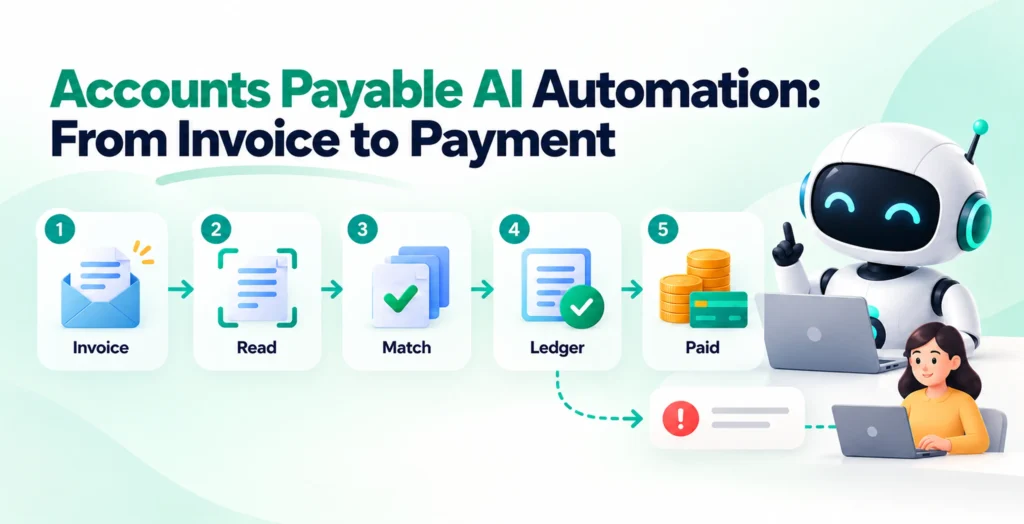
Accounts payable is where most teams start. A typical touchless flow looks like this:
1. An invoice arrives by email, portal or scan
2. IDP reads the vendor, dates, line items and total
3. The system performs a three-way match against the purchasing order and goods receipt
4. If everything fits within set limits, it posts to the ledger and queues payment
5. If not, it sends the invoice to a person with notes on what is off
The savings can be large. According to Ardent Partners’ 2025 research, the average cost to process one invoice is about $10.89, while top teams using AI capture and automated matching spend about $2.78. APQC reports that its median AP team handles about 12,000 invoices per employee each year.
Be careful with “touchless” claims, though. Reports disagree. One summary of Ardent’s data shows that only 22% of companies reach a touchless rate above 75%. Another source puts the average team near one in three invoices and the best teams closer to 49%. Your rate depends on how many invoices have no purchase order or need coding.
Automated Financial Reconciliation Software and the Faster Close
Old-school reconciliation means matching bank lines to ledger entries in spreadsheets, usually at month-end. It is slow and easy to get wrong.
Automated financial reconciliation software pulls bank data all the time through feeds. It uses fuzzy matching, which means it can pair records even when amounts differ slightly due to fees, currency changes or timing. Anything it cannot match goes to a person as an exception.
The payoff is a smaller pile of work at month-end and clearer cash numbers during the month. The month-end close stops being a scramble.
Fraud Checks and Compliance
Humans checking a sample of payments miss things. Software can check every payment. It learns what normal looks like, then flags oddities such as:
- A vendor’s bank account that suddenly changed
- A duplicate invoice
- An invoice number out of sequence
- A payment far larger than usual
Flagged items stop before money leaves. Automated workflows also keep a record of every step, which helps with audits.
Watch the rules, too. In the EU, AI used for credit scoring counts as high-risk. The EU’s Digital Omnibus pushed those duties back and according to the Cloud Security Alliance, standalone high-risk systems now have until December 2, 2027. The same note adds that transparency rules for chatbots took effect on schedule.
Agentic AI in Financial Operations: Hype vs Reality
Agentic AI is the newest piece. Instead of one fixed flow, several agents split the work. One reads documents, another checks them against orders, another scores risk and a fourth sends the approval to your ERP.
It sounds great, but be careful. Gartner predicts that more than 40% of agentic AI projects will be cancelled by the end of 2027 because of rising costs, unclear value or weak risk controls. Gartner also warns about “agent washing,” where vendors relabel chatbots or RPA as agentic AI. It counts only about 130 real agentic vendors among thousands.
The lesson is simple. Choose a clear problem with a measurable payoff and make sure the tool truly does what the label says.
CFO Finance Automation ROI: How to Measure It
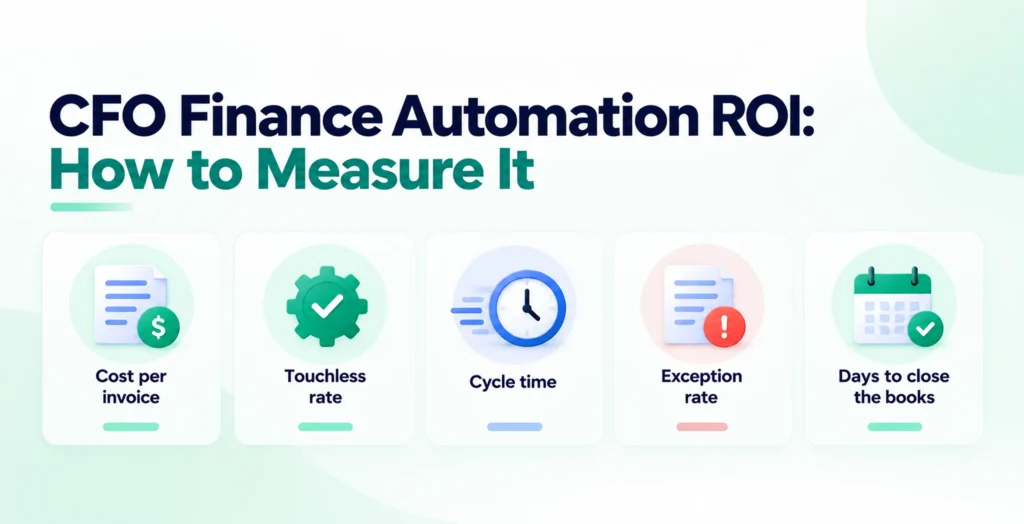
Start with your own “before” numbers. Track these five:
- Cost per invoice
- Touchless rate
- Cycle time from receipt to payment
- Exception rate
- Days to close the books
Here is a simple example. Imagine a company that processes 60,000 invoices a year. If automation moves its cost from $10.89 to $2.78 per invoice, it saves $8.11 on each one. That is about $486,600 a year, before software and setup costs.
Your numbers will differ. Subtract license fees, integration work and staff training, then check the payback time.
A Six-Step Rollout Plan
Automating a disorganized procedure only makes the mess faster. Use this order:
1. Audit your processes and list the repetitive, high-volume ones
2. Check your systems: do they have APIs and where is the data stuck?
3. Name a project lead who connects finance and IT
4. Clean up the workflow before you automate it
5. Pilot one small use case, such as invoice capture
6. Run the new and old methods side by side, then scale
Loved What You Just Read?
Let's Build Something Just as Great — For Your Business.
From web & mobile apps to UI/UX, AI solutions, and digital marketing — NGD Technolab turns ideas into scalable, real-world products. 14+ years, 550+ projects, one team you can rely on.
Keep Risk Under Control
AI needs guardrails. Four habits help most:
- Human approval for payments above a set amount or when the system is unsure
- Drift checks: model drift means the AI slowly gets less accurate as business conditions change, so test it often
- Access control and encryption for sensitive financial data
- Full logs of what the system did and why
Conclusion
Final Thoughts
Intelligent automation in finance works best when you start small, measure honestly and keep people in the loop. Pick one painful process, like invoices and prove the savings before you scale.
This guide is general information, not financial advice, so check the numbers and the rules for your own company.
Frequently Asked Questions
What is the difference between RPA and intelligent automation?
RPA copies fixed human steps, like clicking buttons and copying numbers and it breaks when a screen or document layout changes. Intelligent automation adds AI on top, so the system can read messy documents, handle small changes and decide what to do next. Think of RPA as a worker who follows a checklist and intelligent automation as one who can also read and judge. Many finance teams use both together.
What is a good touchless invoice rate?
There is no single answer, because sources disagree. One summary of Ardent Partners’ data says the average team processes about one in three invoices touchless, with the best teams nearer 49%. Another reports that best-in-class teams reach 85.7% while others sit near 36.2%. Measure your own rate first. Invoices without purchase orders usually hold it down.
How does automated bank reconciliation work?
The software pulls bank transactions through a live feed and compares them with your ledger entries. It uses fuzzy matching to pair records that differ a little because of fees, currency changes or timing. Matches post on their own and anything is not clear is goes to a person as an exception. Because this runs all month, you avoid a big matching job at month-end.
What are the major risks of using AI in finance?
The main risks are bad data, model drift, privacy leaks and rule breaking. Model drift means accuracy slowly drops as business conditions change. Reduce risk with human approval for large or unusual payments, regular accuracy tests, strong access control and complete logs. Also check the rules. In the EU, credit scoring is high-risk under the AI Act, and those duties now apply from December 2, 2027.
Which finance process should I automate first?
Start with accounts payable invoice capture. It has high volume, clear rules and easy-to-measure results, such as cost per invoice and cycle time. Run a small pilot, compare it with your manual numbers and fix the exceptions before you scale. Once that works, move to reconciliation, then fraud checks and reporting. Avoid starting with a messy process, since automation will only speed up the mess.