
The AI app ideas that make money share three traits. They fix one costly job, they sell to businesses rather than casual users and they charge based on the value delivered. Simple “wrapper” tools that only put a chat box on top of an AI model are easy to copy, so they rarely keep customers.
Here are 10 ideas, each with who pays, a price to test and how much proof exists. All figures are reported through October 2026 and I label what is proven and what is still a bet.
Quick list:
1. AI receptionist for local trades
2. Contact center AI migration
3. AI contract review for SMBs
4. AI medical scribe for specialty practices
5.AI recruiting for niche technical roles
6. AI content repurposing engine
7. AI code review and security scanner
8. AI code review and security scanner
9. Private AI for regulated industries
10. AI back office automation for small business
What the Money-Makers Have in Common
Look at the companies with real revenue and a pattern shows up. They pick a narrow field, like law, medicine or customer support. They plug into the tools their buyers already use. And many charge for results instead of seats. Sierra, for example, is described as pricing around resolved customer tickets, so its bill rises only when the work gets done.
That is good news if you are small. You do not need a new model. You need a sharp problem, a clear buyer and a price that matches the value.
1. AI Receptionist for Local Trades
Plumbers, HVAC firms and dental clinics lose money on every missed call. An AI phone agent answers, qualifies the job and books it into tools like ServiceTitan or Google Calendar.
Proof: Real products exist. According to LowCode Agency’s 2026 comparison, pure AI options start at $29 a month and most small businesses spend $50 to $300 monthly.
Price to test: A done-for-you setup fee plus $200 to $800 a month.
Watch out: It is crowded. Win with one trade, deep integrations or a white-label offer.
2. Contact Center AI Migration
Large call centers want to replace old phone menus with AI agents, without ripping out their systems.
Proof: Sierra reached $100 million in annual recurring revenue in seven quarters and one 2026 roundup says it later reached $200 million.
Price to test: Project fees plus a monthly license based on usage.
Watch out: Sales cycles are long, and buyers want proof of accuracy.
3. AI Contract Review for SMBs
Small firms sign vendor contracts without a lawyer. An AI tool flags risky clauses and explains them in plain words.
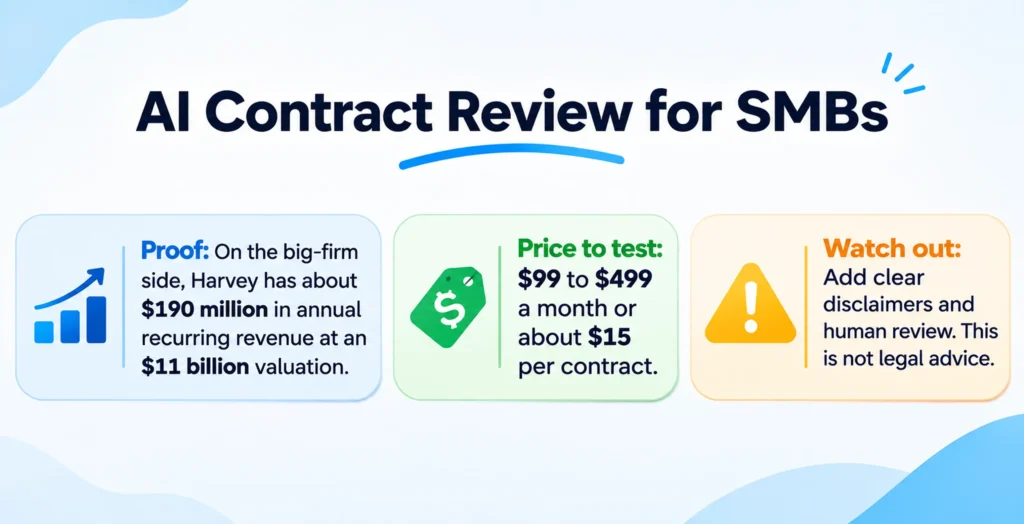
Proof: On the big-firm side, Harvey has about $190 million in annual recurring revenue at an $11 billion valuation. The small-business side is less proven.
Price to test: $99 to $499 a month or about $15 per contract.
Watch out: Add clear disclaimers and human review. This is not legal advice.
4. AI Medical Scribe for Specialty Practices
Doctors lose hours to notes. An ambient scribe listens to the visit and drafts the chart note.
Proof: Abridge is valued at about $5.3 billion. According to Commure, a human scribe costs $32,000 to $42,000 a year per provider, while most AI tools for independent practices cost $59 to $119 a month.
Price to test: $150 to $450 per provider per month for a specialty like dermatology or psychiatry.
Watch out: You need HIPAA-ready hosting and EHR links. Big vendors fight hard in this space.
5. AI Recruiting for Niche Technical Roles
Keyword search misses good engineers. An AI agent can scan code repositories and papers to find real skills.
Proof: Mercor reported more than $100 million in annualized revenue within two years. One analysis warns that its revenue is not as clean as software subscriptions, because of contractor payouts.
Price to test: A $300 to $1,000 monthly plan plus a placement fee.
Watch out: Bias rules and candidate privacy need care.
6. AI Content Repurposing Engine
Brands need many short videos. This tool turns a webinar or podcast into captioned clips and avatar-led ads.
Proof: Demand is visible. HeyGen grew revenue quickly and joined the 2026 Forbes AI 50.
Price to test: $49 to $249 a month, based on render minutes.
Watch out: Video rendering costs real money, so track margins closely.
7. AI Code Review and Security Scanner
This agent scans repositories, finds weak spots and opens fix requests.
Proof: Cursor reached about $2 billion in annualized revenue by February 2026. That shows huge demand, but giants own the broad market.
Price to test: $20 to $60 per developer per month. Aim at one narrow lane, like legacy code modernization.
Watch out: Generated fixes need strong tests.
8. AI Dynamic Pricing Software for E-commerce
Online stores lose margin when prices lag behind demand and competitors. This tool adjusts prices and stock plans automatically.
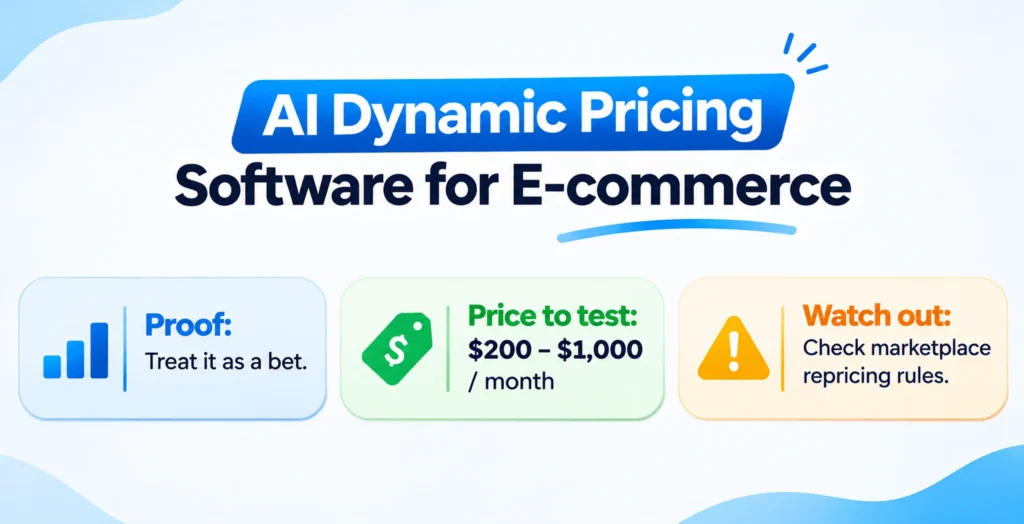
Proof: I found fewer public revenue numbers here, so treat it as a bet.
Price to test: A base fee of $200 to $1,000 a month, plus a share of the extra profit.
Watch out: Marketplaces have repricing rules. Check them first.
9. Private AI for Regulated Industries
Banks, hospitals and agencies often cannot send data to public AI tools. A private AI platform with audit logs fits them.
Proof: Rules are coming. The EU’s Digital Omnibus pushed high-risk AI duties, like credit scoring, to December 2, 2027, so buyers have time but still need to prepare.
Price to test: Annual licenses of $25,000 or more.
Watch out: Expect long sales and security audits.
10. AI Back Office Automation for Small Business
This agent sorts shared inboxes, reads invoices and pushes data into QuickBooks or Xero.
Proof: According to Ardent Partners, average invoice processing costs about $10.89, while top teams using automation spend about $2.78.
Price to test: $49 to $299 a month, based on document volume.
Watch out: Start with one task, like invoices.
Loved What You Just Read?
Let's Build Something Just as Great — For Your Business.
From web & mobile apps to UI/UX, AI solutions, and digital marketing — NGD Technolab turns ideas into scalable, real-world products. 14+ years, 550+ projects, one team you can rely on.
How to Pick Your Idea
Ask five questions:
- Do I know the buyer’s job well?
- Does the problem cost them real money?
- Can I reach them cheaply?
- Do rules or data limits apply?
- Can I earn a profit after AI costs?
Mistakes to Avoid
- Building before talking to buyers. Call ten of them first.
- Picking a crowded space with no angle. Find a niche, a trade or a tool others ignore.
- Ignoring AI costs. Voice, video and large models cost money on every use. Track your cost per customer.
- Skipping rules. Health, legal and money apps carry extra duties. Learn them early.
Conclusion
The best AI app ideas that make money in 2027 are narrow, tied to a clear cost and priced on value. Pick one niche, talk to ten buyers and test a price before you build.
Frequently Asked Questions
Which AI app ideas can a beginner start with low startup cost?
Start with ideas where you can use existing tools. An AI receptionist is one: many platforms offer white-label or reseller options, so you can sell the service under your own brand. AI back office automation for small business is another, since you can build it with no-code tools and sell it for a monthly fee. Pick one trade or one task, such as invoices, so you can learn fast and keep costs low.
How do AI apps charge their customers?
Most use one of three models. Subscriptions charge a monthly fee, often by seat or by document volume. Usage pricing charges by the minute, call or video render. Outcome pricing charges when a result happens, like a solved support ticket. Mix them carefully. Voice and video tools cost money on every use, so a flat price can hurt your margin if customers use them heavily.
Is an AI medical scribe a good business for a small startup?
It can be, but competition is fierce. Published prices for small-practice tools run from about $39 to $119 a month, while enterprise tools reach $600 or more per provider per month. A small startup can win with a narrow specialty, such as psychiatry or dermatology, plus clean EHR links. You also need HIPAA-ready hosting, so plan for security from day one.
Do I need to code to build an AI app?
Not always. You can use no-code builders, AI app builders or an agency to launch a first version. The catch is quality and security. AI-written code and no-code tools can break when you add real customers and data. Use them to test demand, then bring in a developer to review the code before you handle payments, health records or other sensitive data.
How do I validate an AI app idea before building it?
Talk to buyers first. Interview ten people who have the problem and ask what it costs them today. Then put up a simple page with your promise and a price and offer a paid pilot. Track your cost per customer during the pilot, since AI usage costs can surprise you. If people pay or sign a letter of intent, you have real signal. If they only say “sounds nice,” keep testing.