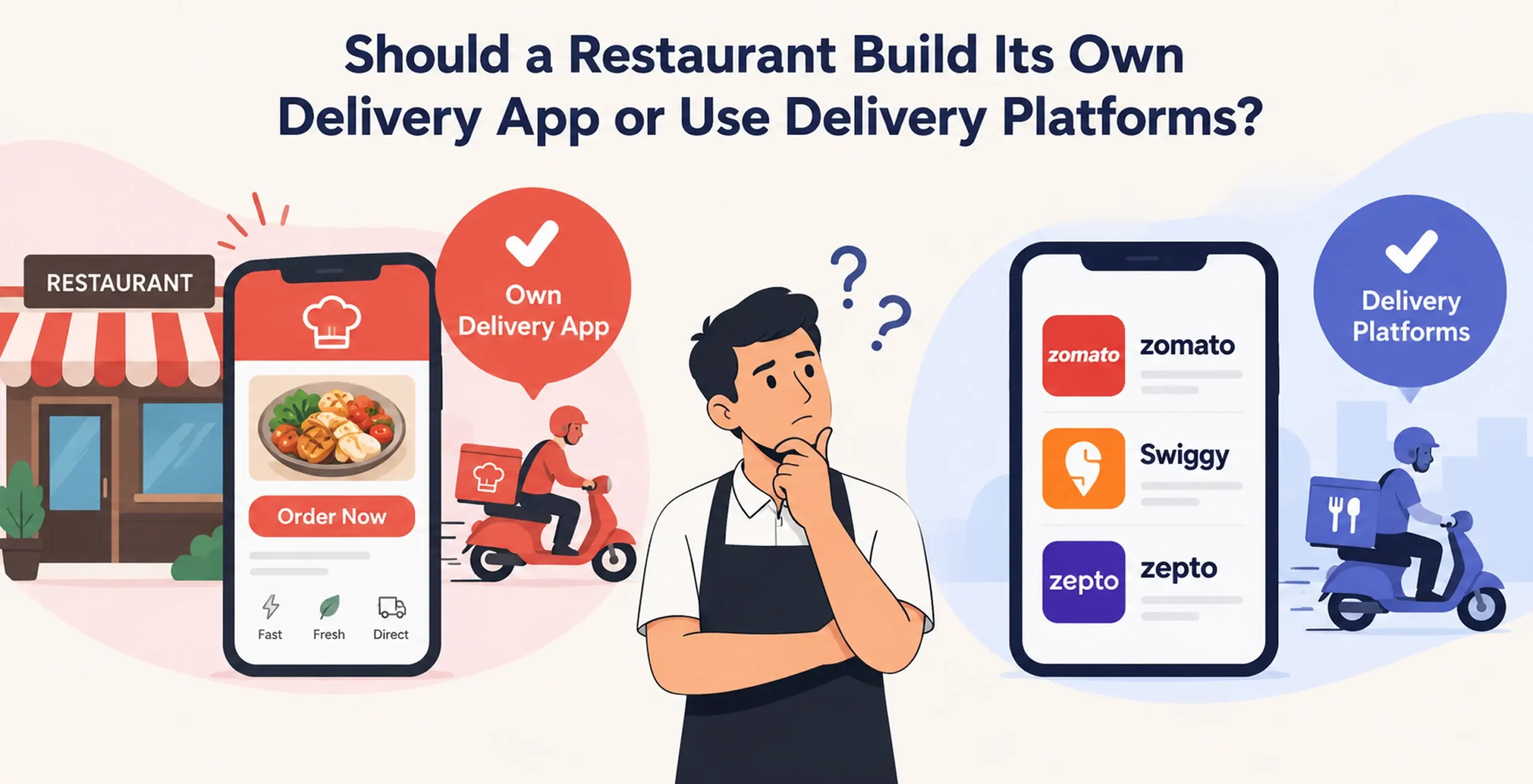
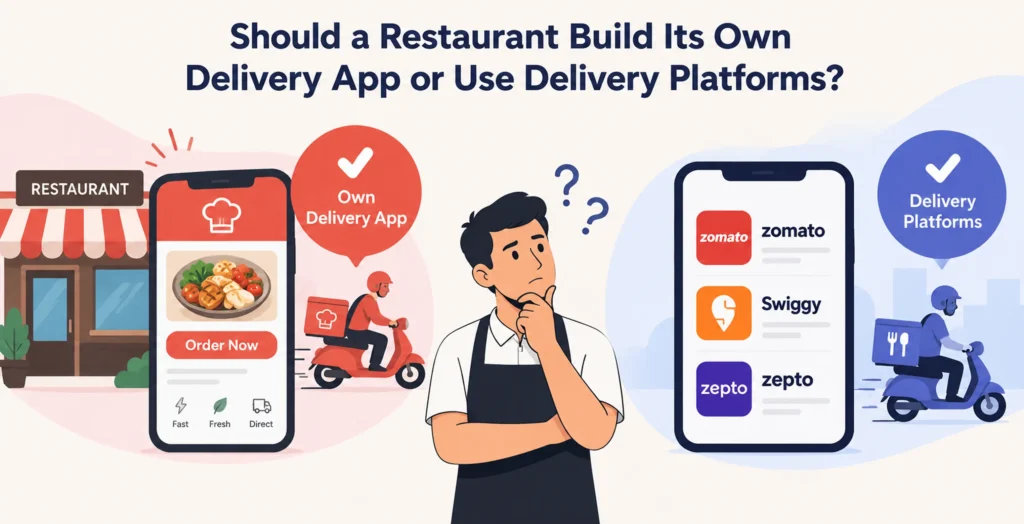
Most restaurants should do both. Use delivery platforms to get found by new customers and set up your own ordering channel to keep the repeat ones. The custom restaurant app vs delivery platforms debate is really about margin: platforms bring orders but take a big cut, while your own channel keeps more money in your pocket.
One more tip before you spend anything. Your “own channel” does not have to be a custom app. For many restaurants, a simple online ordering page works better and costs far less.
Quick summary:
- Delivery platforms give you reach, drivers and zero setup cost
- Your own channel gives you margin, customer data and brand control
- A hybrid plan usually wins
- Start small, then grow
Is It Better for a Restaurant to Build an App or Use Delivery Platforms?
Delivery platforms give you instant discovery and ready-made drivers. Your own app or ordering page gives you higher margin and customer data. Most restaurants earn the most by combining the two: platforms to attract new guests, your own channel to bring them back.
| Delivery platforms | Your own app or page | |
|---|---|---|
| Upfront cost | Almost none | Low to high |
| Cost per order | Commission plus fees | Mostly card processing |
| New customers | Many, built in | You must bring them |
| Customer data | Limited | You own it |
| Drivers | Included | You arrange them |
How Much Do Delivery Apps Charge Restaurants?
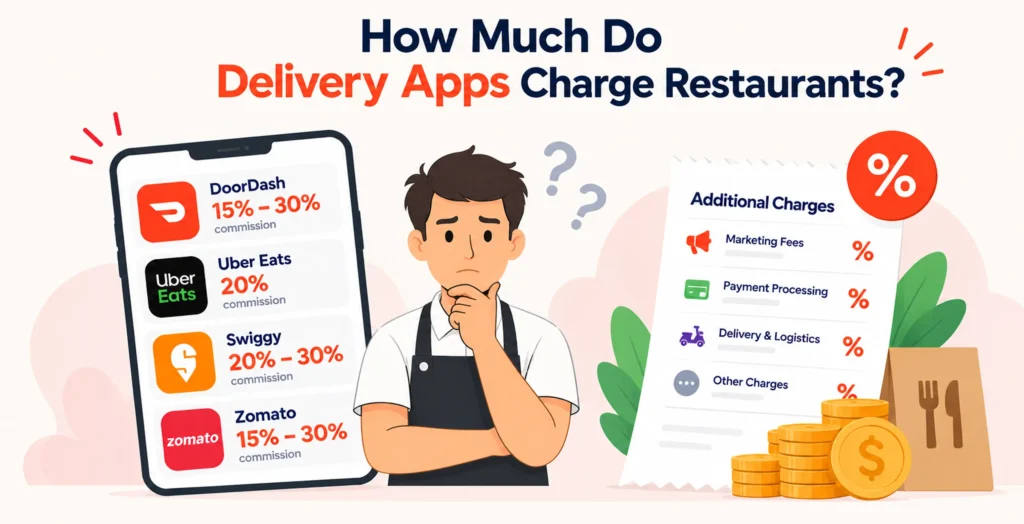
Commission is the big cost. According to one 2026 fee guide, DoorDash charges 15% on Basic, 25% on Plus and 30% on Premier for delivery, with pickup at 6%, plus a card fee of about 2.9% plus $0.30. Uber Eats changed too. Its entry plan rose from 15% to 20% in March 2026.
The headline rate is not the full bill. Another guide says that with marketing, processing and other charges, the all-in cost often reaches 25% to 35%.
Why are food delivery app fees so high? Because the app pays for the driver network, the marketing and the customers it sends you. You are renting reach.
That hurts when margins are thin. Full-service restaurants often earn 3% to 5% net profit and fast casual places 6% to 9%. Giving up 25% of a delivery order can wipe that out.
Many owners raise delivery menu prices to cope. One 2026 study found delivery menu prices run about 18% higher than dine-in on average. Even then, a 25% commission needs roughly a 33% price increase to break even.
Pros and Cons of Delivery Platforms
Pros
- No build cost
- Built-in driver network
- Instant visibility to hungry customers
- Good for a new restaurant that needs traffic
Cons
- High fees on every order
- You rarely get full customer details
- Your rivals sit on the same screen restaurant that needs traffic
- Fees and plans can change, as Uber Eats showed in 2026
Pros and Cons of Your Own Ordering App
Pros
- You keep most of the order value
- You own the customer list, so you can send offers
- You can run your own loyalty rewards
- Full control of your brand
Cons
- Upfront and monthly costs
- Hard to get people to download an app
- You must handle delivery or hire help
- You must market it yourself
What Does It Cost?
Prices vary a lot, so treat them as rough guides. One 2026 guide puts white-label apps at $15,000 to $75,000 upfront plus $500 to $5,000 a month and fully custom apps at $150,000 to $500,000 or more. Another lists a simple cross-platform restaurant app at $10,000 to $25,000.
Here is the smart shortcut. Several guides say a mobile-friendly ordering website often delivers the highest return for independent restaurants and small chains, because it is quick to set up and easy for customers to use. DoorDash even offers online ordering where, aside from card fees, orders through its own ordering tool carry no commission.
How Do Restaurants Handle Delivery Drivers With a Custom App?
You have two choices. You can use your own drivers or you can hire drivers by the delivery through a service like DoorDash Drive or Uber Direct. Uber Direct, for example, starts at $7.99 per delivery for orders placed on your own website or app.
Own drivers give you control but add payroll. A delivery service keeps things flexible. Many restaurants charge a small delivery fee so the cost does not eat the margin.
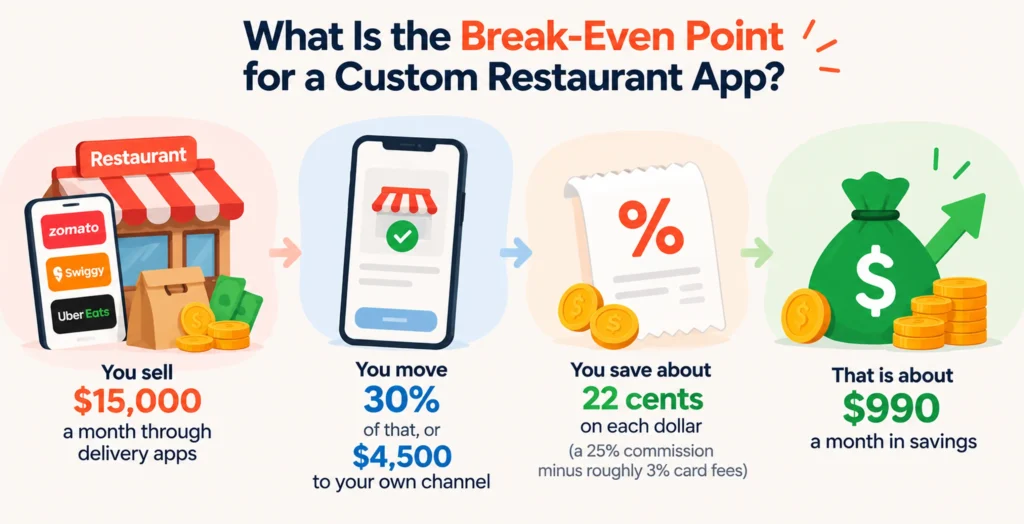
It depends on your volume, so do the math with your own numbers. Here is a simple example:
- You sell $15,000 a month through delivery apps
- You move 30% of that, or $4,500, to your own channel
- You save about 22 cents on each dollar (a 25% commission minus roughly 3% card fees)
- That is about $990 a month in savings
A $20,000 custom app would then take about 20 months to pay back. A ready-made ordering page that costs a few hundred dollars a month pays off almost at once.
Notice the pattern. The cheaper the setup, the faster the payback. That is why many restaurants start with web ordering and only build an app later, once they have loyal repeat customers.
Loved What You Just Read?
Let's Build Something Just as Great — For Your Business.
From web & mobile apps to UI/UX, AI solutions, and digital marketing — NGD Technolab turns ideas into scalable, real-world products. 14+ years, 550+ projects, one team you can rely on.
The Hybrid Strategy: Best of Both Worlds
Think of platforms as your billboard and your own channel as your shop.
- Stay on one or two platforms to get discovered
- Add a flyer or QR code to every delivery bag, with a first-order discount for your own page
- Offer rewards that only direct customers get
- Push pickup orders, since pickup fees are much lower
- Track how many customers move to your channel each month
Check each platform’s rules before you promote offers, so you do not break their terms.
Decision Checklist
A single-location restaurant should:
- Start on one platform
- Add a simple online ordering page
- Skip the custom app for now
A multi-location chain should:
- Consider a white-label or custom app once repeat orders are strong
- Connect it to the POS system so orders flow straight to the kitchen
- Build a loyalty program to bring guests back
Either way, ask yourself:
- Do I have enough repeat customers to justify an app?
- Can I handle delivery on my own orders?
- Will I market the channel every month?
Conclusion
The best answer to custom restaurant app vs delivery platforms is rarely one or the other. Use platforms to get discovered, then guide your best customers to your own ordering channel. Start with the uncomplicated tool, run the break-even math and raise only when your statistics say so.
The numbers here are examples, not financial advice, so check your own sales and fees before you decide.
Frequently Asked Questions
How can a restaurant stop paying DoorDash commission?
Not on orders that come through the DoorDash marketplace, since commission is how it earns. The way out is to move repeat customers to your own channel. Pickup orders on DoorDash cost only 6%, and orders through its own ordering tool carry no commission aside from card processing. A direct restaurant ordering page cuts your cost to roughly 3%. Keep the marketplace for discovery and push loyal guests to order direct.
Should small restaurants build their own app or stay on Grubhub?
Stay on a platform for traffic and add a simple online ordering page before you think about an app. Several guides say a mobile-friendly website gives the highest return for most independent restaurants and small chains. A custom restaurant app makes more sense later, once you have loyal repeat customers who will download it. Starting small keeps your risk low.
How do I get customers to order direct instead of from Uber Eats?
Make the direct option easy and rewarding. Put a flyer with a promo code in every delivery bag, add a QR code to your packaging and counter and offer loyalty perks that only direct customers get. One restaurant tech guide also suggests promoting direct ordering at every customer touchpoint. Check each platform’s rules before you run offers, so you do not break their terms.
Do delivery apps give restaurants their customer data?
Usually only a little. Marketplaces tend to keep most customer details for themselves, which is why many owners say they do not truly own those relationships. Some cities tried to change this. New York passed a law that required delivery companies to share customer data with restaurants on request and DoorDash sued over it. With your own ordering channel, customer data ownership is simple: the list is yours.
What is white-label delivery, and when is it worth using?
White-label delivery means you take the order yourself, then pay a service like DoorDash Drive or Uber Direct to send a driver. You pay per delivery instead of a percentage of the order. For example, Uber Direct starts at $7.99 per delivery for orders on your own website or app. It works well when you want direct orders but have no drivers of your own. Compare the flat fee with your average order size first.