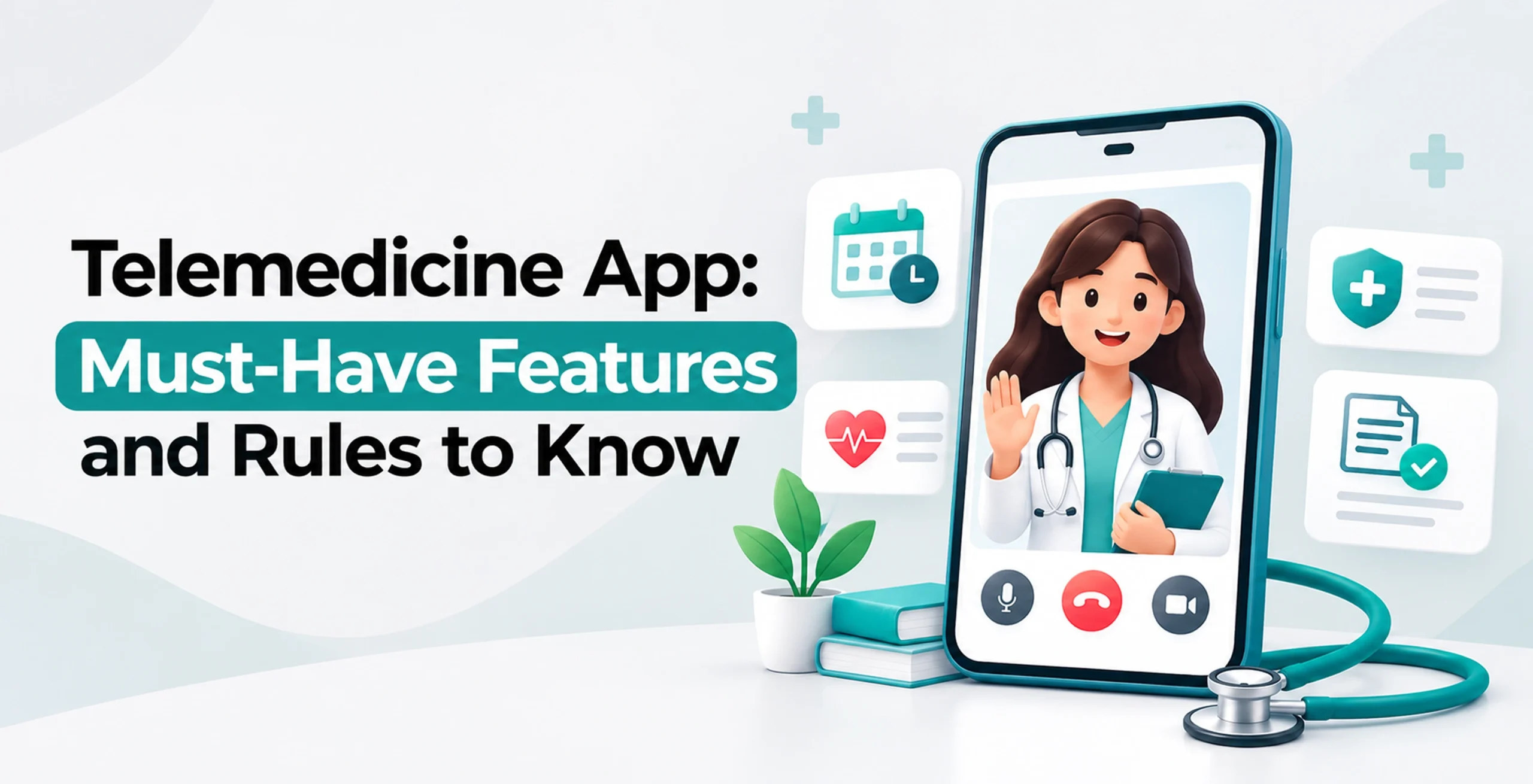
A telemedicine app lets patients see a clinician by video, chat, book visits and pay, while keeping health data private. Getting the telemedicine app features right makes the app easy to use. Getting the telemedicine app regulations right keeps you out of legal trouble.
This guide covers both in plain words, so you know what to build and which rules apply before you spend money.
Here is the quick version:
- Build three parts: a patient side, a doctor side and an admin side
- Start with video, booking, chat, payments and secure records
- Check four sets of rules: HIPAA, FTC, FDA and DEA
- Plan for a real budget and a yearly upkeep cost
Telemedicine vs Telehealth: What Is the Difference?
Telemedicine means giving medical care from a distance, like a video visit. Telehealth is wider. It also covers remote training, health education and admin work. In search, people use both words for the same kind of app, so this guide does too.
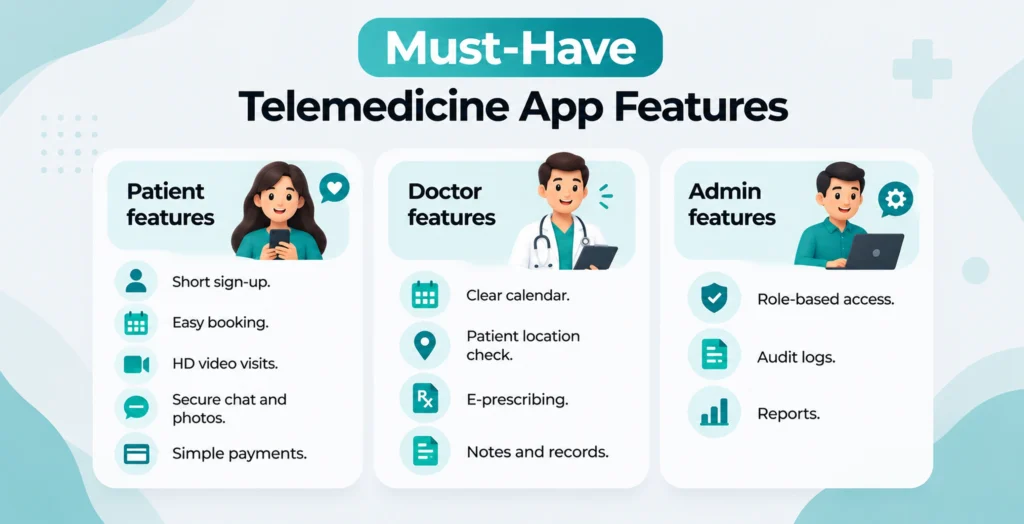
Must-Have Telemedicine App Features
A good platform has three connected parts. Think of them as three doors into one system.
Patient features
- Short sign-up. Ask only for basics first. Collect medical history, insurance and preferences later, before the visit. Long forms make people quit.
- Easy booking. Show open slots in the patient’s own time zone and send text or email reminders to cut no-shows.
- HD video visits. Most apps use WebRTC, which runs in the browser. The video should adjust itself on a weak mobile network.
- Secure chat and photos. Patients can ask follow-up questions or send a wound photo without a phone call.
- Simple payments. Accept cards and, in the U.S., HSA and FSA cards for copays and self-pay fees.
Doctor features
- Clear calendar. Show video visits, walk-in queues and in-person slots in one view.
- Patient location check. In the U.S., a clinician usually needs a license in the state where the patient sits, so the app should confirm location at check-in.
- E-prescribing. Connect to a network like Surescripts to send prescriptions to the patient’s pharmacy, with drug-interaction checks.
- Notes and records. Let doctors read history and write notes during the call. Link to the clinic’s EHR using standards like FHIR.
Admin features
- Role-based access. Staff see only what their job needs.
- Audit logs. Record who opened or changed patient data.
- Reports. Track visits, wait times and payments.
Add remote patient monitoring later if you need it. It pulls readings, like blood pressure, from devices or from Apple Health and Google Health Connect.
Telemedicine App Regulations: Four Rule Sets to Know
Rules depend on who you work for and what your app does. This table gives you the map:
| Rule | Who it covers | Main point |
|---|---|---|
| HIPAA | Providers, plans and their vendors | Sign BAAs, protect patient data |
| FTC Health Breach Rule | Consumer health apps outside HIPAA | No secret data sharing with ad tools |
| FDA | Apps that diagnose or treat | Medical device rules may apply |
| DEA | Prescribing controlled drugs | Strict identity and login checks |
HIPAA
If a clinic or health plan uses your app, you likely handle protected health data for them and every vendor in your chain needs a Business Associate Agreement (BAA).
Be careful with video. During the pandemic, regulators let doctors use everyday video tools without a BAA. According to law firm Akerman, that relief ended after a 90-day transition on August 9, 2023. Pick a video vendor that signs a BAA.
Use strong encryption and multi-factor login. HHS has proposed making these mandatory, but as of October 2026 the update is still only proposed.
FTC Health Breach Notification Rule
Consumer apps outside HIPAA still have rules. The FTC updated this rule in 2024, and the final rule took effect on July 29, 2024. A “breach” now includes sharing health data with a third party without the user’s approval, not just a hack. Think twice before adding ad pixels to health screens.
FDA
If your app diagnoses, reads images or calculates doses, it may count as a medical device. Makers of such software follow the FDA’s quality rules. The FDA’s new Quality Management System Regulation replaced the old Quality System Regulation on February 2, 2026 and it builds on ISO 13485. Simple booking and chat tools usually stay outside this.
DEA and controlled drugs
Prescribing controlled drugs online is the trickiest area. According to a Gordon Rees summary, doctors may keep prescribing controlled substances by telemedicine without a prior in-person visit through December 31, 2026.
One law firm alert from September 2026 says the DEA may soon finalize a special registration process, possibly before that date. Electronic prescribing of controlled drugs also needs multi-factor login and identity proofing. Watch this area before you launch.
If You Serve Patients in India
India has its own rules. The Telemedicine Practice Guidelines ask for patient consent, and doctors cannot prescribe drugs on the prohibited list, which includes Schedule X and narcotic or psychotropic substances.
India’s data law is rolling out in steps. The DPDP Rules were notified in November 2025, and the main duties on notice, consent and breach reporting start in May 2027. Build consent screens now.
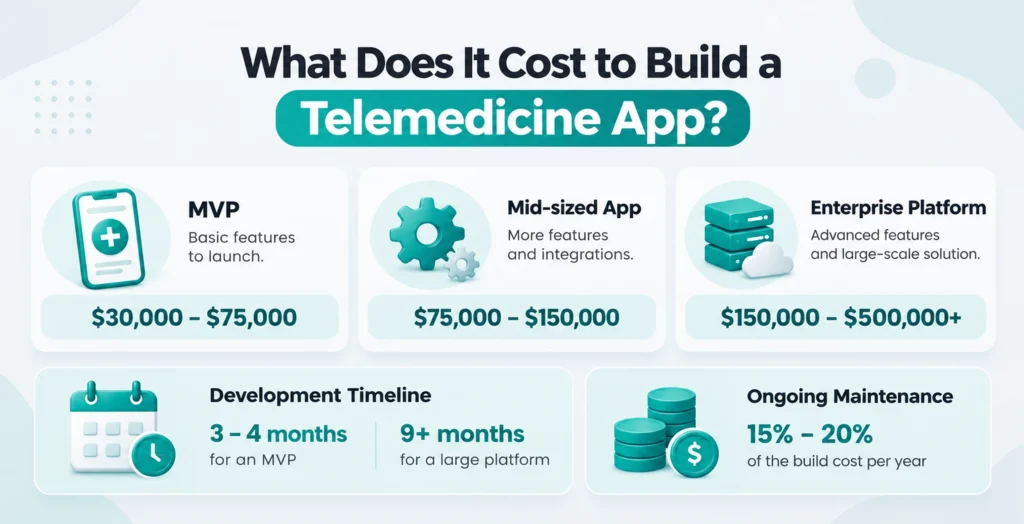
What Does It Cost to Build a Telemedicine App?
Agency guides disagree, so treat every number as a rough guide. One 2026 guide from Blaze puts an MVP at $30,000 to $75,000, a mid-sized app at $75,000 to $150,000 and an enterprise platform at $150,000 to $500,000 or more. Other guides list a basic MVP anywhere from $25,000 to $90,000.
Loved What You Just Read?
Let's Build Something Just as Great — For Your Business.
From web & mobile apps to UI/UX, AI solutions, and digital marketing — NGD Technolab turns ideas into scalable, real-world products. 14+ years, 550+ projects, one team you can rely on.
Timelines run about 3 to 4 months for an MVP and 9 months or more for a large platform.
Plan for upkeep too. Several guides suggest setting aside 15% to 20% of the build cost each year. Video minutes, EHR connections and compliance work add to the bill, so ask vendors for a line-by-line quote.
Conclusion
Final Thoughts
The best telemedicine app features are the simple ones done well: easy booking, clear video, secure chat, safe payments and records you can trust. Pair them with the right rules for your users and your country.
Start small, ask a healthcare lawyer to review your plan and grow from there. This guide is general information, not legal advice.
Frequently Asked Questions
How do telemedicine apps handle state licensing?
The patient’s location decides which state’s license a doctor needs. The physical location of the patient at the time of the visit sets which state’s license rules apply. So one of the key telemedicine app features is a location check at the start of every visit. Ask where the patient is right now, not their home address. A medical licensing compact can speed up multi-state licenses, but it does not issue a single license that works everywhere.
Do telemedicine apps need FDA approval?
Usually not for the basics. Under the 21st Century Cures Act, software for administrative support, such as billing, claims and scheduling, is not a medical device. Simple video, chat and booking tools normally fall here. The picture changes if your app diagnoses disease, reads images or tells a doctor what to do. FDA also updated its decision-support guidance in January 2026, so check the latest rules with a regulatory expert.
What video API is HIPAA compliant for telehealth?
No video tool is “HIPAA compliant” on its own. What matters is whether the vendor signs a Business Associate Agreement (BAA) that covers the exact product you use. Options include video SDKs from providers like Twilio, Vonage and Agora, or your own WebRTC setup on a cloud that signs a BAA. Ask every vendor for the signed BAA in writing before you build, and keep the video encrypted.
Can a telemedicine app prescribe controlled substances?
Yes, but this area is changing. DEA and HHS have extended the pandemic-era flexibilities that let doctors prescribe controlled drugs by telemedicine without a prior in-person visit through December 31, 2026. A permanent rule may arrive soon. Electronic prescribing of these drugs also needs multi-factor login and identity proofing, and state laws still apply. Build your e-prescribing feature to follow the strictest version.
How do telemedicine apps make money?
Most use one of three models. A subscription charges clinics a monthly fee based on doctor seats or patient volume. A per-visit model takes a flat fee or a small cut of each paid consultation. A freemium model gives core video visits away and charges for extras like AI notes, custom intake forms or EHR links. Pick the model that matches how your customers already pay for care.