Fintech apps stay legal by doing two jobs. First, they check who each customer really is. That is KYC. Second, they watch money moving through the app and report anything suspicious. That is AML. Fintech KYC compliance and AML for fintech apps are the price of handling other people’s money.
This guide explains how fintech apps stay compliant, in simple words, so founders, product managers and developers can plan with confidence.
Quick summary:
- KYC (Know Your Customer) confirms identity at sign-up
- AML (Anti-Money Laundering) monitors activity after sign-up
- Both are required for most apps that move or hold money
- Weak controls lead to big fines and lost banking partners
Why Do Fintech Apps Face Bank-Style Rules?
An app that moves money attracts criminals, so lawmakers treat it like a bank. The rules aim to stop money laundering, fraud and terrorism financing.
That is also why fintech apps ask for your ID or a tax number. The app is not being nosy. It is following the law and it can be fined if it skips the check.
What Is the Difference Between KYC and AML in Fintech?
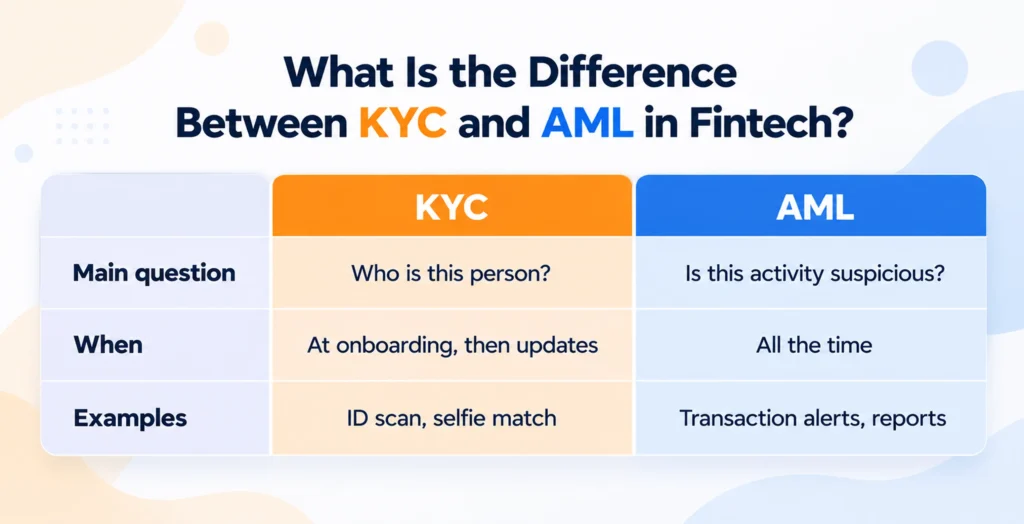
KYC is the identity check at sign-up. AML is the wider system of ongoing monitoring and reporting that stops financial crime. KYC is one part of AML, like a front-door lock inside a full security system.
| KYC | AML | |
|---|---|---|
| Main question | Who is this person? | Is this activity suspicious? |
| When | At onboarding, then updates | All the time |
| Examples | ID scan, selfie match | Transaction alerts, reports |
KYC Made Simple
KYC has three layers. Think of them as three levels of checking.
CIP is the basic identity check. In the U.S., it means collecting a name, date of birth, address and ID number, then verifying them. If your app runs on a partner bank, that bank’s rules usually flow down to you.
CDD asks a deeper question: how risky is this customer? For business accounts, you must also find out who really owns the company. According to a law-firm summary of FinCEN’s rule, it requires covered institutions to identify and verify the beneficial owners of legal entity customers and to run ongoing, risk-based checks.
EDD is extra checking for higher-risk customers, such as politically exposed persons (PEPs) or people in high-risk countries. You ask for more proof, such as the source of funds, and you review the account more often.
What is the difference between CDD and EDD in fintech onboarding? CDD is the normal check for everyone. EDD is the closer look for risky cases.
How Do Fintech Apps Verify User Identity Legally?
Most apps follow the same steps, and the whole thing takes seconds:
- The user scans a government ID
- The app matches a selfie to the ID photo
- Biometric liveness detection checks that a real person is present, not a photo or video
- A RegTech API checks the details against databases, sanctions lists and PEP lists
This is digital identity verification for fintech, often called eKYC. When you compare KYC API vendors, look at pass rate, speed, countries covered and price and test them with your own users.
How to Implement KYC in a Fintech App Without Losing Users
Every extra step loses some people. These habits help cut drop-off:
- Ask only for what the law requires at each stage
- Give clear camera tips, like “move to a bright spot”
- Let users save progress and return later
- Send failed checks to a quick manual review instead of a dead end
- Where rules allow, give low limits first and unlock more after full checks
How AML Works After Sign-Up
AML never stops. Three jobs run in the background.
Transaction monitoring in fintech software means automatic rules and sometimes AI, that scan activity as it happens. They look for odd speed, unusual amounts or transfers to high-risk places. A flagged item goes to a human reviewer.
Apps check customers against government sanctions lists and PEP lists at sign-up and again over time. Lists change often, so one check is never enough.
When something looks wrong, the app files a report with the authorities. In the U.S., money transmitters and similar businesses must file when a suspicious transaction is $2,000 or more and they have 30 days after detecting it to file.
For banks, the usual threshold is $5,000, with up to 60 days if no suspect is known. In the UK and EU, the report is often called a Suspicious Transaction Report (STR).
There is also a strict rule: you cannot tell the customer. U.S. rules for money services businesses include a legal bar on telling the customer.
Many companies name a Money Laundering Reporting Officer (MLRO) or compliance officer to own all of this. Keep a record of every report and its evidence.
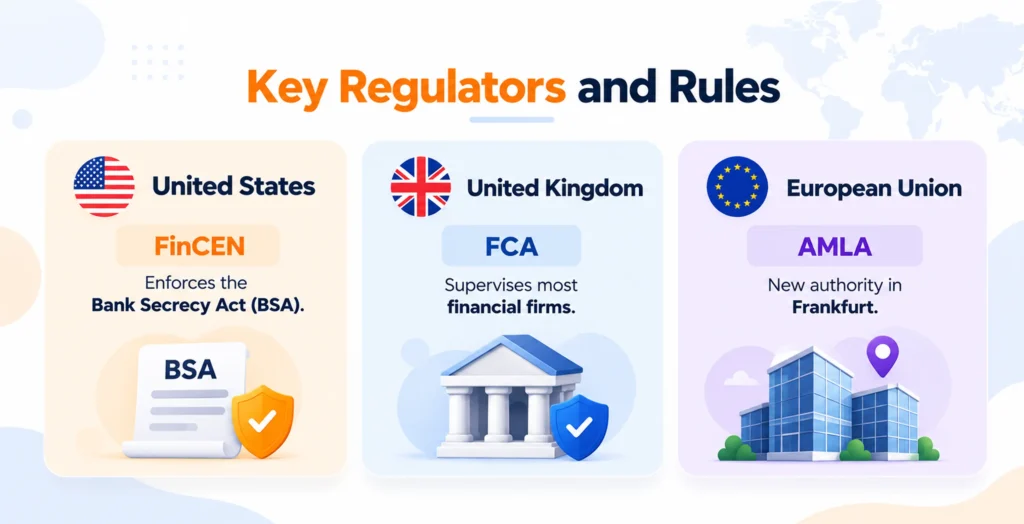
Key Regulators and Rules
Rules depend on where you operate:
- United States: FinCEN enforces the Bank Secrecy Act (BSA). Money transmitters usually register with FinCEN and also need state licenses.
- United Kingdom: The Financial Conduct Authority (FCA) supervises most financial firms.
- European Union: The EU is replacing its patchwork of national rules with one rulebook. The AML Regulation applies directly in every member state from 10 July 2027. A new authority, AMLA, now sits in Frankfurt.
If you serve users in several countries, plan for each one. A global app needs a compliance map, not one rule set.
What Happens If a Fintech App Fails AML Compliance?
The costs add up fast: fines, orders to stop onboarding, lost partner banks and, for willful violations, criminal penalties.
Real cases show how this looks:
- In 2025, the FCA fined Monzo £21.1 million for weak onboarding, risk checks and monitoring and found it had accepted “implausible” addresses, such as famous London landmarks.
- In 2024, Starling Bank was fined £29 million for what the regulator called “shockingly lax” controls around risky customers.
- In the EU, one industry guide says AMLA will be able to fine firms up to 10% of annual group turnover or €10 million
Both UK fines came from banks that grew fast without growing their controls. The lesson is simple: scale your compliance with your user numbers.
Loved What You Just Read?
Let's Build Something Just as Great — For Your Business.
From web & mobile apps to UI/UX, AI solutions, and digital marketing — NGD Technolab turns ideas into scalable, real-world products. 14+ years, 550+ projects, one team you can rely on.
A Simple Fintech Compliance Checklist
Use this list before launch, and again each year:
- Confirm which licenses and registrations you need
- Write a risk assessment that covers your products, countries and customers
- Choose KYC and AML tools and test them with real users
- Set transaction monitoring rules and alert reviews
- Name a compliance officer and train your team
- Keep records and prepare for audits
Start by doing the risk assessment. Everything else builds on it. If you lack in-house experience, a fintech AML compliance consultant can review your plan before regulators do.
Conclusion
Fintech KYC compliance and AML rules look complex, but the idea is simple. Know your customer, watch the money and report what looks wrong. Build these steps into your product early and they will protect both your users and your license.
This guide is general information, not legal advice, so have a compliance lawyer review your plan.
Frequently Asked Questions
What is the difference between KYC and AML in fintech?
KYC (Know Your Customer) checks a customer’s identity before they use a financial service. AML (Anti-Money Laundering) covers the wider process of preventing and detecting financial crime. It includes identity checks, transaction monitoring, sanctions screening and reporting suspicious activity. Fintech apps need the right controls for their services and the laws of the countries where they operate.
Are fintech apps required to follow KYC and AML regulations?
Many fintech apps must follow KYC and AML rules if they provide services such as payments, digital wallets, money transfers, or other regulated financial activities. The exact requirements depend on the business model, location and applicable laws. Even when a fintech works with a partner bank or payment provider, it should clearly understand who is responsible for each compliance task.
How does KYC verification work in a fintech app?
KYC verification usually starts when a user enters personal details and submits an accepted identity document. The app or its verification suppliers reviews the information and may ask for a selfie or a liveness check to validate that a real person is applying. Additional checks may include address verification and screening against relevant risk lists. If the information cannot be verified automatically, the case may need manual review. The exact steps depend on the service and local rules.
What is transaction monitoring in fintech AML compliance?
Transaction monitoring is the process of checking financial activity for unusual patterns that may indicate money laundering or other financial crime. For example, a fintech app might flag repeated transfers, activity that differs sharply from a customer’s normal behaviour or payments involving higher-risk parties. A compliance team reviews alerts and decides whether further investigation or reporting is needed. Effective monitoring helps fintech businesses manage AML risks after account opening.
How can fintech apps improve KYC and AML compliance?
Fintech apps can improve KYC and AML compliance by creating a clear risk assessment, choosing reliable identity verification tools, screening customers against relevant sanctions lists and monitoring transactions on an ongoing basis. They should also train their compliance teams, keep accurate records, review alerts promptly and update their controls when regulations or business risks change. Regular testing helps identify weak points before they lead to serious compliance problems.