Custom software development cost in 2026 typically ranges from $15,000 for a basic proof of concept to more than $1,200,000 for an enterprise AI platform with custom machine learning pipelines. Most mid-complexity commercial applications land between $150,000 and $350,000.
The exact number for your project depends on five factors: functional complexity, platform choice, team location, compliance requirements and how much ongoing ownership you plan to take on after launch.
A single average is close to useless for budgeting. A basic internal tool and a HIPAA-compliant healthcare platform can share the same feature list on paper and still differ in price by a factor of ten. This guide breaks the market into real budget brackets, explains what actually drives the number up or down, and shows what a project costs after launch — not just before it.
Cost by Project Type
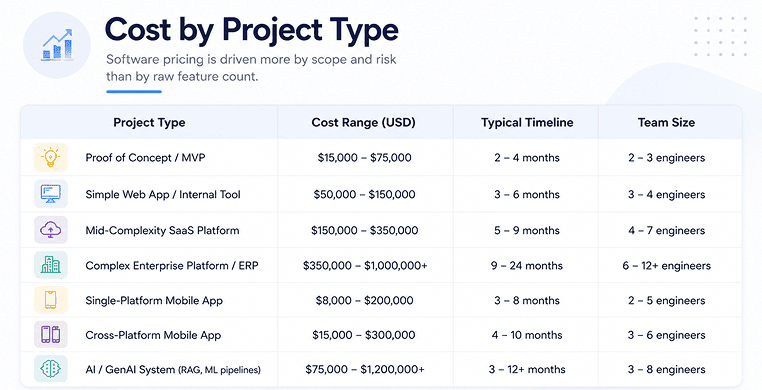
Software pricing is driven more by scope and risk than by raw feature count. Here’s how the market breaks down by project tier.
| Project Type | Cost Range (USD) | Typical Timeline | Team Size |
|---|---|---|---|
| Proof of Concept / MVP | $15,000 – $75,000 | 2–4 months | 2–3 engineers |
| Simple Web App / Internal Tool | $50,000 – $150,000 | 3–6 months | 3–4 engineers |
| Mid-Complexity SaaS Platform | $150,000 – $350,000 | 5–9 months | 4–7 engineers |
| Complex Enterprise Platform / ERP | $350,000 – $1,000,000+ | 9–24 months | 6–12+ engineers |
| Single-Platform Mobile App | $8,000 – $200,000 | 3–8 months | 2–5 engineers |
| Cross-Platform Mobile App | $15,000 – $300,000 | 4–10 months | 3–6 engineers |
| AI / GenAI System (RAG, ML pipelines) | $75,000 – $1,200,000+ | 3–12+ months | 3–8 engineers |
An MVP proves that an idea works: one core workflow, basic login, a simple backend and a usable interface. A mid-complexity SaaS platform adds multi-tenant architecture, billing automation and several third-party integrations — which is where budgets tend to jump fastest.
Enterprise and ERP builds carry the highest costs because they need to run reliably at scale, integrate with legacy systems, and support many user roles at once.
What Actually Drives the Price
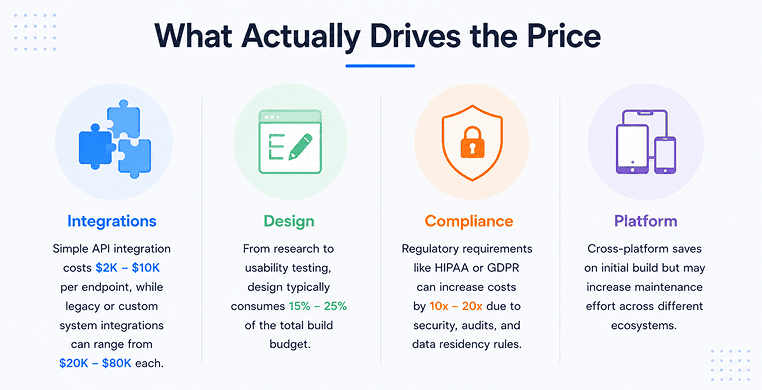
Most budget overruns don’t come from bad estimates on the visible interface. They come from underestimating what happens behind it.
Integrations. A connection to a modern, well-documented API — Stripe, Twilio, SendGrid — usually costs $2,000 to $10,000 per endpoint. Connecting to an older SAP instance, an Oracle database or a custom on-premise ERP system runs $20,000 to $80,000 per integration, because the documentation is often incomplete and the authentication methods aren’t standard. Projects with five or more integrations should plan for 20% to 30% of the entire engineering budget to go toward integration and middleware work alone.
Design. UX research and stakeholder interviews cost $5,000 to $20,000. Information architecture and wireframing add another $5,000 to $15,000. Custom visual design and a design system run $10,000 to $40,000 and usability testing adds $10,000 to $35,000 more. Altogether, design typically consumes 15% to 25% of the initial build budget — more if the product is consumer-facing.
Compliance. Adding a regulatory requirement can change a project’s price more than any feature ever will. Turning a standard scheduling tool into a HIPAA-compliant one, for example, can increase the cost by 10x to 20x for what looks like the same functionality on the surface. The increase comes from audit logging, strict role-based access control, encryption at rest and in transit and hiring restrictions tied to data residency rules.
Platform. A single native app (Swift or Kotlin) is cheaper to build than a cross-platform product but more expensive to maintain across two ecosystems long-term. React Native and Flutter reduce duplicate work but add their own tooling and update overhead.
Hallucinations in a retail chatbot aren’t a single failure type. They tend to fall into four recognizable patterns, each with its own business fallout.
Regional Labor Rates
Where your development team sits changes the bottom line more than almost any other variable — but it isn’t the whole story. Weak project governance can erase the savings from a lower hourly rate through rework and miscommunication.
| Region | Junior | Mid-Level | Senior | Solutions Architect |
|---|---|---|---|---|
| United States | 80–120/hr | 120–180/hr | 150–250/hr | 200–350+/hr |
| United Kingdom | 70–110/hr | 100–160/hr | 140–220/hr | 180–300/hr |
| Western Europe | 60–100/hr | 90–150/hr | 120–200/hr | 160–280/hr |
| Eastern Europe | 30–50/hr | 45–80/hr | 65–120/hr | 90–160/hr |
| Latin America | 25–45/hr | 40–70/hr | 60–110/hr | 80–150/hr |
| South & Southeast Asia | 15–30/hr | 25–50/hr | 40–80/hr | 60–120/hr |
Offshore teams in Eastern Europe, Latin America or South and Southeast Asia can cut labor costs by roughly 40% to 60% compared to U.S.-based teams. Latin America is a common middle ground for U.S. companies because of closer time zone overlap, even though nominal rates run slightly higher than South Asia.
Fixed Price, Time and Materials or Dedicated Team
The contract model you choose shapes both your budget certainty and how much scope flexibility you keep.
- Fixed price gives you a locked number upfront, but any change to requirements needs a formal change order. Vendors usually build a 15% to 30% risk premium into the quote to cover scope uncertainty, which means you’re often paying for flexibility you’re not allowed to use.
- Time and materials (T&M) bills for actual hours worked. It costs less on paper and suits products that will change shape during development, but it shifts scope management onto you.
- Dedicated team models charge a predictable monthly rate, typically a 5% to 15% premium over baseline T&M pricing. This works well for products that need sustained development over a year or more rather than a single deliverable.
A tightly scoped MVP with well-defined requirements is a reasonable fit for fixed price. A product still finding its market fit is usually a better fit for T&M or a dedicated team.
The Cost After Launch
The build itself is only part of the budget. Hosting, security patching, CI/CD pipelines, and third-party licenses typically add 15% to 30% of the original build cost every year after launch. A $200,000 application can reasonably cost $30,000 to $60,000 annually just to keep running and current.
Within a typical initial budget, direct engineering usually takes up 40% to 55% of spend, quality assurance and testing take 15% to 25%, deployment and infrastructure setup take 5% to 10% and discovery and prototyping take another 10% to 15%.
Treating these as one-time costs rather than an ongoing commitment is one of the most common budgeting mistakes companies make.
Where AI Tools Fit Into the Price
AI-assisted coding and testing tools speed up development on well-defined, repetitive tasks and many teams have adopted them by 2026. But this hasn’t translated into a straightforward drop in project pricing.
The hours saved on routine coding are often absorbed elsewhere — vector database maintenance, GPU infrastructure for AI features, data pipeline governance and higher pay for the specialized engineers who build and maintain these systems.
A project that includes retrieval-augmented generation or a custom machine learning pipeline still commands premium pricing, generally $75,000 to well over $1,000,000 because the infrastructure and specialized talent involved haven’t gotten any cheaper even as coding itself has gotten faster.
Loved What You Just Read?
Let's Build Something Just as Great — For Your Business.
From web & mobile apps to UI/UX, AI solutions, and digital marketing — NGD Technolab turns ideas into scalable, real-world products. 14+ years, 550+ projects, one team you can rely on.
Getting a Realistic Number for Your Project
There’s no substitute for a proper scoping conversation, but you can get close by working backward from three questions: What tier does your project actually fall into based on the table above? How many integrations and are they modern APIs or legacy systems? And does your industry carry compliance requirements that will multiply the base estimate?
A vendor quote that skips these questions and jumps straight to a single number is usually either underscoping the work or padding for risk they haven’t explained. Ask for the breakdown by category — engineering, design, QA, infrastructure — and treat any number without one as a starting point for negotiation, not a final answer.
Conclusion
Custom software development cost in 2026 isn’t one number — it’s a range shaped by scope, compliance, team location and how much you plan to spend after launch. The brackets and drivers above give you a realistic starting point, but the only way to get an exact figure is to scope the work in detail before you sign a contract.
Budget for the full lifecycle, not just the build, and you’ll avoid the surprise costs that catch most first-time buyers off guard.
Frequently Asked Questions
How much does custom software development cost in 2026?
Most projects fall between $50,000 and $350,000, depending on complexity. A basic MVP can start around $15,000, while a full enterprise platform with compliance requirements or AI features can exceed $1,000,000. Project scope and integration count matter more than any single feature you add.
What is the average hourly rate for custom software developers?
Hourly rates vary sharply by region. U.S.-based senior developers charge $150 to $250 an hour, while senior developers in Eastern Europe or Latin America typically charge $60 to $120 an hour. The rate alone doesn’t determine total cost — team size, project length, and management overhead matter just as much.
Is time and materials or fixed price better for custom software development?
Time and materials works best when requirements are likely to change during the build, since it doesn’t require formal change orders for every adjustment. Fixed price gives budget certainty but usually includes a 15% to 30% risk premium, making it a better fit for tightly scoped, well-defined projects like an MVP.
How much does it cost to maintain custom software after launch?
Ongoing maintenance, hosting, security patching, and licensing typically run 15% to 30% of the original build cost every year. A $200,000 application usually needs $30,000 to $60,000 annually to stay secure, updated, and running reliably.
Why is custom software so expensive for regulated industries like healthcare?
Compliance requirements such as HIPAA add audit logging, strict access controls, end-to-end encryption, and hiring restrictions tied to data residency. These requirements can raise the cost of an otherwise standard application by 10x to 20x, even when the visible feature set looks unchanged.