Meera had it all planned out. She saved up $10,000, made a neat spreadsheet, and hired a small team to build her app. Three months in, the number on her screen said $17,500 — and the app still wasn’t live. Nobody stole her money. No one made a mistake either. The costs were just… hidden.
Small charges here, a surprise fee there, until they added up to something she never budgeted for. If you’re planning to build a digital product — an app, a SaaS tool, an online course, or anything people use or download — this happens more often than you’d think. The good news?
Once you know where these costs hide, you can plan for them instead of getting surprised by them.
What Is a Digital Product, Anyway?
A digital product is anything you sell or offer that isn’t physical — apps, software (SaaS), online courses, ebooks, templates, or digital downloads. You don’t ship a box. You ship code, content, or access.
And that’s exactly why the costs of building one are different from building anything physical. There’s no warehouse rent, but there are servers, APIs, and fees that quietly bill you every month.
Why Does App Development Go Over Budget?
Most founders budget for the parts they can see: design, coding, maybe testing. But a digital product isn’t just “built once and done.” It needs to run, get found by users, accept payments, stay secure, and keep working as more people use it.
Each of those needs comes with its own price tag — and most of them don’t show up until after launch. That’s the real reason software development budgets go over: the plan covers the build, but not the business of running it.
Here are the 10 costs that catch almost everyone off guard.
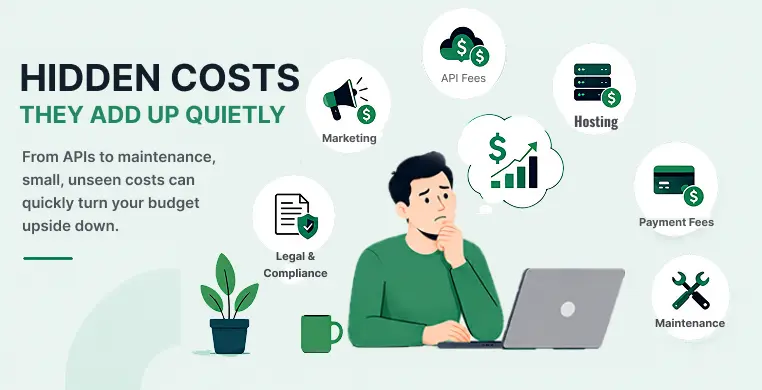
The tools you build with — your tech stack — often come with usage-based pricing. A weather API, a mapping tool, an AI feature, or a messaging service might be free at first and then charge you per request once you grow. Always check the pricing tier of every third-party API before you rely on it, not after your bill jumps.
Hosting feels cheap when you have ten users. It stops feeling cheap when you have ten thousand. As your product grows, server scaling costs rise with it — more storage, more bandwidth, more computing power. Budget for hosting like a subscription that grows with your success, not a one-time setup fee.
If you’re selling anything — a SaaS subscription or digital downloads on Shopify — payment gateways like Stripe or PayPal take a cut of every sale, usually 2-3% plus a small fixed fee. Add chargebacks (when a customer disputes a payment) and you lose the sale amount plus a penalty fee. These SaaS hidden fees are small per transaction but add up fast at scale.
You planned a simple Minimum Viable Product (MVP) — just the core features to test your idea. Then someone suggests “just one more feature.” Then another. Before you know it, your MVP has grown into a full product, and so has the bill. Scope creep is one of the biggest, quietest budget killers in digital product development.
Building the product is only half the job — getting people to actually use it is the other half. Your user acquisition cost (CAC) covers ads, influencer deals, content marketing, and more. Many founders spend everything on development and forget they need a budget just to get their first real users through the door.
Launch day isn’t the finish line. Bugs need fixing, operating systems update, and users need support. Ongoing maintenance and support usually costs 15-20% of your original build cost every year. Skip this budget line, and your product slowly breaks while nobody’s watching.
Terms of service, privacy policies, data protection laws (like GDPR), and app store approval rules all need attention — usually from a lawyer. Yes, you do need to budget for legal fees when building an app, especially if you’re handling user data or payments. Skipping this can cost far more later in fines or rejected app store submissions.
Your first design is rarely your last. Once real users try your product, you’ll find confusing screens, awkward flows, and buttons nobody clicks. Budget for a few rounds of design changes after launch — not just before it.
Bugs are expensive, but finding them late is even more expensive. Testing across devices, browsers, and operating systems takes real time and often a dedicated tester. Many teams treat testing as a “nice to have” and pay for it later with unhappy users and emergency fixes.
Beyond the core developer’s rate, there are project managers, QA testers, designers, and the time spent coordinating everyone. This overhead rarely appears in the first quote you get, but it’s very real once the project is underway.
Loved What You Just Read?
Let's Build Something Just as Great — For Your Business.
From web & mobile apps to UI/UX, AI solutions, and digital marketing — NGD Technolab turns ideas into scalable, real-world products. 14+ years, 550+ projects, one team you can rely on.
How Much Should You Actually Budget?
A simple rule: take your development quote and add another 25-30% on top for the costs above. If you want more precision, use a digital product budget template or a SaaS cost calculator before you start — most app development estimators let you break down costs by feature, so you’re not budgeting blind.
A software project cost breakdown spreadsheet is worth the hour it takes to set up; it will save you from Meera’s situation.
Key Takeaways
- Hidden costs like APIs, hosting, and payment fees often cost more over time than the actual coding.
- MVP scope creep quietly turns a simple build into an expensive one — protect your MVP scope early.
- Budget 15-20% of your build cost every year for maintenance and support after launch.
- Legal fees and compliance aren’t optional extras — they protect you from bigger costs later.
- Add 25-30% on top of your development quote to cover the costs most people forget.
- Use a cost calculator or budget spreadsheet before you start, not after you’re over budget.
Conclusion
Meera’s app did launch — a little late, and a little over budget. But the second time she built a product, she knew better. She mapped out hosting, payment fees, legal costs, and support before writing a single line of code.
Her second launch came in almost exactly on budget — not because costs disappeared, but because she stopped letting them hide. That’s really the whole point. Hidden costs aren’t dangerous because they’re big. They’re dangerous because nobody looks for them until it’s too late.
Frequently Asked Questions
What are the most commonly forgotten costs when building a digital product?
Cloud hosting, payment processing fees, legal and compliance costs, ongoing maintenance, and user acquisition cost are the ones founders forget most, since they don’t show up until after the core product is built.
How much does Stripe take from digital product sales?
Stripe typically charges around 2.9% plus a small fixed fee per transaction, though rates vary by country and payment type. Always check current pricing on Stripe’s site before budgeting, since it can change.
Do I need to budget for legal fees when building an app?
Yes. Even a simple app needs a privacy policy and terms of service, and handling user data or payments usually requires legal review for compliance. Skipping this can lead to bigger costs later, like app store rejections or fines.
How much should I budget for API costs in my SaaS?
It depends on usage, but a safe starting point is to check each API’s pricing tier and estimate cost based on your expected number of users. Many APIs are free at low volume and charge per request once you scale, so re-check pricing as you grow.
What are the hidden costs of building a course platform?
Beyond the platform itself, expect payment processing fees, video hosting and streaming costs, student support, and marketing to get your first students. Many course creators also underestimate the cost of updating content over time.