The best way to get your first 100 app users is to find them one by one. Pick a small group of people with a clear problem, talk to them directly where they already hang out and help each new user yourself. Ads and big launches can wait.
Y Combinator’s Paul Graham has said for years that founders must recruit their first users by hand, because users will not come on their own. This guide turns that idea into six steps you can start this week.
Why Paid Ads Rarely Work for Your First 100 Users
Ads buy installs, not loyal users. Cost matters too. Reports disagree on exact numbers, but one 2026 report puts iOS installs at about $4 to $6 and Android at rarely more than $3.50. Another puts the global average near $2.24 on iOS and $1.12 on Android.
Take the low end. One hundred installs still costs over $100 and many of those people may never open the app twice. At this stage you also need feedback and a stranger from an ad rarely gives you any.
That is why a mobile app user acquisition strategy for a new product starts with people, not budgets.
Step 1: Pick One Small Group of Users
Your Ideal Customer Profile (ICP) is a short description of the one person who needs your app most right now. Make it narrow.
“Busy people” is too wide. “Home mentors who monitor lesson payments in a spreadsheet” is much higher. You can identify those people and you identify what to say to them.
Write your ICP in one sentence:
- Who they are
- What annoying task they do today
- Where they talk online
If you cannot finish the third line, your group is still too broad.
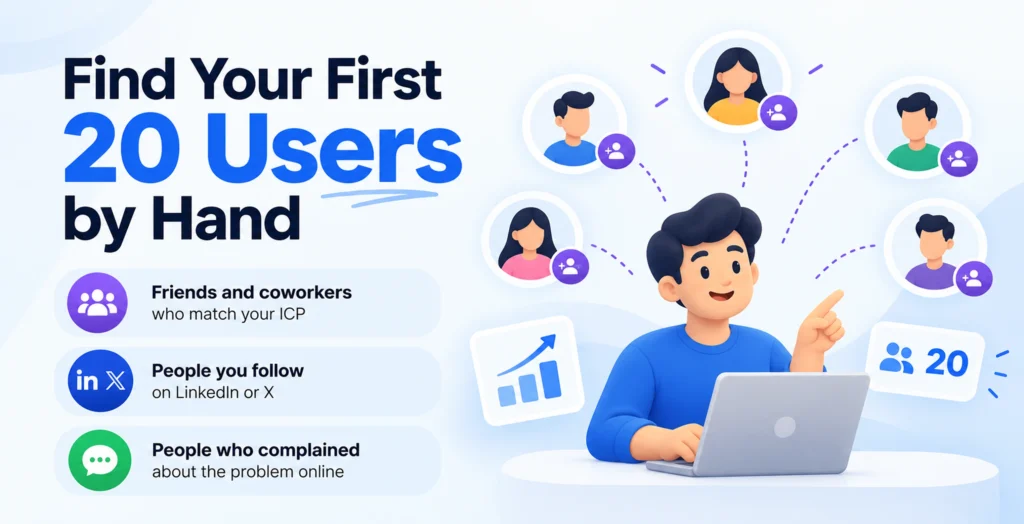
Step 2: Find Your First 20 Users by Hand
This is founder-led sales for an app launch and it is the part most people skip. Paul Graham points to Airbnb as the classic case. The founders went door to door in New York, signing up hosts and helping them improve their listings.
You do not need to knock on doors. Start with:
- Friends and coworkers who match your ICP
- People you follow on LinkedIn or X
- People who complained about the problem online
Ask for feedback, not for a signup. Here is a cold outreach DM template for an app that you can copy and change:
Hi [Name], I saw your post about [problem]. I built a small app that helps with this and I’m looking for honest feedback from a few [ICP]. Could I send you a free link? No pitch, I just want to know what’s missing.
Keep it short and send it to a real person, not a list. Reply fast when someone answers.
Step 3: Join Communities Without Spamming
The best communities to launch a new app are the ones where your ICP already asks for help. Think subreddits, Discord servers, Slack groups and Indie Hackers.
Here is a simple four-step way to turn Reddit threads into app signups:
- Search for the problem in plain words, like “how do I track…”
- Answer the question fully, without a link.
- Mention your app only when it truly fits, and say you built it.
- Read the subreddit rules first, because each one has its own.
Reddit’s own self-promotion guidelines say about 10% or less of your posts and comments should link to your own content and you should never ask for votes. Break that rule and you risk a ban.
Step 4: Run a Beta and Build a Waitlist
A beta gives people a reason to try the app now. For iPhone apps, Apple’s TestFlight lets you invite up to 10,000 external testers by email or a public link. Apple reviews the build and its details before outside testers can join, so send it early.
Pair the beta along with a simple page that has only assurance and one email box. That is how you build a pre-launch waitlist. Then share short weekly updates on LinkedIn or X, with what you fixed and what you learned. This “build in public” habit makes people trust you and gives them a reason to join before launch day.
Step 5: Use Directories and Newsletters
A product directory launch list helps you get seen by people who enjoy trying new tools. Product Hunt is the best known. Its official guide says you may share your launch link anywhere, but you cannot ask people directly to upvote. It also assures the better day to launch is the day you are most prepared.
Do not expect one launch to bring everything. Treat it as a bonus on top of your direct outreach.
Small newsletters can work well too. To pitch niche newsletters for early access, write three lines:
- Who the app helps
- What problem it solves
- What readers get, such as free early access
Offering readers something special makes the editor’s job easy.
Step 6: Keep the Users You Win
Getting a signup is not the goal. Getting someone to use the app is.
Monitor your activation rate, which is the share of new users who conclude the key first activity. Also watch churn rate, which is how many people leave. A weak number here usually means onboarding needs work.
Offer a short setup call to your first 20 or 30 users. Send a quick check-in message after three days. Ask what almost made them quit.
Then invite your happiest users into a small founding group. Let them vote on features. Their quotes also become honest social proof for your landing page.
Paul Graham also notes that at 100 users, adding just 10 more each week is 10% weekly growth. That is a calm, doable pace.
Loved What You Just Read?
Let's Build Something Just as Great — For Your Business.
From web & mobile apps to UI/UX, AI solutions, and digital marketing — NGD Technolab turns ideas into scalable, real-world products. 14+ years, 550+ projects, one team you can rely on.
Paid Ads vs Manual Outreach: A Quick Comparison
These are general patterns, not fixed rules:
| Paid ads | Manual outreach | |
|---|---|---|
| Upfront cost | Ad spend from day one | Mostly your time |
| Feedback quality | Low, strangers rarely reply | High, you talk to real users |
| Speed | Fast installs | Slower start |
| Best for | Later, once the app keeps users | Your first 100 users |
A Simple 30-Day Plan
- Week 1: Write your ICP. List 50 people who fit it.
- Week 2: Send personal messages. Start helpful posts in two communities.
- Week 3: Open the beta. Set up your waitlist page. Post your first update.
- Week 4: Pitch two newsletters. Launch on one directory. Follow up with everyone.
Track how many people reply, try the app and come back. Those numbers show you what to repeat.
Conclusion
To get your first 100 app users, think small and personal. Choose a narrow group, talk to them directly, help them use the app and learn from what they say. The first 100 are not a crowd. They are people you can actually talk to.
Start with the list of 50 names today.
Frequently Asked Questions
How do I get my first 100 SaaS customers?
Start with one narrow group and reach them by hand. Write down who they are, find them on LinkedIn, X or in niche communities and ask for feedback before you ask for money. Paul Graham says the most common unscalable task for founders is to recruit users manually. Offer a free setup call and your first 100 SaaS customers will come from real conversations.
Where can I find beta testers for my app?
Look first at the people you already reach: friends of friends, replies to your outreach and your waitlist. Then add communities where your ICP asks for help, like subreddits, Discord servers and Slack groups. For iPhone apps, TestFlight lets you invite up to 10,000 external testers by email or a public link. Ask each tester specific questions, not just “any feedback?”
How do I get app users from Reddit without getting banned?
Be helpful first and promotional last. Answer questions fully, without a link and mention your app only when it truly fits. Reddit’s guidelines say about 10% or less of your posts and comments should link to your own content and you should never ask for votes. Read each subreddit’s rules before you post, since moderators set their own limits.
How do I build a pre-launch waitlist for my app?
Make a simple landing page with one clear promise and one email box. Say who the app helps and what problem it solves. Then share the page in your outreach and communities and send short weekly updates about what you built or fixed. This build-in-public habit keeps people interested and it gives you a warm group to invite when the beta opens.
What is the best way to get app downloads on a small budget?
Use people before paid ads. Direct messages, community help, a beta test and one directory launch cost time, not money. Ads get pricey fast, since one 2026 report says the global average is near $2.24 per iOS install and $1.12 per Android install. Save paid campaigns for later, once users stay and you know what a good user is worth.