For most growing stores, Shopify is the better pick. It is faster to launch, cheaper to run and easier to manage. A custom build only wins when your business has needs Shopify cannot meet, like complex wholesale pricing, product configurators or deep links to your ERP system.
This guide explains Shopify vs custom ecommerce in plain words. You will see the real costs, the limits to watch for, a middle path called headless and a short checklist to help you decide.
Quick summary:
- Shopify suits most stores with standard products
- Custom builds suit unusual workflows and large budgets
- Headless Shopify sits in the middle
- Run a three-year cost check before you switch
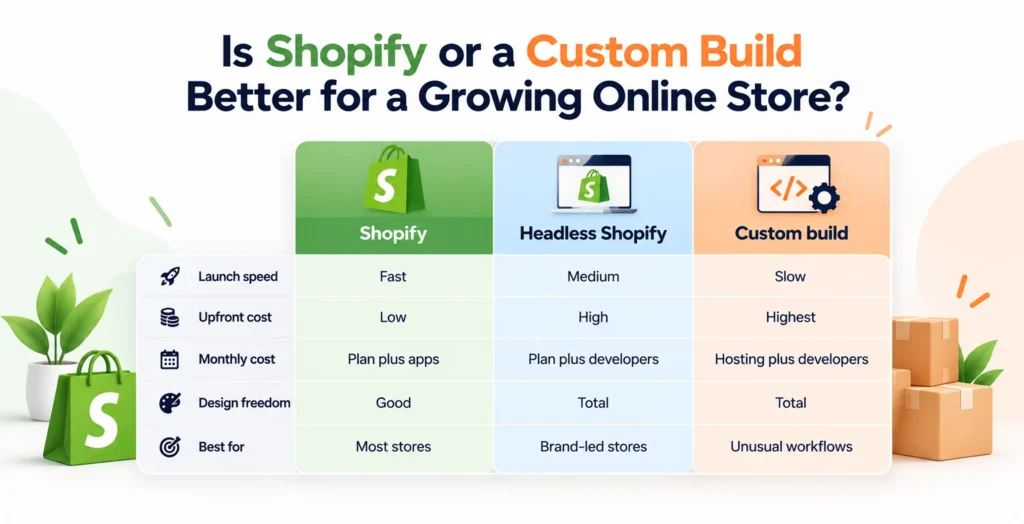
Is Shopify or a Custom Build Better for a Growing Online Store?
Shopify is better for stores that sell standard products and want to launch fast. A custom build is better for stores with complex pricing, configurators or legacy software links.
Many growing brands land in the middle with headless Shopify, which keeps Shopify’s back end and adds a custom front end.
| Shopify | Headless Shopify | Custom build | |
|---|---|---|---|
| Launch speed | Fast | Medium | Slow |
| Upfront cost | Low | High | Highest |
| Monthly cost | Plan plus apps | Plan plus developers | Hosting plus developers |
| Design freedom | Good | Total | Total |
| Best for | Most stores | Brand-led stores | Unusual workflows |
The Growth Tipping Point
Most stores do not outgrow Shopify overnight. They feel squeezed in small ways first:
- App fees keep piling up each month
- Your theme is full of hacks that slow the site
- Checkout cannot do what your sales team wants
- Pricing rules for different buyers get too messy
If two or three of these sound familiar, it is time to look at your options. It does not mean you must leave Shopify.
Shopify: Pros, Cons and Ceilings
Pros
- Launch in days or weeks
- Hosting and card security (PCI) are handled for you
- A big app store
- Your team can run it without a developer
Cons and ceilings
Shopify plans cost $39 a month for Basic, $105 for Grow, $399 for Advanced and from $2,300 for Plus. If you skip Shopify Payments and use another gateway, Shopify adds a fee of 0.2% to 2% on every order, on top of what your processor charges.
Some old limits have eased. Shopify used to cap products at 100 variants, but a Shopify developer update says the limit rose to 2,048 variants per product. Product options are still limited, though, so check your catalog.
Checkout is the bigger ceiling. One agency guide notes that building custom checkout logic with Shopify Functions requires Plus. The same guide says Shopify spread basic B2B tools to all plans in April 2026.
Custom Build: Pros, Cons and Cost Realities
Pros
- You own the code and the database
- Custom pricing rules for wholesale buyers
- Product configurators built your way
- Direct links to your ERP and CRM
Cons
- Big upfront cost and long timelines
- You pay for hosting, security and developers forever
- Your team needs technical help for every change
On price, one 2026 guide lists custom development at $25,000 to $80,000, with custom B2B features adding $20,000 to $50,000. The same guide says to budget 15% to 25% of the build cost every year for upkeep. Treat these as rough guides, since quotes vary a lot.
What Is Headless Shopify, and Is It Better Than a Custom Build?
Headless Shopify means Shopify still handles orders, payments and security. A separate custom front end, often built with Next.js or React, handles what shoppers see. You get full design freedom and speed without rebuilding the back end.
It is not cheap. Shopify’s Hydrogen tool is free, but one guide puts a headless build at $25,000 to $150,000 or more, with ongoing development at $2,000 to $15,000 or more per month. Headless also needs more upkeep, since your front end does not update itself.
It pays off when your design or speed is a real edge, like editorial product pages or custom configurators.
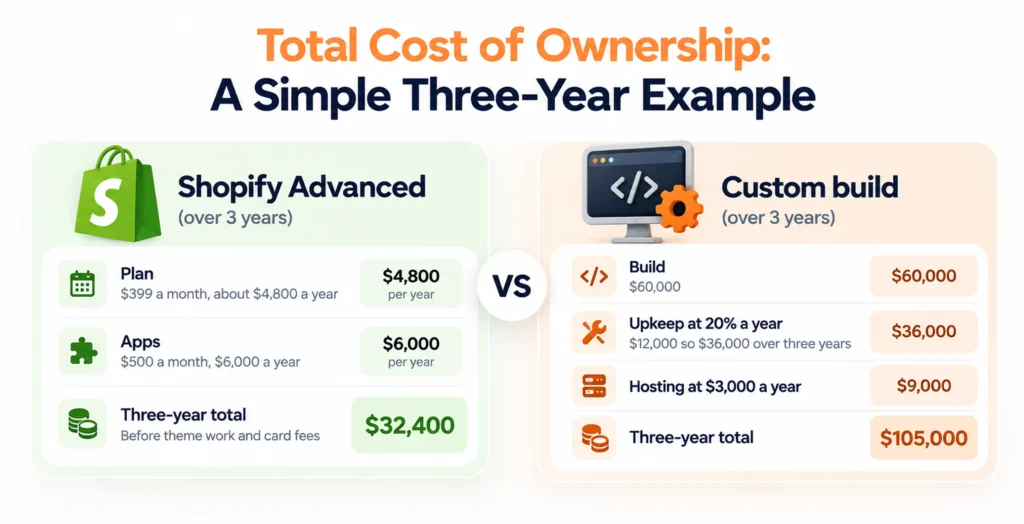
Total Cost of Ownership: A Simple Three-Year Example
Here is a made-up store with $2 million in yearly sales. The numbers are examples, not quotes.
Shopify Advanced (over 3 years)
- Plan: $399 a month, about $4,800 a year
- Apps: $500 a month, $6,000 a year
- Three-year total: about $32,400, before theme work and card fees
Custom build (over 3 years)
- Build: $60,000
- Upkeep at 20% a year: $12,000 so $36,000 over three years
- Hosting at $3,000 a year: $9,000
- Three-year total: about $105,000
In this example, Shopify costs about a third as much. Real stories look similar. One agency compared the two for a fashion brand with about 6 million euros in online sales. Over three years, Shopify Plus came to about 250,000 euros, versus nearly 390,000 euros for a headless custom build.
Custom only wins when it unlocks sales Shopify cannot. If it does not, you are paying extra for freedom you may not use.
Loved What You Just Read?
Let's Build Something Just as Great — For Your Business.
From web & mobile apps to UI/UX, AI solutions, and digital marketing — NGD Technolab turns ideas into scalable, real-world products. 14+ years, 550+ projects, one team you can rely on.
When Should an Online Store Migrate Away From Shopify?
Move when Shopify blocks revenue, not just when it feels limiting. Look for these signs:
- App fees cost more than a developer would
- Your pricing or product rules need logic no app can handle
- Your ERP or warehouse needs a live, deep link
- Your catalog structure keeps breaking
- Third-party gateway fees are large and you cannot switch to Shopify Payments
Try cheaper fixes first, like cleaning up apps, rebuilding the theme or upgrading to Plus.
A Five-Question Decision Checklist
- Do you need pricing or checkout rules that no app can handle?
- Does your ERP need a live, two-way link to your store?
- Are your monthly app and fee costs close to a developer’s salary?
- Do you have a developer team, or a budget to hire one for years?
- Will a custom front end clearly raise sales or speed?
Mostly no? Clean up your theme and apps. Hitting checkout or fee limits? Look at Shopify Plus. Mostly yes, with the budget to match? Price out headless or a custom build.
Conclusion
The right answer to Shopify vs custom ecommerce depends on one thing: what is actually holding your store back. If the problem is design or small limits, fix it inside Shopify. If the problem is deep business logic, a custom or headless build may earn its cost.
Do the three-year math with your own numbers before you decide. This guide is general information, not financial advice.
Frequently Asked Questions
Does Shopify take a percentage of sales?
Yes, in two ways. With Shopify Payments, card rates run 2.9% plus 30 cents on Basic, 2.7% plus 30 cents on Grow, and 2.5% plus 30 cents on Advanced. If you use another gateway, Shopify adds its own fee of 0.2% to 2% on top of your processor’s charge. Using Shopify Payments removes that extra fee, so it is the first thing to check when you compare Shopify vs custom ecommerce costs.
What is the difference between Shopify and Shopify Plus?
Plus is Shopify’s top tier for high-volume brands. It starts around $2,300 a month, charges the lowest third-party gateway fee, and unlocks deeper checkout control. One agency guide says custom Shopify Functions for checkout logic require Plus. If your only pain is checkout rules or fee size, Shopify Plus vs custom website is often a cheaper fix than a rebuild.
Can Shopify handle large catalogs and wholesale selling?
Better than it used to. Shopify raised the cap to 2,048 variants per product and one agency says it added native B2B tools to all plans in April 2026. Very complex catalogs, custom pricing tiers and deep ERP links may still need Plus, custom apps or a headless setup. List your must-have rules first, then test them before you commit.
Is a custom website better than Shopify?
Not by default. For stores with standard products, Shopify is usually faster and cheaper, as the fashion-brand example above shows. A custom website is better when your business needs something unusual, like complex wholesale pricing, product configurators or tight links to old software. Choose custom because of a clear business need, not because it sounds more powerful.
How long does it take to move from Shopify to a custom site?
Agency estimates range widely. One puts a full headless build at 12 to 18 weeks, including catalog migration and testing, while another counts 6 to 9 months for full headless. One guide also lists migrating existing store data at $4,000 to $25,000. Protect your search traffic by keeping your URLs or setting up redirects, and plan the launch outside your busiest sales season.