
To measure AI project savings, compare the whole cost of the project with the real change it makes to your budget. If you cannot show that gap in dollars, you do not have savings yet. You have a good feeling.
That gap is the heart of enterprise AI ROI. And it is where many teams get stuck. According to industry research, about 71% of enterprise AI projects stall before they deliver results at scale.
This guide shows you a simple way to check your own numbers. No finance degree needed.
Why Most Teams Cannot Prove Their AI Savings
Most AI projects do not fail because the tool is bad. They fail the money test because nobody set a starting point.
Say your team uses an AI assistant and says it “saves time.” That sounds great. But time saving is not the similar as money saved.
Hours recaptured only become real cost savings when they lead to lower spend or higher revenue.
If ten people each save five hours a month but nobody does more work, cuts overtime, or drops a vendor, your bank balance does not change. That is the variation separating productivity benefits and real savings.
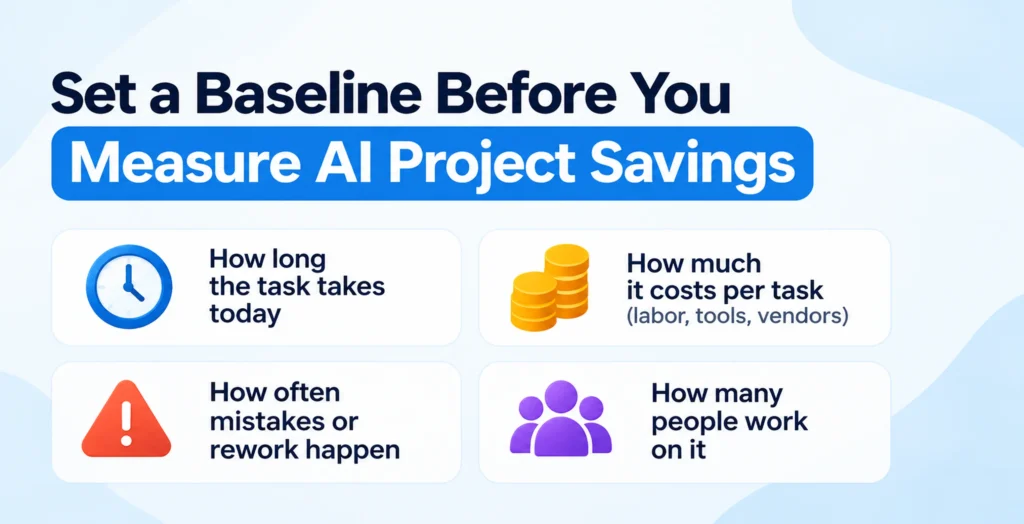
Set a Baseline Before You Measure AI Project Savings
A baseline is a snapshot of how work looked before AI. Without it, you cannot prove anything later.
Write these numbers down before launch or as early as you can:
- How long the task takes today
- How much it costs per task (labor, tools, vendors)
- How often mistakes or rework happen
- How many people work on it
For example, if a support team handles a ticket in 12 minutes today, that number is your starting line. After AI, you measure again. The difference is your cycle time compression.
No baseline means no proof, so capture it first.
Count the Full AI Total Cost of Ownership
Many teams only count the software fee. That is a big mistake. Your real AI total cost of ownership (TCO) is much larger.
Industry benchmarks show that TCO often runs 40% to 60% above the first estimate. The same research says data preparation and pipeline upkeep can eat 60% to 80% of a project’s timeline.
Here are the five cost areas to track:
1. Infrastructure and compute: cloud costs, API usage, and vector databases
2. Model upkeep: retraining when the model drifts or your business changes
3. Data work: cleaning data and connecting it to tools like your CRM and ERP
4. Security and compliance: guardrails, audits, and rules such as GDPR or HIPAA
5. People and training: change management and workflow redesign
Watch cloud bill shock in generative AI especially. Usage can grow fast once more people adopt the tool. A regular AI cloud compute spend audit helps you catch it early.
If you leave out even one of these five costs, your savings will look bigger than they are.
Use a Simple AI ROI Framework With Three Tiers
You do not need a complex model. A three-tier AI ROI framework keeps things clear, and it works well for generative AI business value assessment too.
Tier 1: Adoption. Are people actually using the tool? Track active users, how often they use it, and who stops. Unused licenses are pure waste.
Tier 2: Process efficiency. Is work faster and cleaner? Look at cycle time, errors, and rework. This is where you measure labor capacity released.
Tier 3: Profit and loss impact. Did the money show up? Look for cost avoidance, lower vendor bills, higher margins, or new revenue.
Most projects look good at Tier 1 and Tier 2, but only Tier 3 convinces a CFO.
Use this order. Tier 1 and 2 are early signs. Tier 3 is the proof.
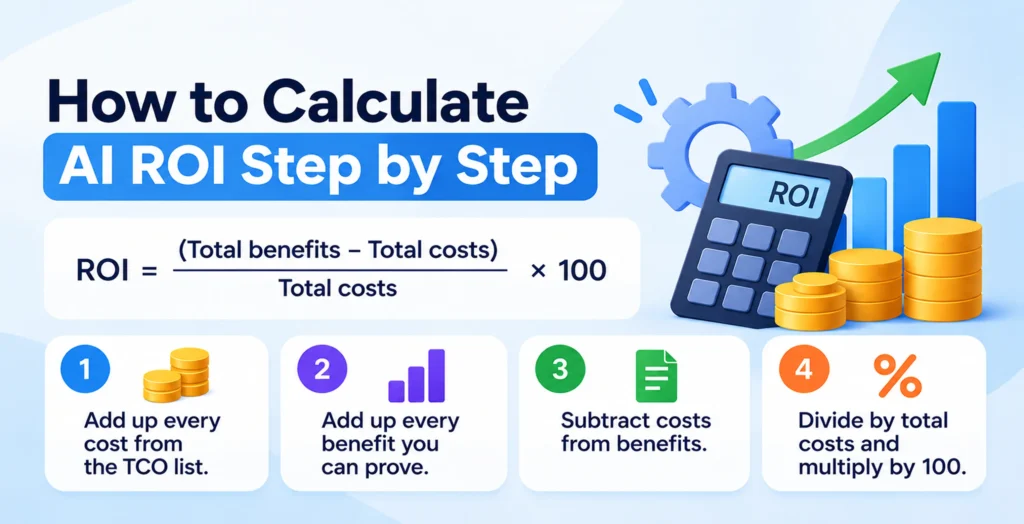
How to Calculate AI ROI Step by Step
Here is how to calculate AI ROI in plain terms. The basic formula is:
ROI = (Total benefits − Total costs) ÷ Total costs × 100
Follow these steps:
1. Add up every cost from the TCO list above.
2. Add up every benefit you can prove, such as avoided costs in AI deployment, dropped contractors and fewer errors.
3. Subtract costs from benefits.
4. Divide by total costs and multiply by 100.
Now a real-style example. One industry case describes a recruiting platform with a yearly cost of $240,000. It created $350,000 in labor savings and agency fees. That is a net gain of $110,000, an ROI of about 46% and a payback period of roughly 8 months.
Your numbers will differ. Treat this as an example, not a promise.
Do Not Forget the Time Value of Money
AI value often arrives slowly, over 12 to 24 months. So finance teams also use Net Present Value (NPV) for AI investment. NPV simply adjusts future savings for the fact that money today is worth more than money later.
If your CFO asks for it, build NPV into your sheet. A simple AI ROI calculator template or spreadsheet makes this easy.
How Long Does It Take for Enterprise AI to Show Positive ROI?
Usually months, not days. Anyone who promises instant returns is guessing.
Research on AI adoption suggests that about 75% of users need at least 10 weeks of steady use before productivity gains become reliable. After that, real savings still need time to reach the budget.
So set your expectations early. Check Tier 1 monthly. Check Tier 2 every quarter. Check Tier 3 at six and twelve months.
Loved What You Just Read?
Let's Build Something Just as Great — For Your Business.
From web & mobile apps to UI/UX, AI solutions, and digital marketing — NGD Technolab turns ideas into scalable, real-world products. 14+ years, 550+ projects, one team you can rely on.
Common Mistakes That Hide the Truth
Even careful teams slip up. Watch out for these:
- Counting saved hours as saved dollars
- Ignoring training, security and retraining costs
- Measuring only once, right after launch
- Comparing AI results to a guess instead of a baseline
- Claiming credit for revenue that AI did not cause
If you want ideas for where AI cost savings often appear, many companies look first at finance operations, customer support and hiring. Start small, prove one win, then grow from there. That approach is the safest path to real generative AI cost optimization.
Conclusion
So, how do you tell if your AI project is saving money? Set a baseline, count the full cost, track the three tiers and calculate ROI with real numbers.
Remember the key point: time saved is not money saved until it shows up in your budget. Be honest about costs and give the project enough time.
Your next step is simple. Pick one AI project today, write down its baseline,and build a basic cost sheet. In a few weeks, you will know far more than a hunch can tell you.
Frequently Asked Questions
How do you calculate AI ROI?
Subtract total costs from the value created, divide by total costs, then multiply by 100. Value can include time saved, errors avoided, and extra revenue. Costs should cover the full AI total cost of ownership, not just the software fee.
What is included in the total cost of an AI project?
Track five areas: compute and infrastructure, model upkeep and retraining, data work, security and compliance and people and training. Industry benchmarks say total cost often lands 40% to 60% above first estimates, so plan your budget with room to spare.
Is time saved by AI the same as real cost savings?
No. Saved hours become real savings only when they lower spend, such as less overtime or fewer vendors or when they add revenue. Otherwise, you have a productivity gain. That is useful, but it does not change your bank balance.
How long does it take for enterprise AI to show positive ROI?
Deloitte’s 2025 research found that typical AI ROI takes two to four years and only 6% of organizations saw payback in under a year. Early signs like adoption and faster cycle times can show up within months, so track those first.
How do you calculate the payback period for an AI project?
Divide total cost by monthly net benefit. For example, $120,000 divided by $10,000 gives a payback period of 12 months. Include the ramp-up period, because costs often exceed benefits while the project is being rolled out.