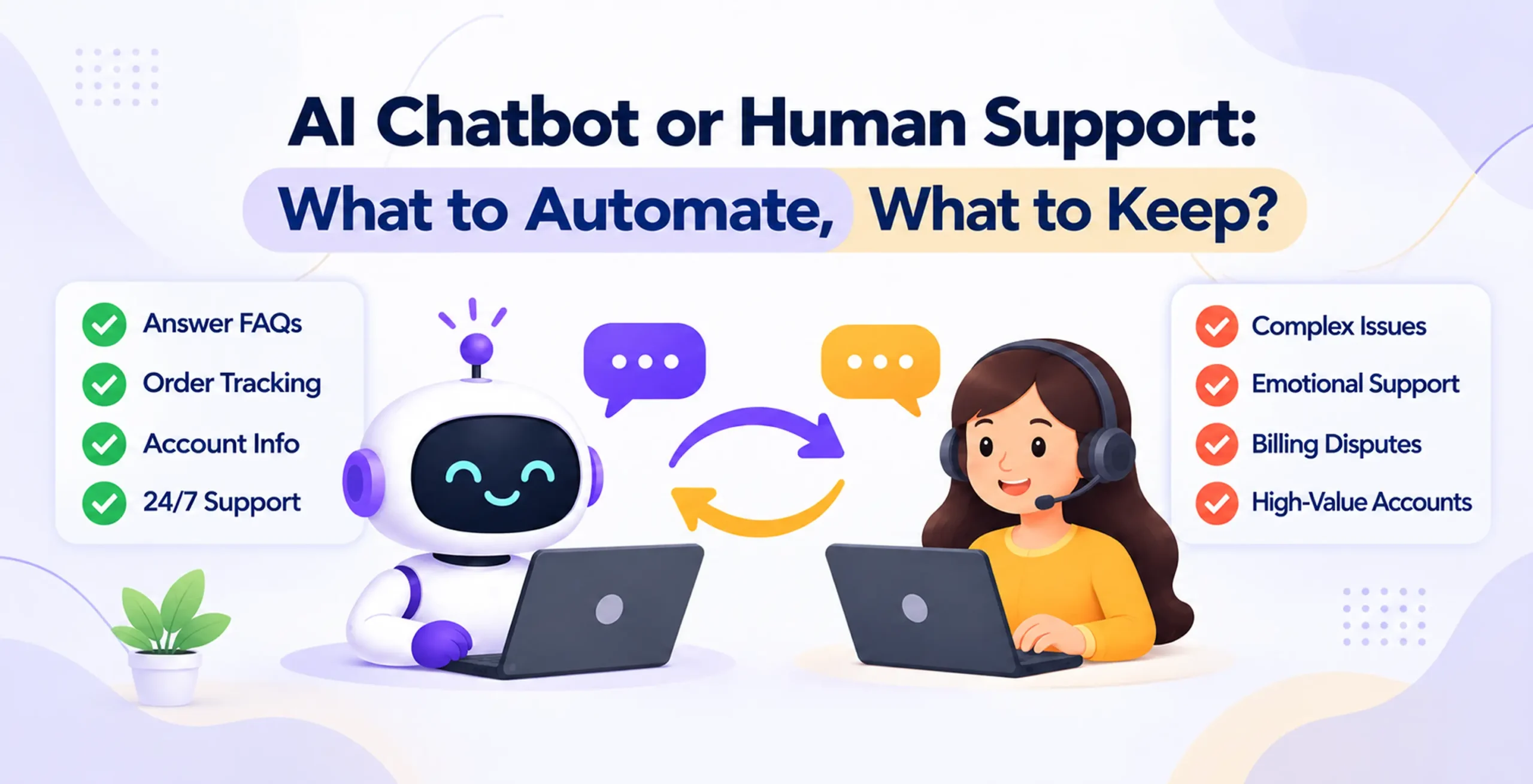
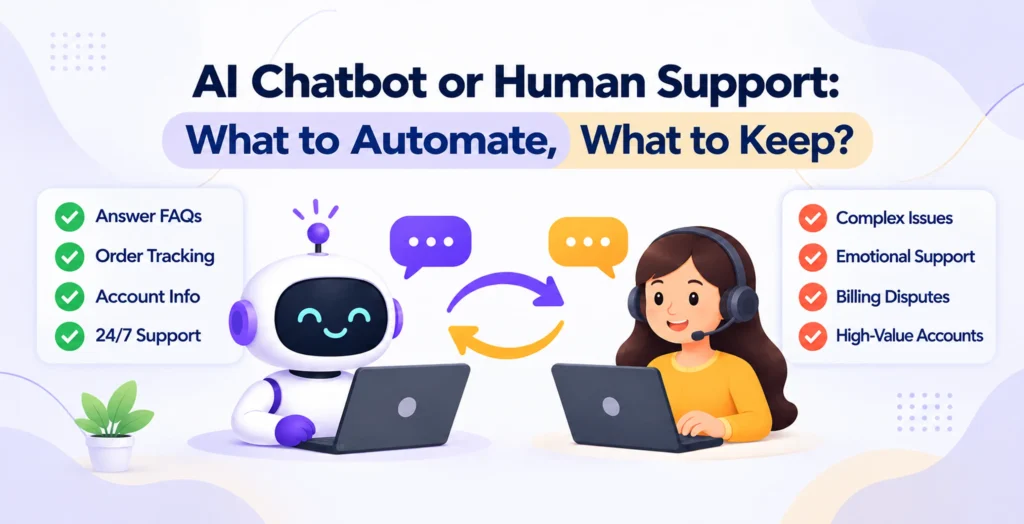
In the AI chatbot vs human support debate, the best answer is both. Automate simple, repeat questions, and keep real people for emotional, complex, or high-value ones. That mix cuts cost without hurting trust.
It sounds easy. The hard part is knowing where to draw the line. This guide gives you a simple way to decide, plus the real numbers behind customer support automation.
What Is a Hybrid Customer Support Model?
A hybrid customer support model uses an AI chatbot for the first reply and simple fixes, then passes harder issues to trained people. The bot handles volume. Humans handle judgment. Customers get fast answers at any hour and tough cases still get real care.
Think of it as three layers:
1. Tier 1: AI answers common questions instantly
2. Tier 2: The bot hands off when it is unsure or the customer is upset
3. Tier 3: Specialists solve the toughest cases
The goal is not to replace your team, but to point each task at the right worker.
AI vs Human Customer Service Cost: What the Numbers Say
AI is much cheaper per contact. Gartner benchmarks put the median self-service contact at $1.84, against $13.50 for an agent-assisted one. Other 2026 roundups show chatbot chats near $0.50, versus $6 to $15 for a live agent.
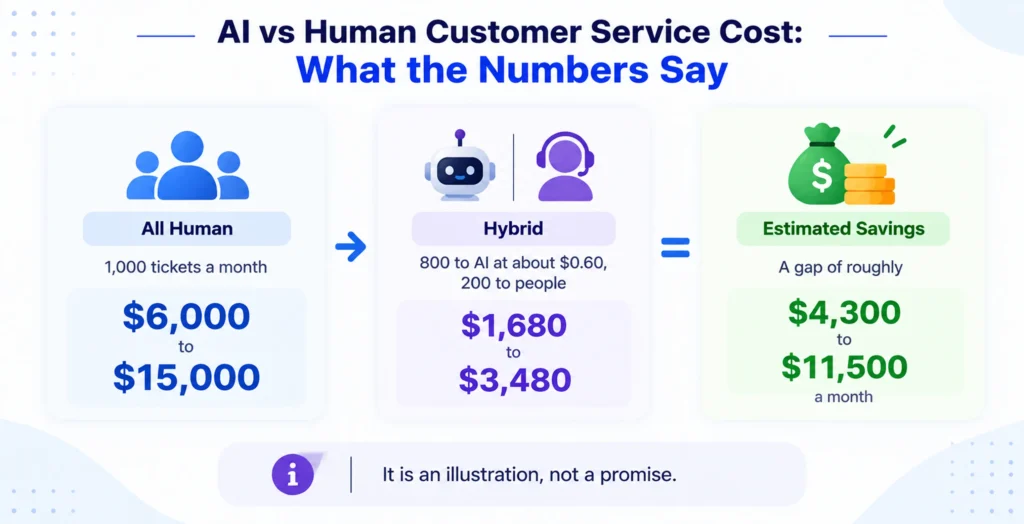
Here is a simple example using those ranges. Say you get 1,000 tickets a month:
- All human: about $6,000 to $15,000
- Hybrid (800 to AI at about $0.60, 200 to people): about $1,680 to $3,480
That is a gap of roughly $4,300 to $11,500 a month. It is an illustration, not a promise.
One warning matters here. Cost per ticket is not cost per resolution. A task the bot closes but does not solve comes back as a second contact at full human price.
Only count a saving when the customer’s problem is truly solved.
What to Automate in Customer Service
Ask four questions about every type of request. How complex is it? How emotional is it? How much money is at stake? How often does it come up?
Low complexity, low emotion, and high frequency mean automate. Good examples include:
- Order and shipment tracking
- Password resets
- Account balance checks
- Simple help-center questions
Picture an online shop. “Where is my order?” arrives all day and a bot can answer with live tracking in seconds. But “My gift arrived broken and the wedding is Saturday” needs a person who can say sorry and fix it fast.
Automating the first kind raises your ticket deflection rate and frees your team for the second.
Many teams use an 80% rule of thumb for routine tickets. But results vary a lot. AI-native platforms report first contact resolution (FCR) of about 55% to 70%. Start with your top five repeat questions and grow from there.
Automate the boring, repeat requests first and let results guide how far you go.
What to Keep Human When Choosing AI Chatbot vs Human Support
Keep people on any request where judgment or care matters. That includes:
- Billing disputes
- Upset or distressed customers
- Cancellations
- Contract talks with big accounts
- New problems the bot has never seen
Customers care about this too. Metrigy’s 2026 consumer research found that 84.9% of clients want a human agent over an AI agent.
So full automation of emotional moments is risky. It can push good customers away and raise churn.
When money, feelings or trust are on the line, put a person in the conversation.
Move routine work to AI when you see these signs:
- The same questions fill most of your queue
- Customers wait too long for simple answers
- Agent burnout and turnover are rising
- You need 24/7 first-contact coverage
Do not switch everything at once. Pilot one topic, measure then expand.
How Automation Helps Your Team, Not Just Your Budget
Responding the identical question fifty times a day wears people down. That is a big driver of agent burnout and turnover.
When AI takes the dull tickets, agents spend their time on problems that need skill and kindness. You can also train them to review bot chats and coach the AI. That turns a line up worker into an AI-augmented counselor, which is a potent role.
Happier agents give better service and better service keeps customers.
How to Build a Chatbot Human Handoff Strategy
A good chatbot human handoff strategy decides when the bot steps aside and what it passes along. Most hybrid setups fail at this step. One in three human agents lacks the customer context needed after a handoff.
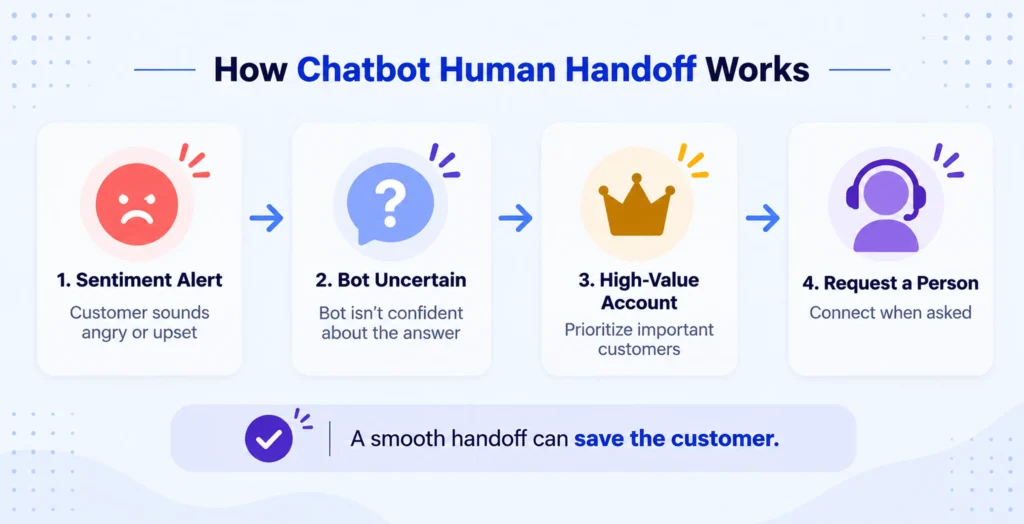
Set clear triggers for a live handoff:
- Sentiment analysis escalation, when the customer sounds angry or upset
- A question the bot is not confident about
- A high-value account
- A direct request for a person
Then use context-aware routing. Send the full chat, account details and mood history to the agent’s screen. The customer should never have to repeat themselves.
A smooth handoff turns a failed bot chat into a saved customer.
How to Prevent Customer Frustration With Automated Customer Service
Most frustration comes from one thing: the bot loop. The bot cannot help, but it will not let go.
Avoid it with a few habits:
- Say clearly that it is a bot
- Offer “talk to a person” within two steps
- Keep answers short and plain
- Review failed chats every week and fix the gaps
Your customer satisfaction score (CSAT) will tell you if it is working.
How to Measure ROI From Customer Support Automation
Track four numbers: ticket deflection rate, first contact resolution, CSAT and total cost of ownership (TCO).
Use this simple formula:
ROI = (Savings − TCO) ÷ TCO × 100
Loved What You Just Read?
Let's Build Something Just as Great — For Your Business.
From web & mobile apps to UI/UX, AI solutions, and digital marketing — NGD Technolab turns ideas into scalable, real-world products. 14+ years, 550+ projects, one team you can rely on.
TCO is more than the software fee. Include integration work, model upkeep, knowledge-base updates and staff training. Plug your numbers into an AI support chatbot ROI calculator or a basic spreadsheet to see the full picture.
If you compare enterprise AI support agent software, check per-resolution pricing and add-on fees, not just the headline price.
If your AI savings do not survive a full TCO check, they are not real savings yet.
Conclusion
AI chatbot vs human support is not a fight. Automate routine, low-emotion tasks. Keep people for complex, sensitive, high-value ones. Connect them with a clean handoff and measure real resolutions, not just closed tickets.
AI in customer service trends 2026 point the same way. The future of call centers with AI is people backed by smart bots, not bots alone.
Pick one repeat topic this week and automate it. Then check the results.
Frequently Asked Questions
Is AI chatbot vs human support the better choice for customer service?
Neither wins alone. A hybrid customer support model works best. Let the bot handle simple, repeat questions and keep people for sensitive ones. Customers still want that option: Metrigy’s 2026 research found that 84.9% of consumers prefer a human agent over an AI agent.
What should you automate in customer service?
Automate low-complexity, low-emotion, high-volume requests. Good examples are order tracking, password resets, status updates and basic confirmations. Frequent questions can go to a chatbot with a human backup. Keep billing disputes, upset customers and big accounts with trained people who can use judgment and show care.
How much cheaper is AI than human customer service?
Per contact, AI costs far less. Gartner benchmarks put self-service at a median of $1.84, versus $13.50 for an agent-assisted contact. Other 2026 roundups show chatbot chats near $0.50, against $6 to $15 for a live agent. Count only solved issues, though or the savings are not real.
When should a chatbot hand off to a human?
Hand off when the customer asks for a person, sounds angry or upset or the bot is unsure. Forrester recommends passing the customer to a human if automation cannot solve the issue after two attempts. Send the full chat history along, so the customer never has to repeat themselves.
What percentage of customer support tickets can AI automate?
Many platforms claim AI can handle about 80% of Tier 1 inquiries, but real results vary. AI-native platforms report first contact resolution of roughly 55% to 70%. Treat 80% as a goal, not a promise. Pilot your top repeat questions first, then expand based on your own ticket deflection rate.