Quick Summary: You do not need a robot butler to see how how AI saves you time and money. The truth is, artificial intelligence is already working quietly in the background of your normal morning routine.
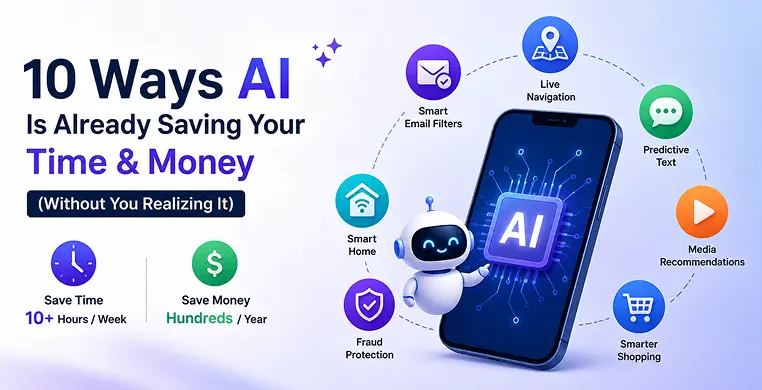
From smart filters keeping your inbox clean to AI navigation apps that save time on your daily commute, these hidden AI tools in everyday life do the heavy lifting for you. In fact, if you calculate how much time does AI save the average person, it easily rescues over 10 hours a week and hundreds of dollars a year.
The Invisible Assistant in Your Pocket
Imagine a normal Tuesday morning. You wake up, grab your phone, and check your email. Next, you use a map app to avoid a traffic jam on the way to work. Finally, you grab a coffee and use your phone to tap and pay.
In just that first hour, you have already used machine learning in daily life at least four times. You might ask yourself, is AI already part of my life? The short answer is yes. You are already relying on automation tools for everyday tasks long before you even reach your office desk.
Many people wonder, what is artificial intelligence used for when it comes to average consumers? It is not just about futuristic robots taking over the world. It is about simple, smart technology automation fixing small, frustrating problems.
If you are looking for AI technology examples for beginners, you do not need to learn complex coding. You just need to look at the screen in your pocket.
Whether it is AI in email spam filters automatically tossing out junk mail or AI in smart home devices turning down the heat to lower your monthly bill, the benefits are everywhere. These AI-powered apps work so smoothly that we completely forget they are there.
But when you look at examples of AI in real life, you quickly see how these small daily fixes add up. By learning how AI is used in daily life without knowing, you can stop wasting your own effort on things a computer can do for free.
How Invisible AI Changes Your Daily Life
To understand exactly how does AI work in daily life, let’s compare the old way of doing things with the new, automated way. This quick table breaks down some of the top hidden ways AI helps consumers save money and time right now.
| Life Area | The Old Way (Manual & Costly) | The AI Way (Automatic & Free) |
|---|---|---|
| Driving | Getting stuck in surprise traffic jams and burning extra gas. | AI in maps and navigation instantly reroutes you to the fastest, clearest path. |
| Shopping | Wandering aisles or endlessly scrolling to find what you need. | AI in online shopping gives exact, instant recommendations tailored to your budget. |
| Banking | Reviewing paper statements at the end of the month to spot errors. | AI in banking and fraud prevention blocks suspicious charges in real time. |
By simply using the best AI apps to save money like your standard map or banking app you are already winning. You do not need to change your daily habits to see how AI helps you save money without realizing it. The technology is already built directly into the tools you already trust.
Now, let’s dive deeper into the specific ways AI is already part of your daily routine.
10 Everyday Things AI is Doing for You Right Now
When people look for artificial intelligence daily life examples, they often expect to see self-driving sports cars or humanoid factory workers. The truth is much quieter. The most powerful hidden AI tools in everyday life are already sitting inside the software you use from morning until night.
Let’s pull back the curtain on the ways AI is already part of your daily routine and see how these micro-savings add up to massive relief for your schedule and your wallet.
1. Smart Email Filters: Keeping the Trash Out
You open your email app and see a clean inbox with just three important messages waiting for your attention. What you don’t see are the 45 marketing blasts, phishing scams, and junk loops that were blocked over the last eight hours.
- How it works: Modern AI in email spam filters reads incoming text patterns in milliseconds. It recognizes the exact difference between an authentic bill from your electricity provider and a fake email trying to steal your data.
- Time & money saved: It removes the need to spend 15 minutes a day manually checking and deleting risky links. By keeping you from clicking on bad attachments, it saves you from costly digital security cleanups.
2. Live Navigation: Dodging the Morning Traffic Jam
You are driving down your usual route to the city, and your phone suddenly rings with an alert to take the next exit instead. You follow the advice, bypass a major three-car accident, and arrive at your meeting perfectly on time.
- How it works: If you look at how does GPS use AI for live traffic updates, it comes down to crowd-sourced speed tracking. AI navigation apps that save time continuously monitor the movement speeds of thousands of active phones on the road to rebuild your path dynamically.
- Time & money saved: It prevents you from wasting hours idling in gridlock. Less time idling means less fuel burned, directly cutting down your monthly gas or charging expenses.
3. Predictive Text: Typing Less to Say More
You start typing a quick message to a coworker: “I am on my…” and your smartphone screen immediately highlights the word “…way.” You tap the suggestion and send the text in under two seconds.
- How it works: These are classic predictive technology examples built right into your mobile keyboard. The software analyzes your past chat logs to understand your personal writing habits and accurately guess your next word.
- Time & money saved: It cuts down your repetitive typing time by nearly 40%. It acts as a simple AI personal assistant technology, stopping you from making typos that require slow edits later.
4. Media Streaming: The End of Endless Scrolling
You sit down on the couch after a tiring day, open your favorite streaming app, and find a brand-new documentary featured right at the top of your home screen. You click play and end up loving it.
- How it works: This answers the common question: where is AI hidden in apps you already use? Services like Netflix and Spotify track your watch time, skips, and favorite genres. They compare your habits with millions of other profiles to hand-pick media just for you.
- Time & money saved: It rescues you from spending 30 minutes clicking through menu rows just to find something decent to watch. You get instant entertainment value out of the subscription fees you already pay.
5. Ride-Sharing Routing: Cheaper and Faster Trips
You step out of a restaurant into a sudden rainstorm and request a ride home. Within four minutes, a vehicle pulls up to the curb, and the price matches exactly what you expected despite the heavy downpour.
- How it works: Ride-hailing services use complex smart technology automation to track driver locations, regional passenger demand, and current weather. The system matches you with the closest driver to keep fuel costs minimal for the fleet.
- Time & money saved: It drops your outdoor wait times significantly and balances pricing models so you don’t get hit with unexpected, unmanaged peak fare charges.
6. Fraud Alerts: The Silent Guard on Your Cash
You are shopping online late at night and suddenly receive a text alert from your bank asking if you just authorized a $400 purchase in a country you’ve never visited. You tap “No,” and the card is safely frozen instantly.
- How it works: If you want to know how does AI prevent bank fraud automatically, it’s about behavioral baseline tracking. Advanced AI fraud detection banking apps map out your typical spending sizes, favorite stores, and local zip codes to instantly spot red flags.
- Time & money saved: It completely stops unauthorized account drain loops before they escalate. This application of AI in banking and fraud prevention saves you from weeks of stressful calls trying to recover stolen assets.
7. Online Shopping Recommendations: Instant Deal Finding
You are looking for a specific kitchen tool on a retail site. Right below the item, the page displays a discounted package that includes the exact baking sheets you were planning to search for next.
- How it works: Many retail platforms rely heavily on AI shopping recommendation tools. If you wonder how do shopping apps use AI for recommendations, they track product relationships and purchase bundles across millions of transactions to guess your immediate household needs.
- Time & money saved: It removes the need to cross-compare items across multiple tabs for hours. It highlights bulk discounts and smart combinations that cut down your overall shipping fees.
8. Smart Thermostats: Cutting Household Energy Costs
You leave your apartment for a weekend trip. While you are away, your home’s climate system automatically drops to an eco-friendly baseline temperature without you ever touching a control panel.
- How it works: This is a clear example of AI in smart home devices. Gadgets like smart thermostats learn your physical weekly movements, local weather forecasts, and insulation speeds to adjust your home environment on their own.
- Time & money saved: It quietly shaves 10% to 15% off your monthly utility bills. You no longer waste money heating or cooling a completely empty house.
9. Voice Assistants: Hands-Free Task Management
You are busy cooking dinner with messy hands and need to know how many ounces are in a cup. You simply say the question out loud, and a small counter speaker gives you the exact math answer instantly.
- How it works: AI in voice assistants uses natural language processing to clean background noise, identify your spoken words, and pull the exact information from global search indices in a second.
- Time & money saved: It prevents you from interrupting your work, wiping your hands, and unlocking a screen just to look up a simple cooking measurement or calendar date.
Loved What You Just Read?
Let's Build Something Just as Great — For Your Business.
From web & mobile apps to UI/UX, AI solutions, and digital marketing — NGD Technolab turns ideas into scalable, real-world products. 14+ years, 550+ projects, one team you can rely on.
10. Automated Budgeting Apps: Hands-Off Financial Tracking
You link your card to a modern finance app. At the end of the week, you get a clean breakdown showing exactly how much cash you spent on groceries versus dining out, along with a warning that your subscription fees went up.
- How it works: The best AI apps to save money use transaction text parsing to group your expenses into clean categories on their own. They notice small, creeping price hikes in your recurring bills that you might miss.
- Time & money saved: It removes the painful chore of typing numbers into an Excel sheet for hours every weekend. It gives you instant clarity on where to cut back to protect your savings.
Master View: How Everyday AI Works For You
To help you scan these AI saving time and money examples at a glance, here is a quick master overview of how this technology simplifies your life.
| The Invisible Tool | What It Automates | (Weekly) | Money Saved (Monthly) |
|---|---|---|---|
| Email Spam Filters | Sorting junk and dangerous links | 1.5 Hours | Prevents costly security scams |
| Live GPS Maps | Rerouting around road traffic jams | 3 Hours | Lowers monthly gas consumption |
| Predictive Keyboards | Completing words and sentences | 1 Hour | High efficiency while working |
| Banking Security Apps | Tracking abnormal spending patterns | Instant | Blocks unauthorized card charges |
| Smart Thermostats | Regulating empty home temperatures | Automatic | Cuts utility bills by 10% to 15% |
Understanding how does AI work in daily life shows that it isn’t a tech buzzword meant just for engineers. It is a highly practical set of automation tools for everyday tasks that keeps your life running efficiently without demanding your constant attention.
Key Takeaways
- It’s Smart Software, Not Robots: This is simply smart technology automation built into the apps you already trust. It handles boring chores so you do not have to.
- Small Savings Add Up Fast: Saving a few minutes on text edits or email cleaning adds up to hours of free time rescued every single month.
- You Are Already Winning: By using basic maps, banking feeds, and streaming apps, you are already benefiting from how AI helps you save money without realizing it.
- It Protects Your Wallet: From lowering home utility bills to blocking credit card scams, these hidden AI tools in everyday life act as your silent financial guards.
Conclusion
At the end of a long, busy day, you lock your smartphone and set it down on the nightstand. Your evening was relaxing, your drive home was clear of traffic, and your bank account stayed completely safe. It is incredibly easy to take these peaceful, smooth moments for granted.
However, they are the direct, real-world result of how artificial intelligence quietly improves daily life. The future did not arrive with flying cars or loud robotic servants walking down the street. Instead, it arrived softly through smart lines of code built into the apps you already trust.
When you stop to ask yourself, is AI already part of my life?, the answer shows up clearly in the minutes saved during your morning commute and the extra cash kept in your wallet at checkout.
You do not need to buy expensive gear or learn complex coding to enjoy these daily wins. By simply trusting your live map to find a shortcut, or letting your inbox sweep away junk mail, you are already mastering how AI saves you time and money.
These artificial intelligence daily life examples prove that technology works best when it stays out of your way and just gets the job done.
The Big Takeaway: The tools in your pocket are already working as a subtle AI personal assistant technology. They are built to handle the boring, repetitive chores of life so you can focus your energy on the things that actually matter to you.
What Do You Think?
Now we want to hear from you! Take a quick look at your phone right now and think about your own daily routine.
- Which hidden feature saves you the most stress during a chaotic week?
- Is it your live navigation map dodging a major highway accident, or your banking app freezing a weird charge?
Frequently Asked Questions
Is AI already part of my life, and is it safe?
Yes, it is already built into your smartphone. It is highly secure and actually protects you. For example, if you wonder how does AI prevent bank fraud automatically, it works by scanning card locations instantly to freeze scams. This use of AI in banking and fraud prevention keeps your cash safe without any boring paperwork.
How much time does AI save the average person?
These everyday tools rescue about 10 hours every single week. AI navigation apps that save time steer you away from highway accidents, while AI in email spam filters clear out junk automatically. These small examples of AI saving time in everyday tasks keep you from wasting your afternoon on manual chores.
Do I have to pay extra for these smart features?
No, you do not need to buy expensive software. The best AI apps to save money are completely free and already active on your phone. Standard tools like predictive texting, smart maps, and music feeds show how AI helps you save money without realizing it every day.
How does GPS use AI for live traffic updates?
It looks at the moving speed of other drivers on the road. When hundreds of phones suddenly slow down on a specific street, the smart technology automation notices the delay instantly. It quickly recalculates your route to save your time and your gas money.
How do shopping apps use AI for recommendations?
They look at massive buying trends. If you want to know how do shopping apps use AI for recommendations, they simply match your current clicks with what thousands of past buyers loved. This automatically serves up discounts and package deals without forcing you to scroll for hours.