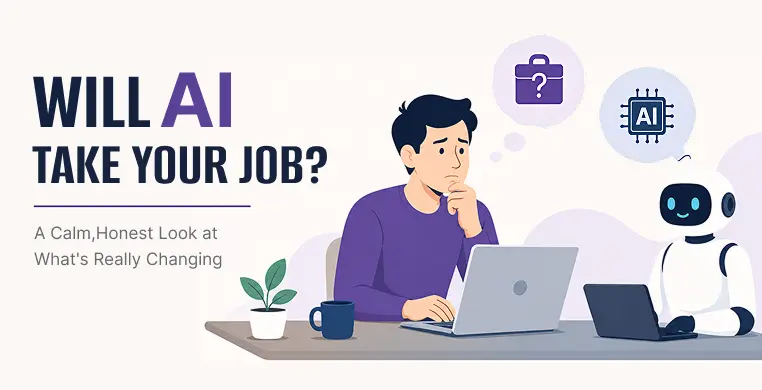
It’s 11 p.m. You’re scrolling before bed, and a headline stops your thumb: “AI Could Replace 300 Million Jobs.” Your stomach does that small drop. You think about your own work the reports you write, the calls you take, the spreadsheets you live in and a quiet question shows up: will AI take my job?
Here’s the honest answer, without the drama: most jobs are not about to vanish overnight. But almost every job is changing shape, some faster than others. That difference between “gone” and “different” is what this article is really about.
So, Will AI Take Your Job? The Honest Answer
Here’s the thing most headlines skip: AI usually doesn’t take a whole job. It takes pieces of it.
Think about what your job actually is. It’s not one giant task it’s a bundle of smaller tasks stitched together. A marketing manager writes emails, analyzes data, sits in meetings, comes up with campaign ideas, and manages a team.
AI might handle the first draft of an email or crunch the data faster. It’s not going to sit in the meeting and read the room, or decide which campaign idea actually fits the brand’s personality.
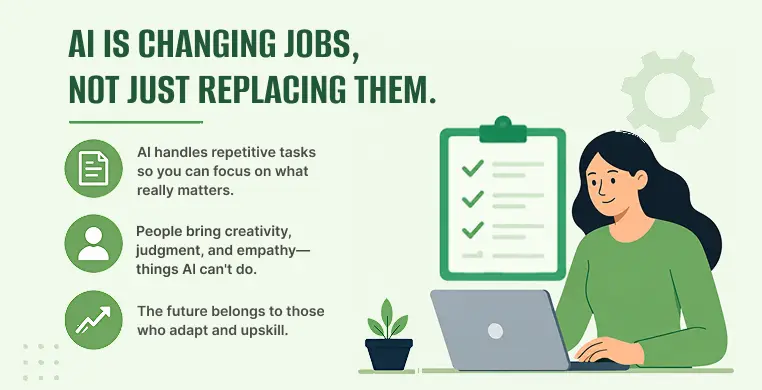
This is the real story behind “AI reshaping jobs” it’s less about replacement and more about redistribution. The repetitive, predictable parts of a job move to AI. The parts that need judgment, relationships, and taste stay with people.
Take a graphic designer. A few years ago, she’d spend hours on rough drafts before showing a client anything. Now, she can generate five directions in minutes using AI tools. Her job hasn’t disappeared it’s shifted.
She spends less time on blank-page struggle and more time on the part only she can do: understanding what the client actually wants and shaping the final result around it.
How AI Is Actually Changing Jobs Right Now
Right now, in most workplaces, AI is showing up more like a fast, slightly clumsy assistant than a replacement worker.
A few ways this is already playing out:
- Writers and marketers use AI for first drafts, then rewrite and refine.
- Customer support teams let AI handle simple, repeated questions, freeing people up for the messy, emotional, or unusual ones.
- Developers use AI coding tools to write boilerplate code faster, but still design the system and debug the tricky parts.
- Accountants and analysts let AI sort and summarize data, then apply their own judgment to what it means.
- HR and admin teams use AI to draft job posts or schedule interviews, saving hours of manual work each week.
This is what people mean when they talk about AI and the future of work it’s not one big switch flipping. It’s hundreds of small changes, industry by industry, task by task.
Which Jobs Are Most Exposed to AI?
Some jobs are genuinely more exposed than others, and it’s worth being upfront about that instead of pretending everyone’s equally safe.
Jobs built around repeating the same steps, following a script, or processing information in a predictable pattern tend to sit in the higher-risk zone. That includes:
- Basic data entry and simple bookkeeping
- Routine customer service scripts (the kind with a fixed set of answers)
- Entry-level content writing that mostly summarizes or rewrites existing material
- Simple translation and transcription work
- Repetitive scheduling and paperwork-heavy admin roles
Lower-exposure work tends to involve things AI still struggles with: physical dexterity in unpredictable environments, reading emotional cues, making judgment calls with incomplete information, or building trust with another human being over time.
Worth noting too: entry-level jobs are often hit first, simply because they tend to involve more repeatable tasks.
That’s a real concern for people just starting their careers, and it’s one of the more uncomfortable parts of this shift the ladder’s first few rungs are the ones AI reaches easiest.
Jobs AI Probably Won't Replace
If a job depends on trust, hands-on skill, or genuine human connection, it’s in a much safer spot.
Some examples:
- Nurses and doctors: patients need a human who can read pain, fear, and context, not just symptoms.
- Therapists and counselors: trust and emotional safety can’t be automated.
- Electricians, plumbers, and other skilled trades: every house, pipe, and wiring job is a little different, and it happens in the physical world.
- Teachers: especially for younger kids, where patience, encouragement, and adapting to one child’s confusion matters more than information delivery.
- Senior strategists and leaders: the people who have to weigh competing priorities, manage people, and take responsibility for a decision.
None of these jobs are “AI-proof” in the sense of being untouched a teacher might use AI to plan lessons faster, a doctor might use it to double-check a diagnosis. But the core of the job, the part that requires being a trustworthy human in the room, stays firmly human.
A Quick Way to Check Your Own Job's Risk
You don’t need a fancy tool to get a rough sense of where you stand. Ask yourself three questions:
- Is most of my day spent on repeatable tasks: The same steps, the same format, over and over?
- Does my job depend on trust, judgment, or reading people: The kind of thing that’s hard to write rules for?
- Am I already using AI tools in my work, or is my industry actively avoiding them?
If your answers lean toward “repeatable” and “no AI use yet,” it’s worth paying closer attention. If they lean toward judgment and trust, you likely have more breathing room.
There are also more formal AI job risk calculators online now if you want a numbers-based version of this same check they’re a decent starting point, though no calculator knows your specific role better than you do.
Does AI Create Jobs Too?
Yes — and this part gets left out of a lot of the scarier headlines.
New kinds of work are already appearing that didn’t exist five years ago: people who train AI models, people who write and refine prompts for a living, people whose whole job is checking AI output for bias or errors. Whole teams currently operate just to make sure a company’s AI tools are used responsibly.
But it’s worth being honest here too: the jobs AI creates and the jobs AI disrupts don’t always land on the same people. Someone who loses a repetitive data-entry role isn’t automatically qualified for a new AI oversight job.
And some fields affected earliest like administrative and clerical work happen to employ more women than men, which means this shift isn’t landing evenly across the workforce. That’s a real, ongoing conversation, not a footnote.
How to AI-Proof Your Career (Without Panicking)
You don’t need to become a machine learning engineer to stay relevant. You need to become someone who works well with AI, not someone racing against it.
A few practical steps:
- Learn the AI tools already used in your field. You don’t need to master everything just the two or three tools people in your role are starting to use.
- Double down on human skills. Communication, leadership, empathy, and judgment are getting more valuable, not less, as routine tasks get automated.
- Stay a little curious. You don’t have to become an expert overnight. Spending twenty minutes a week trying a new AI tool adds up over a year.
- Don’t just wait for a crisis to start learning. The people who adapt calmly are usually the ones who started early, quietly, before it felt urgent.
If you’re wondering whether it’s worth learning something specific like prompt engineering it’s a genuinely useful skill in a lot of fields right now, but it’s a tool, not a career on its own. Treat it the way you’d treat learning Excel well: useful everywhere, not a replacement for expertise in your actual field.
What If You're Worried About Your Job Specifically?
It’s okay to feel uneasy about this. A lot of people do, and pretending otherwise doesn’t help anyone.
If you’re genuinely worried, one of the most useful things you can do is have an honest, low-pressure conversation with your manager. Ask about what AI tools the company is considering, whether your role is likely to change, and whether there’s adequate support for learning new skills. Most managers would rather have that conversation early than watch someone quietly panic in silence.
Key Takeaways
Close your phone for a second and think back to that headline. It’s not wrong that AI is changing work it is, quickly, and in ways that are genuinely uneven across industries and roles. But “changing” and “disappearing” are not the same word.
The people who come out ahead in this shift usually aren’t the most technical people in the room. They’re the ones who stayed curious, kept their human skills sharp, and treated AI as a tool worth learning rather than a threat worth fearing. That’s a much steadier place to stand than the headlines make it seem.
Frequently Asked Questions
Will AI take my job completely?
For most people, no — not completely, and not overnight. AI tends to take over specific tasks within a job rather than the entire role. Jobs built heavily around repetitive, predictable tasks face more risk than jobs built around judgment, trust, or hands-on skill.
What jobs are safest from AI?
Roles that depend on human trust, emotional connection, or physical dexterity in unpredictable settings tend to be safest think nurses, therapists, skilled trades, teachers, and senior leadership roles. These jobs may use AI as a tool, but their core work stays human.
How many of the jobs will AI replace by 2030?
Estimates vary widely depending on the study and how “replace” is defined. Most credible research suggests a mix of job displacement and job transformation, with entry-level and repetitive roles affected the most, alongside a meaningful number of new AI-related jobs being created in the same window.
Do I need to learn AI tools to stay employed?
You don’t need to become an AI expert, but having basic comfort with the AI tools used in your field is becoming a real advantage. Think of it less like learning a whole new career and more like learning a new piece of software everyone in your industry is starting to use.
How do I know if my job is at risk?
Ask yourself how much of your day involves repeatable, rule-based tasks versus judgment calls, relationship-building, or physical adaptability. The more your role leans on the second group, the more secure it likely is. Online AI job risk tools can offer a rough estimate too, but your own honest read of your daily tasks is usually just as accurate.