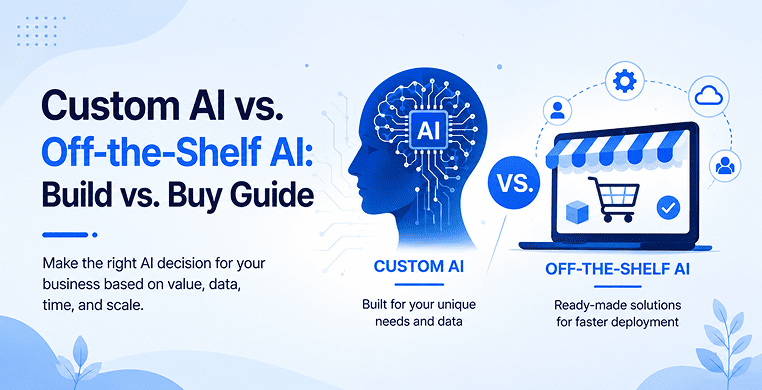
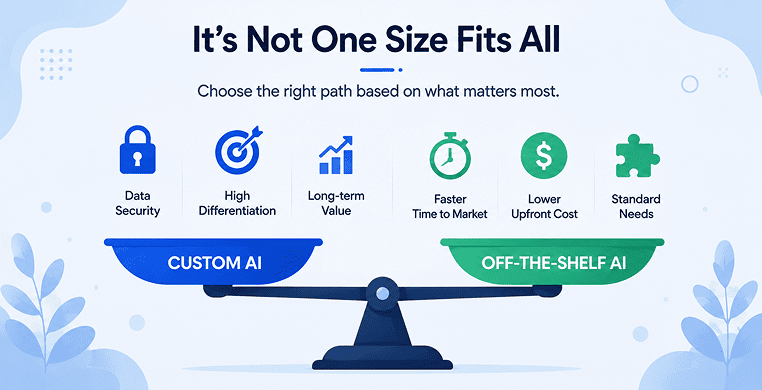
The custom AI vs off the shelf AI decision comes down to three questions: how differentiated does this capability need to be, how sensitive is the data behind it and how much time and capital can you actually commit? Off-the-shelf AI tools win when you need speed and a vendor already covers most of what you need.
Custom artificial intelligence solutions win when the workflow is core to how you compete and no vendor’s generic model can replicate it. Everything else in this build vs buy AI decision framework is detail underneath that split.
What "Custom AI" and "Off-the-Shelf AI" Actually Mean
Off-the-shelf AI is pre-built software you subscribe to: a vendor’s chatbot platform, a forecasting tool, a document-processing API. You configure it within the limits the vendor set. Custom AI is a system built, trained or fine-tuned around your own data, workflows and constraints, either in-house or through a development partner. You own the logic, but you also own the maintenance.
Most businesses don’t actually choose one path for the whole company. They choose it project by project, which is why treating this as one company-wide decision usually leads to the wrong answer.
The Real Cost Difference
This is where the decision gets concrete for finance and operations leaders evaluating enterprise AI implementation cost.
| Factor | Custom AI | Off-the-Shelf AI |
|---|---|---|
| Upfront cost | Often $100,000–$750,000+ for enterprise-grade builds, sometimes more for autonomous agent systems | Low entry cost, typically a recurring subscription |
| Cost curve over time | Stabilizes and can improve per-unit as usage scales | Climbs with seat counts, API volume, and tier upgrades |
| Deployment time | 12–24 months for traditional builds, though agentic development stacks can compress this to weeks for narrower scopes | Days to a few months for standard SaaS onboarding |
| Ownership | You own the model, the IP, and the roadmap | The vendor owns the roadmap; you rent the capability |
| Maintenance | Falls on your team or a development partner | Handled by the vendor, including patches and model updates |
The pattern that matters most: off-the-shelf software is an operating expense that grows with you, while custom AI is a capital investment that can pay down over time if the use case has enough volume and longevity to justify it.
A tool processing a handful of requests a month rarely earns back a six-figure build. A workflow running thousands of times a day often does.
Why Off-the-Shelf AI Wins for Most Standard Use Cases
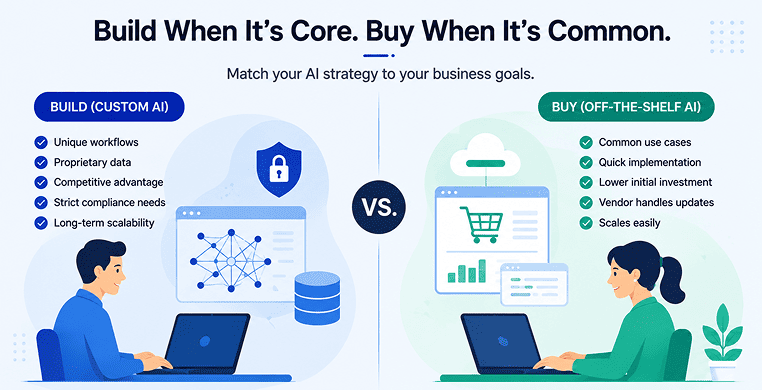
A useful rule of thumb from enterprise procurement: if a vendor’s platform already covers 80% or more of what you need out of the box, buy it. Pushing past that point usually means paying for custom modifications that end up costing close to what a custom build would have cost anyway, without the ownership benefits.
Off-the-shelf AI tools are the right call when:
- The workflow is common across your industry — a customer support chatbot, basic marketing content generation, or routine forecasting.
- Speed matters more than differentiation and waiting a year for a custom system isn’t an option.
- You don’t have in-house data engineering talent or a six-figure capital budget to allocate.
- The task doesn’t touch data sensitive enough to require single-tenant hosting.
When Custom AI Is Worth Building
The mirror rule applies on the other side: if commercial software meets less than 60% of what you actually need, custom development is usually the more defensible option, because the cost of forcing a mismatched tool to fit often exceeds the cost of building it right.
Custom artificial intelligence solutions make sense when:
- The capability sits directly behind your competitive advantage rather than supporting it from the sidelines.
- You hold proprietary data that a generic model, trained on public or generic industry data, simply can’t match in accuracy or relevance.
- You operate under regulatory constraints — finance, healthcare, defense — where routing data through a third-party multi-tenant cloud creates legal exposure that single-tenant or on-premises deployment avoids.
- You’re comparing a custom LLM vs ready-made AI for a workflow where off-the-shelf accuracy plateaus below what the business actually needs.
Why Enterprise AI Projects Fail When Buying Off-the-Shelf Software
The failure pattern is consistent across procurement post-mortems: a company buys a platform built for a different industry’s data patterns, spends heavily on integration to force-fit it and ends up with modest performance gains while its roadmap is now dependent on a vendor’s release schedule.
The tool wasn’t broken. It was never built for this specific problem and no amount of configuration fully closes that gap.
This is also where hidden costs of off-the-shelf AI platforms tend to surface — not in the subscription line, but in the integration engineering, the workflow redesign, and the opportunity cost of a roadmap you no longer control.
The Build vs Buy AI Decision Framework
Two questions decide most of this: how strategically differentiating is the capability, and how much proprietary data advantage do you bring to it?
- High differentiation, low proprietary data: Build custom, but expect a longer runway before the investment justifies itself.
- Low differentiation, low proprietary data: Buy off-the-shelf. This is commodity territory, and a vendor has already solved it better than a first attempt would.
- Low differentiation, high proprietary data: Buy a foundation platform and extend it with your own data layer through APIs and retrieval-augmented generation (RAG).
- High differentiation, high proprietary data: This is the strongest case for a full custom build, since the data and the strategic value compound together.
Loved What You Just Read?
Let's Build Something Just as Great — For Your Business.
From web & mobile apps to UI/UX, AI solutions, and digital marketing — NGD Technolab turns ideas into scalable, real-world products. 14+ years, 550+ projects, one team you can rely on.
The Hybrid Path: Buy to Learn, Build to Last
Roughly two-thirds of enterprise AI architectures today aren’t purely custom or purely off-the-shelf — they’re staged. The pattern, often described as “buy to learn, build to last,” works in three phases: validate the use case with a commercial platform or public model API, extend that foundation with custom RAG pipelines and proprietary data connectors once value is proven, then move only the highest-value, most differentiating workflows to a fully custom, fine-tuned model.
There’s real evidence behind why this staged approach outperforms committing early. Research from MIT’s Project NANDA found that AI initiatives routed through an external vendor first reach successful production deployment roughly twice as often as purely internal builds — about 67% versus 33%. Proving the use case with a purchased tool first, even imperfectly, substantially lowers the risk of the eventual custom investment.
A Quick Way to Decide
Before defaulting to either path, walk through this:
- Does a vendor already cover 80%+ of the requirement? If yes, buy.
- Is the workflow tied directly to your competitive edge? If yes, weigh a custom build.
- Does the data need to stay off third-party multi-tenant infrastructure for legal reasons? If yes, custom or single-tenant hosting is close to mandatory.
- Could you validate the use case with a cheaper commercial tool first before committing capital? If yes, do that before building anything.
Conclusion
Custom AI and off-the-shelf AI aren’t competing philosophies. They’re tools for different stages of the same problem. Buy where the workflow is common and speed matters. Build where the capability is genuinely yours to own. Start with the vendor when you’re not sure, prove the value, then build the differentiating layer once you know exactly what you’re protecting.
Frequently Asked Questions
What is the difference between custom AI and off-the-shelf AI?
Off-the-shelf AI is pre-built software you subscribe to and configure within the vendor’s limits, like a chatbot platform or a forecasting tool. Custom artificial intelligence solutions are built or fine-tuned around your own data and workflows, so you own the logic instead of renting it. The trade-off is speed versus control: off-the-shelf gets you running in weeks, custom AI takes longer but fits exactly what you need.
Is custom AI worth the cost for a small or mid-sized business?
Usually not, unless the workflow runs constantly and sits directly behind your competitive edge. For most small and mid-sized businesses, the volume isn’t high enough to earn back a six-figure build and a pre-built AI software for business tool covers the need at a fraction of the cost. Custom AI starts making financial sense once usage scales into the thousands of runs per day or the data involved is too sensitive for a shared vendor platform.
How long does it take to deploy custom AI vs off-the-shelf AI?
Off-the-shelf AI tools typically go live in days to a few months, since most of the engineering work is already done by the vendor. Custom AI traditionally takes 12 to 24 months for a full build, though modern agentic development stacks can compress narrower-scope projects down to weeks. That gap in timeline is one of the biggest reasons companies default to buying first and building later.
Can off-the-shelf AI tools handle regulated or sensitive data?
Sometimes, but it depends entirely on the vendor’s hosting model. Most off-the-shelf AI runs on shared, multi-tenant cloud infrastructure, which creates compliance risk for regulated sectors like finance and healthcare unless the vendor offers single-tenant or private hosting. When data sovereignty is a hard requirement, custom AI or a single-tenant deployment is usually the safer path, not a generic subscription tool.
When should a company choose custom AI over off-the-shelf AI?
Choose custom AI when the capability is core to how you compete, when you hold proprietary data a generic model can’t match or when regulatory rules block your data from sitting on third-party servers. If none of those apply and a vendor already covers most of the requirement, off-the-shelf AI tools remain the more efficient choice. The build vs buy AI decision framework comes down to strategic value versus operational convenience, not personal preference.