Think of an MVP as a taste test, not the full menu. You cook one dish, put it in front of real people and watch their faces. If you want to know how to build an MVP, the path is short: find out if people care, choose one job for your product, make a rough version with AI tools, tighten it, launch it to a small group and use the results to win over investors.
This MVP development guide walks through each stage in plain words, with costs and funding advice for 2026. To keep things concrete, we will follow an imaginary founder who wants to build a booking app for yoga studios.
What Counts as an MVP (and Why It Saves You Money)
An MVP is a first version that does one job from start to finish. A pitch deck doesn’t count and neither does an app that only works on the demo screen.. A studio owner should be able to use it for real.
Why bother? CB Insights read through the post-mortems of failed startups. In that study, 42% of founders said nobody truly needed what they built, while 29% ran out of money. The report also pointed out that money problems usually show up months after the demand problem. In other words, the cash runs out because the idea was never tested. An MVP tests it cheaply.
Step 1: Prove People Care Before You Write Code
Our yoga-app founder starts with phone calls, not code. She asks 15 studio owners one question: “What went wrong with your class schedule last week?”
Here is a simple checklist you can copy:
- Interview 10 to 20 people who live with the problem
- Listen for stories, not compliments
- Build a one-page site that explains your promise and collects emails
- Offer a paid pilot or a deposit
Words are cheap. “I’d love that” costs nothing. A deposit or a signed note is much harder to fake and that is how you spot early product market fit.
Step 2: Cut Your Feature List With MoSCoW
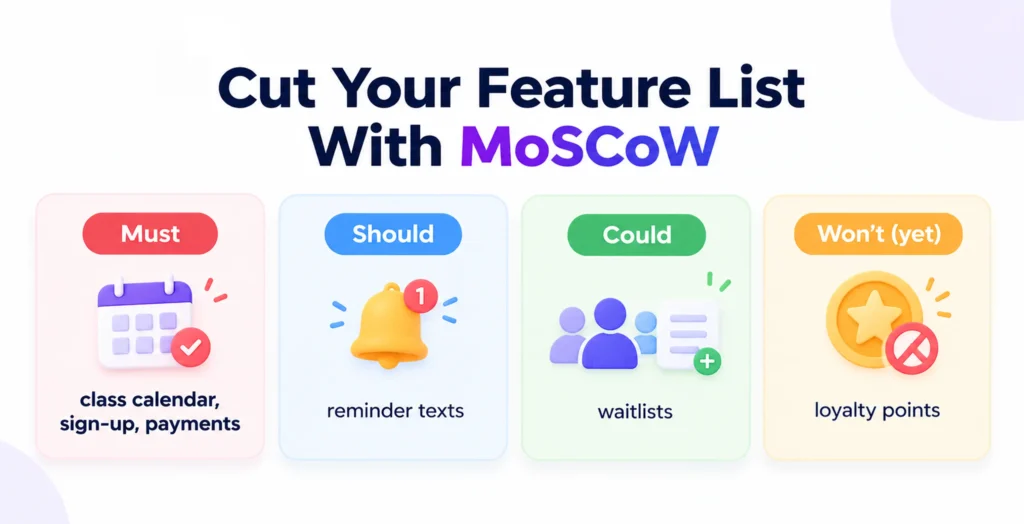
MoSCoW prioritization is a way to sort ideas into four buckets: Must, Should, Could and Won’t (for now). Only the “Must” bucket goes into your MVP.
For the yoga app, the lists might look like this:
- Must: class calendar, sign-up, payments
- Should: reminder texts
- Could: waitlists
- Won’t (yet): loyalty points
One agency describes a lean build as a single main feature, plus sign-in, billing and a first-run guide. If a feature does not help a new user reach that first win, park it.
Step 3: Build a Rough Version With AI Tools
In February 2025, Andrej Karpathy gave a name to a new habit: vibe coding. You type out the idea the way you would explain it to a friend and an AI assistant turns it into working software. By 2026, many founders use it to test ideas fast.
No coding background? These AI builders are where many non-technical founders begin:
- Lovable, Bolt.new and Replit Agent: turn a written prompt into a working app
- v0 by Vercel: creates screens and React parts from a prompt
- Cursor and Claude Code: help you grow and fix a real codebase
Torn between Lovable and Bolt.new? Paste the same prompt into both. Keep the one whose result feels closer to your idea.
Speed has a price, though. Veracode tested AI-written code and found that 45% of it carried known security problems. A 2026 engineering guide recommends a hand-off routine: sketch quickly in a tool like Bolt or Lovable, then finish in Cursor or Claude Code with a human reviewing the work. Keep real customer data out of any prototype nobody has checked.
Step 4: Pick a Plain Tech Stack
Choose well-known tools. Most SaaS MVPs need a web front end, an API, a database, logins and payments. Two choices now can spare you a rebuild next year:
- Build API-first. Put your features behind an API, so a mobile app can plug in later without a rewrite.
- Plan for many customers. In a multi-tenant SaaS setup, every studio shares one app, but each studio’s data sits behind its own lock, like apartments in one building.
If AI is the heart of your product, design for it on day one. Bolting it on later can mean starting over.
What Will an MVP Cost in 2026?
Prices are all over the map. One 2026 guide says founders collect quotes anywhere from $3,000 to $300,000 for what looks like the same product.
StartupHub groups the routes this way. No-code tools run up to about $8,000. A solo builder using AI usually spends $2,000 to $15,000. Freelancers or a small team cost $15,000 to $60,000 and agencies start around $50,000 and can pass $200,000.
The first two routes often take 4 to 10 weeks, while agencies run 12 to 20. The same guide adds that adding a true native mobile app next to a web product roughly doubles the bill.
What should a SaaS MVP budget look like this year? A simple one can come in under $15,000 with AI help. Hiring experienced engineers for a production-grade version pushes the number up sharply. Before you sign, ask what is included: testing, security checks and fixes after launch.
Step 5: Launch Small and Watch Four Numbers
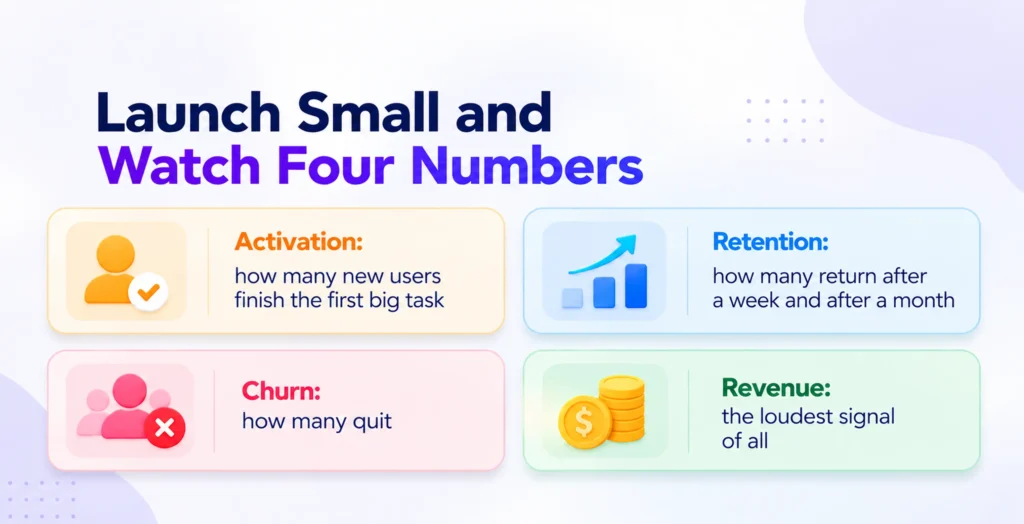
Open the doors to a small group first, like five or ten studios. Then watch these:
- Activation: how many new users finish the first big task
- Retention: how many return after a week and after a month
- Churn: how many quit
- Revenue: the loudest signal of all
Y Combinator is often quoted as aiming for 5% to 7% growth each week. Treat it as a stretch goal, not a law. If you need help finding early users, read our guide on getting your first 100 users.
MVP Funding Strategies: What Investors Want to See
What counts as proof depends on how far along you are. CRV explains that pre-seed backers accept softer proof, like waitlists, pilots or letters of intent, while seed backers want numbers showing people use, pay for and keep the product.
Another guide says early investors care more about activation and signed letters than a long signup list.
Use this running order when you present your MVP:
- Start with the problem, in one sentence
- Show a two-minute demo
- Share three numbers: activation, retention and revenue (or paid pilots)
- Show your unit economics: the money you spend to land one customer, compared with the money that customer brings in
- Say exactly what the money will buy
Skip vanity numbers like downloads and page views. And do not rush. Raising on weak numbers often costs more than spending a few extra months to improve them.
Loved What You Just Read?
Let's Build Something Just as Great — For Your Business.
From web & mobile apps to UI/UX, AI solutions, and digital marketing — NGD Technolab turns ideas into scalable, real-world products. 14+ years, 550+ projects, one team you can rely on.
Should You Hire an Agency?
Consider it if you cannot code and you have a budget. Ask any agency:
- Have you shipped MVPs like mine?
- Will the code and the hosting accounts be in my name?
- How do you check AI-written code?
- What support comes after launch?
Be wary of a team that says yes to every idea. A good partner helps you cut.
Conclusion
Small wins beat big plans. Check the demand, cut the features, prototype with AI, protect what you build and track what matters. Strong early numbers tell a better funding story than a long feature list.
Start this week: call ten people who have the problem. Use these ideas as a starting point, and check big money decisions with a qualified advisor.
Frequently Asked Questions
Prototype, proof of concept or MVP: which one do I build first?
Each one answers a different question. A proof of concept asks, “Can this even work?” Order them by risk. A proof of concept shows the technology can do what you need. A prototype is a clickable mock-up that lets people judge the design. An MVP is the first version people can actually use and pay for. So test the tech, then the look, then the real demand. So when you plan how to build an MVP, test the idea first, mock it up second and ship the smallest working version last.
How many weeks should an MVP take?
It depends on who builds it. According to a 2026 guide, no-code and AI-assisted builds take about four to ten weeks, freelance teams eight to sixteen and agencies twelve to twenty. Another agency puts a well-scoped business SaaS MVP at 10 to 14 weeks. Every extra feature adds time, so keep the list short.
Can I build an MVP without coding?
Yes, and many founders do. No-code tools and AI app builders can get a working product live in weeks. There is a catch, as one 2026 cost guide warns: no-code tools lower the starting cost but are likely to cause scaling limits later. Use them to prove demand, and bring in a developer if the product grows.
How much traction do I need to raise seed funding after an MVP?
There is no single number, so treat every benchmark as a guide. Another 2026 guide says SaaS founders raising a seed round often show $5,000 to $20,000 or more in monthly recurring revenue, plus users who stay and a steady upward trend. It varies by investor and product. Pre-seed investors usually accept less, such as paid pilots or letters of intent. Ask investors in your own market what they expect.
Is vibe coding safe for building an MVP?
It is fine for prototypes, but real customer data needs a review first. Veracode found that 45% of AI-written code had known security flaws. Treat AI code like work from a new contractor: scan it, read it and fix problems before launch. If your MVP handles payments or personal data, have a developer check it.